
Science & the occult · The 1890s
The Hypnoscope: Hypnotism by Mail, 1895
Three lines of small type in an 1895 magazine offered physicians, dentists and students of the occult a device that “proves hypnotization possible in all cases.” Who was selling it, and why then?

It is one of the smallest advertisements in the April 1895 issue of Munsey’s Magazine, three lines of type with a big initial T. Here is all of it:
THE HYPNOSCROPE.—For Physicians, Dentists, Investigators, and Students of the Occult; proves hypnotization possible in all cases. Circulars free. Address M. O. TODD, M. M., Los Angeles, Cal.
Munsey’s Magazine, April 18951
The spelling is not ours. The ad really does say Hypnoscrope, a slip by the typesetter or the advertiser. The device it meant had a short and curious history, and the timing of the ad, in the spring of 1895, is no accident.
A magnet for the finger
The original hypnoscope was the invention of Julian Ochorowicz, a Polish psychologist and inventor who spent years in Paris working with hypnosis as a therapy.4 American newspapers picked up the news in 1885. The Daily Alta California of San Francisco, reprinting a story from the New York Sun, described the instrument as “a little tube of magnetic steel about an inch long,” open along the top so that its two edges formed the poles of a magnet. It could be made, the paper said, for fifty cents.2 The Scientific American Supplement ran its own account the same year.3
The test was simple. The tube went on the subject’s forefinger, touching both poles, and stayed there for two minutes. According to the report, about 70 people in 100 felt nothing at all. The other 30 reported creeping and itching, waves of heat or cold, aching joints, swelling skin and, in a few cases, numbness or rigid muscles. Those were the people Ochorowicz considered hypnotizable.2
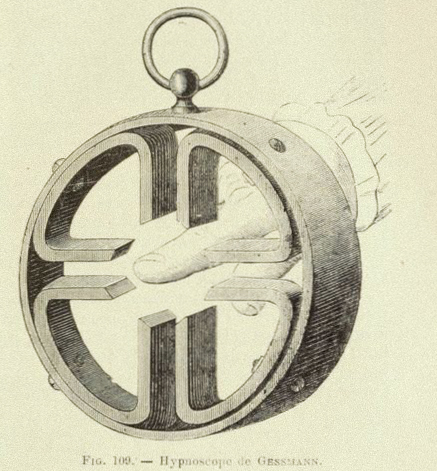
The idea drew on the old belief, going back to Franz Mesmer, that the body responds to magnetism. Critics doubted the hypnoscope worked at all, and psychologists soon lost interest.4
That makes M. O. Todd’s claim interesting. The point of Ochorowicz’s hypnoscope was to sort people: to tell the hypnotist in advance who would respond and who would not, and by its inventor’s own figures most people would not. Todd’s version, he said, “proves hypnotization possible in all cases.” The scientific instrument promised to find the minority who could be hypnotized. The one for sale in Los Angeles promised that everyone could.
Physicians and dentists
The list of customers in the ad sounds odd now, but it was not invented. In the early 1890s American medical and dental journals were seriously debating hypnotism as an anesthetic. Dentists had good reason to pay attention: the 1885 newspaper report recalled watching the New York physician George Beard pull teeth from hypnotized subjects, apparently without pain.2
In 1890 a Cincinnati dentist told the Ohio State Dental Society that “one can scarcely read a daily newspaper now days without seeing article after article devoted to hypnotism,” much of it, he thought, ridiculous.5 In 1892 the Harvard Odontological Society heard a Boston dentist describe using light hypnotic sleep in his own practice.6 At a meeting of dental surgeons in Baltimore the next spring, a physician, Dr. William Lee Howard, told the audience that by hypnotism they could “extract teeth and perform any dental operations painlessly.”7 The American Academy of Dental Science in Boston heard another paper on the subject in October 1895, though that speaker was more cautious.8
Anesthesia by ether and nitrous oxide was well established by then, but it carried real risks, and a method that needed no drugs at all was an attractive idea. An advertiser who put “Dentists” second on his list was following a live professional conversation. The professionals and the mail-order sellers were not saying the same thing, though. The dentists in the journals were arguing about whether hypnosis worked and for whom. The ad simply said it worked on everyone.
Svengali’s spring
The other reason hypnotism was in the air in 1895 had a name: Svengali. George du Maurier’s novel Trilby, about an artist’s model put under the spell of a sinister hypnotist, ran as a serial in Harper’s in 1894 and appeared as a book that September. By February 1895 it had sold more than 200,000 copies in the United States.9 In the spring of 1895 a stage version opened in Boston on March 4 and moved to New York six weeks later.11 There were Trilby soaps, sweets and dolls, a Trilby ham and, before long, the trilby hat.10
Trilby made hypnotism thrilling and frightening at once. It also made Svengali, drawn by du Maurier as a grotesque antisemitic caricature, a name that has stuck in the language.10 For a small advertiser offering to prove that anyone could be hypnotized, there could hardly have been a better season.
Who was M. O. Todd?
We still can’t say for certain, but he left at least one more trace. On February 24, 1895, about six weeks before the Munsey’s ad appeared, the Los Angeles Herald printed a short testimonial among the small business notices in its “Jottings” column, between an ad for trunks and one for hat cleaning. Its headline was “Given Up to Die.”
My case was considered hopeless by physicians and as a last resort I called to see the much advertised hypnotist and magnetic physician of Chicago, now at [Spring] st. To my great delight Professor Anderson’s first treatment seemed to transform me magically into a new being… M. O. TODD.
Los Angeles Herald, February 24, 1895
The signature is M. O. Todd’s.12 So in the same weeks that a Los Angeles man named M. O. Todd was selling a hypnotism device by mail across the country, a man of the same name was vouching in the local paper for a traveling hypnotist and “magnetic physician.” Whether he was a grateful patient, a business partner or a name for hire, the notice doesn’t say. A personal notice in the same paper a month earlier was signed “M. O. Todd, general delivery,” which suggests someone without a fixed address in town.13
The letters “M. M.” after his name in the Munsey’s ad remain unexplained. They may stand for a title Todd gave himself, as self-styled mesmerists and magnetic healers of the period sometimes did. Los Angeles in 1895 was a fast-growing city, already a magnet for health seekers and for teachers of new spiritual and mental-healing ideas, and a mail-order hypnotist fit right in.
Hypnotism by mail
Todd was early, but he was not alone for long. By about 1901 the Psychic Research Company of Chicago was selling a mail-order course called Hypnotism, part of a series that also offered lessons in personal magnetism, mind reading and magnetic healing. One of its chapters was titled “Why Dentists Do Not Openly Advocate Hypnotism.”14,15 Selling the mind by mail became a business of its own, and it ran on the same promise as Todd’s little ad: that a power the professionals argued about could be yours for the price of a stamp. For the respectable end of the same trade, see A Better Life by Mail. For other cures sold on confidence rather than evidence, see Thirty Years of Baldness Cures and the history of Mrs. Winslow’s Soothing Syrup.
If you know more about M. O. Todd, Professor Anderson or the Hypnoscope, we would like to hear from you. Small mysteries like this are part of what an archive is for.
Sources
- “The Hypnoscrope,” advertisement, Munsey’s Magazine, April 1895. No. 00153 in this archive.
- “Testing Hypnotic Subjects,” Daily Alta California, March 23, 1885, reprinted from the New York Sun. California Digital Newspaper Collection.
- “The Hypnoscope,” Scientific American Supplement, vol. 19, 1885, p. 7556.
- Julian Ochorowicz, Psi Encyclopedia, Society for Psychical Research.
- J. R. Callahan, “Hypnotism,” read before the Ohio State Dental Society, October 1890; published January 1891.
- Thomas Fillebrown, “The Uses of Hypnotism in Dentistry,” read October 27, 1892.
- “A Demonstration of Hypnotism,” American Journal of Dental Science, April 1893.
- George F. Grant, “Hypnotism: Its Value to the Dental Specialist,” read October 2, 1895.
- Trilby, Delaware Art Museum Library exhibit.
- The First Svengali, History Today.
- Trilby (play), Wikipedia.
- “Given Up to Die,” notice in “Jottings,” Los Angeles Herald, February 24, 1895. California Digital Newspaper Collection.
- Personal notice signed M. O. Todd, Los Angeles Herald, January 13, 1895, p. 8. California Digital Newspaper Collection.
- Psychic Research Company, Hypnotism (Series “B,” part 3), Chicago, ca. 1901. Wood Library-Museum of Anesthesiology.
- Magic by Return of Post: How Mail Order Delivered the Occult, The Public Domain Review.

