Small-town advertising · Holidays
Merry Christmas from Jefferson County, 1929
Seven weeks after the stock market crash, one Colorado county newspaper filled its pages with holly borders, turkeys and toboggans. Read closely, the ads describe a whole community.
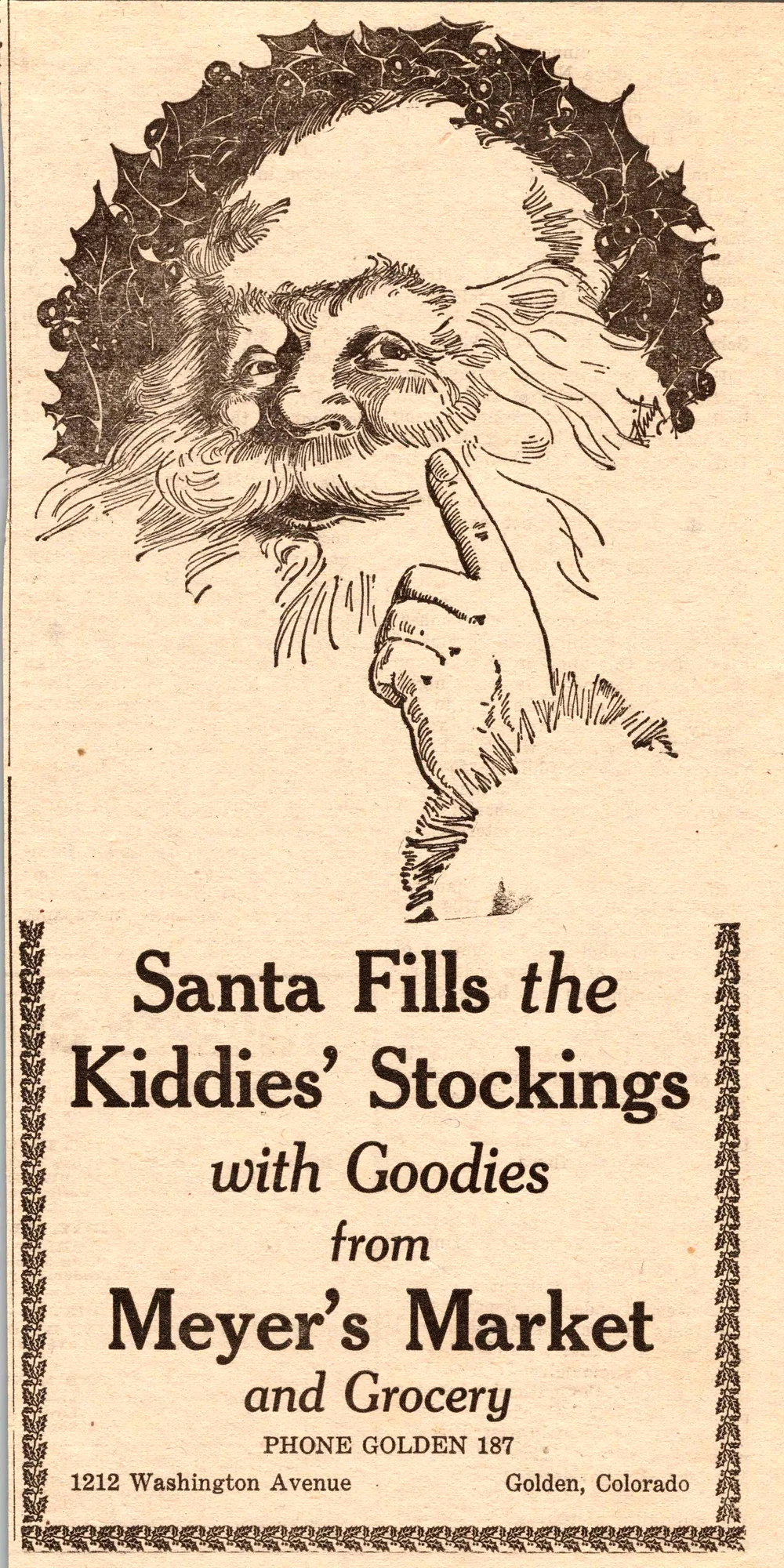
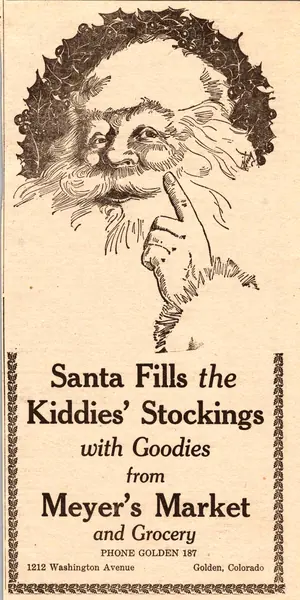
The Jefferson County Republican for Thursday, December 19, 1929, does not look like a paper printed in the shadow of a financial disaster. Black Tuesday had come and gone on October 29, but the Christmas pages are crowded with holly borders, rows of little bells and a twinkling Santa Claus framed in a wreath. Merchants wish their customers “a happy, prosperous New Year” so often that the phrase starts to read like a hope rather than a formula.
Magazine advertising was written in New York for the whole country. A county newspaper was different: almost every advertiser was within a few miles of the reader, and many of them were the reader’s neighbors. The archive holds fifty-four advertisements from this one issue, and taken together they work almost like a census of the county seat at Golden and the farm towns around it.
Who was selling Christmas
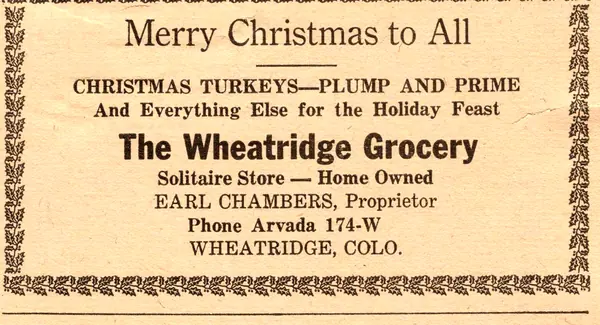
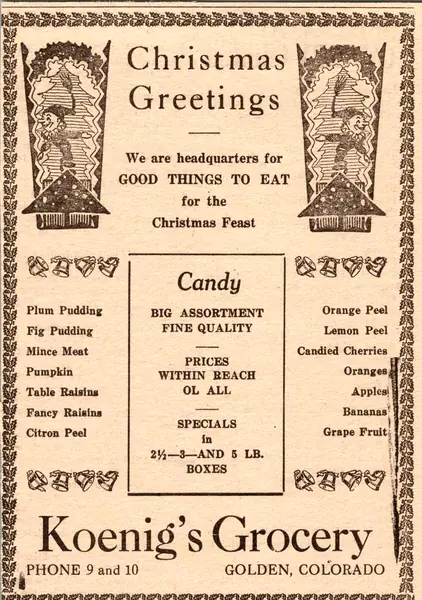
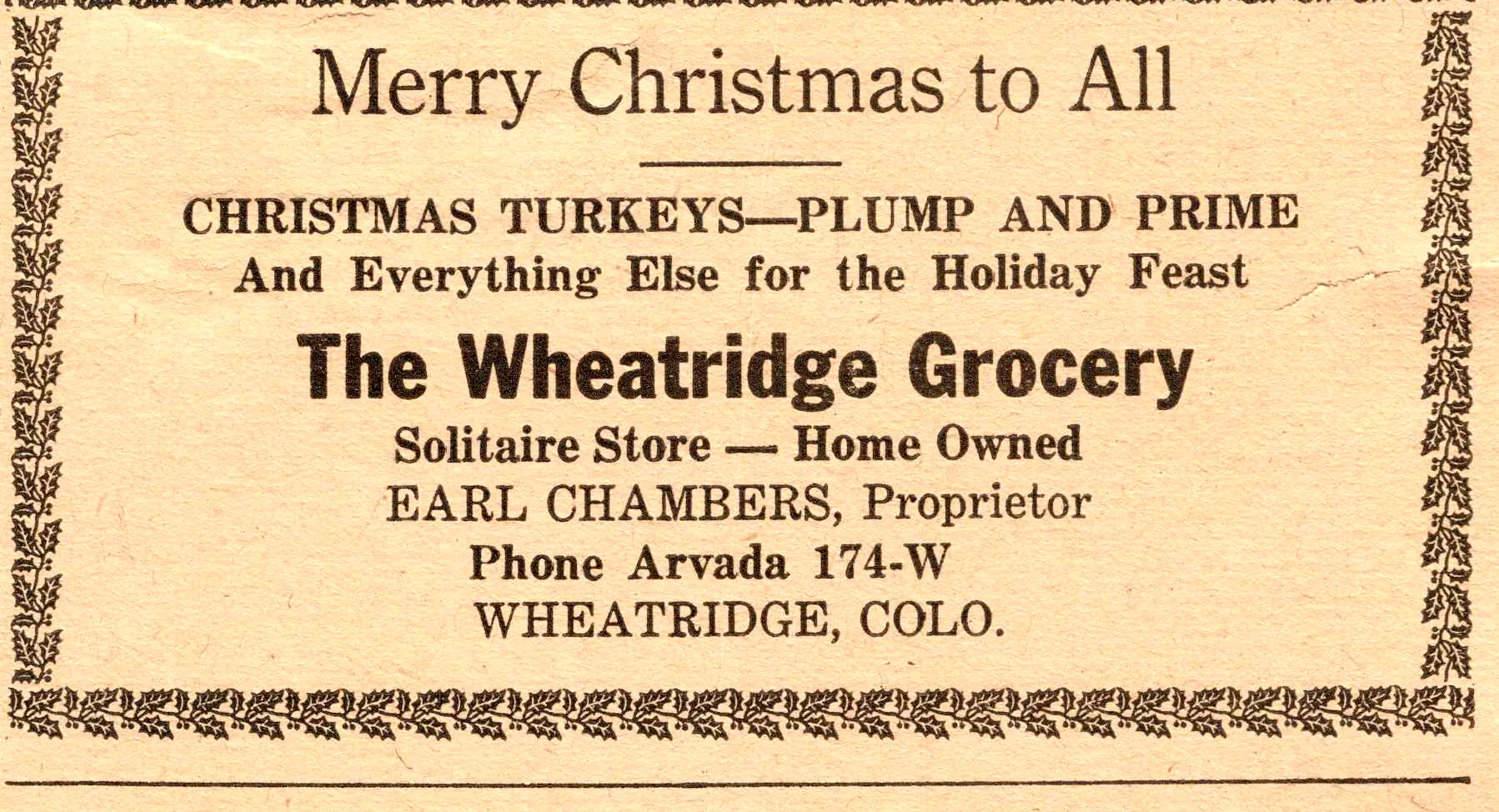
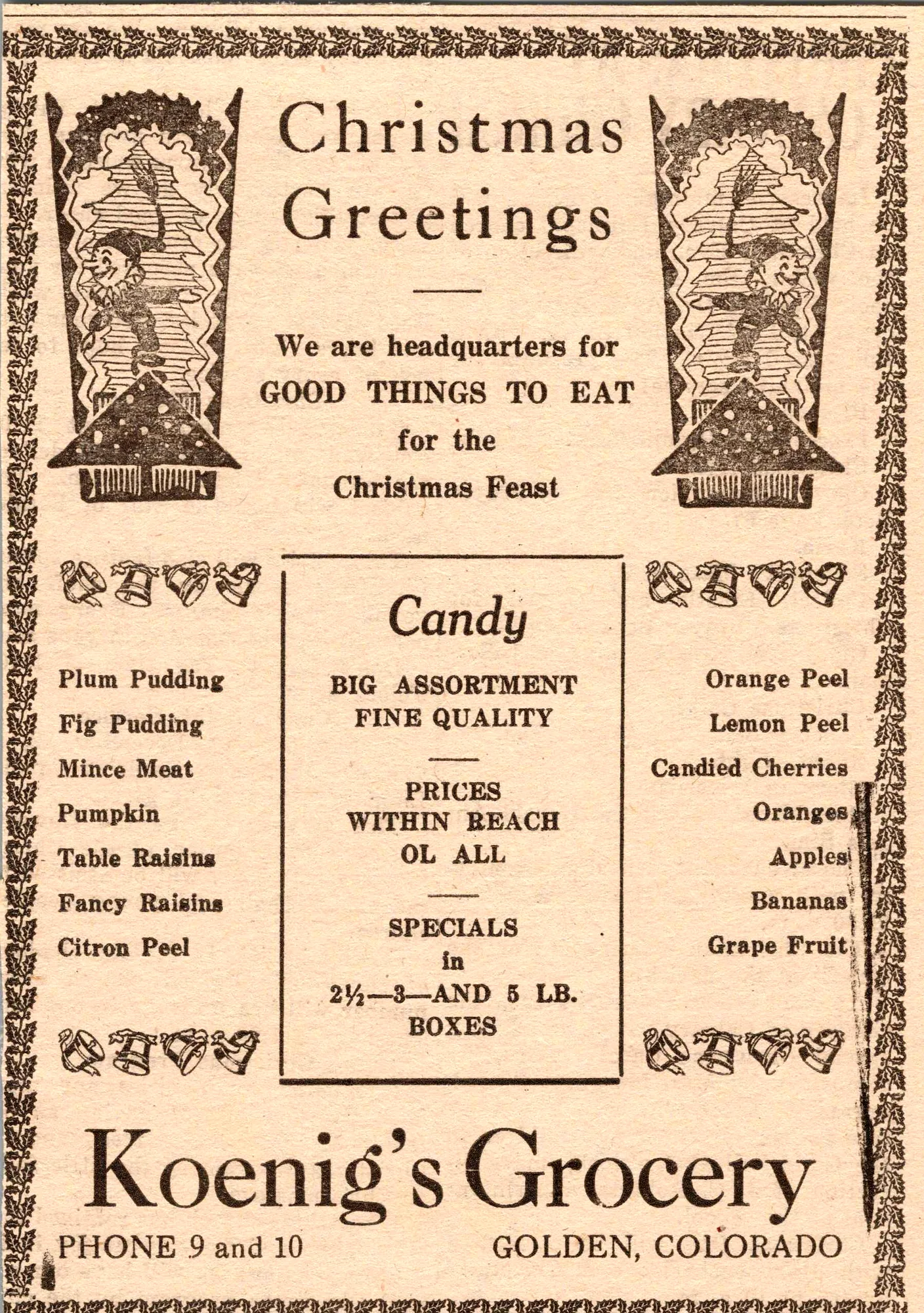
The grocers came first, and there were a lot of them. Red & White stores in Golden and Lakewood, Meyer’s Market, Koenig’s, Bender, the Rifle Range Grocery at Pleasant View, the Morningside Grocery run by Miss M. A. Haller, and The Wheatridge Grocery, which called itself a “solitaire store, home owned” and promised turkeys “plump and prime.” Koenig’s lists the full Christmas pantry of 1929: plum pudding and fig pudding, mince meat, citron and orange peel, candied cherries, and fine candy in five-pound boxes.
Golden had two flour mills, and both advertised. The Rock Flour Mills pushed Golden Seal Flour “for the Christmas baking,” while the Golden Mill & Elevator Co. answered with Golden XXX. Readers were told to ask their grocer for the flour by name, a reminder that brand loyalty could be fought over on a single main street.
A brewery that couldn’t brew
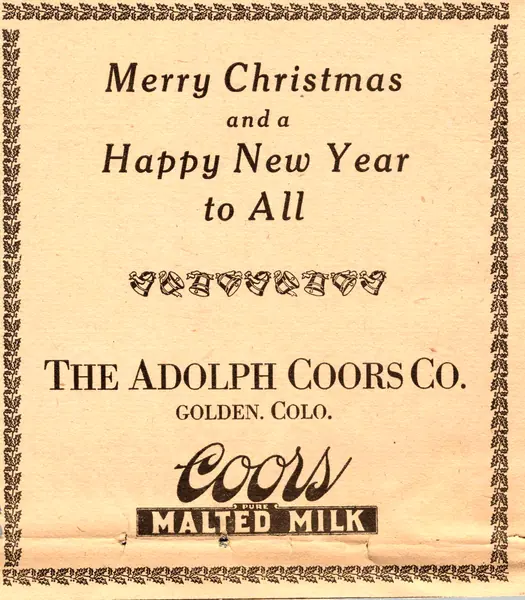
The most surprising holiday card in the issue is also one of the plainest. It wishes everyone a Merry Christmas from The Adolph Coors Co. of Golden, and it ends not with beer but with a banner for Coors Pure Malted Milk.
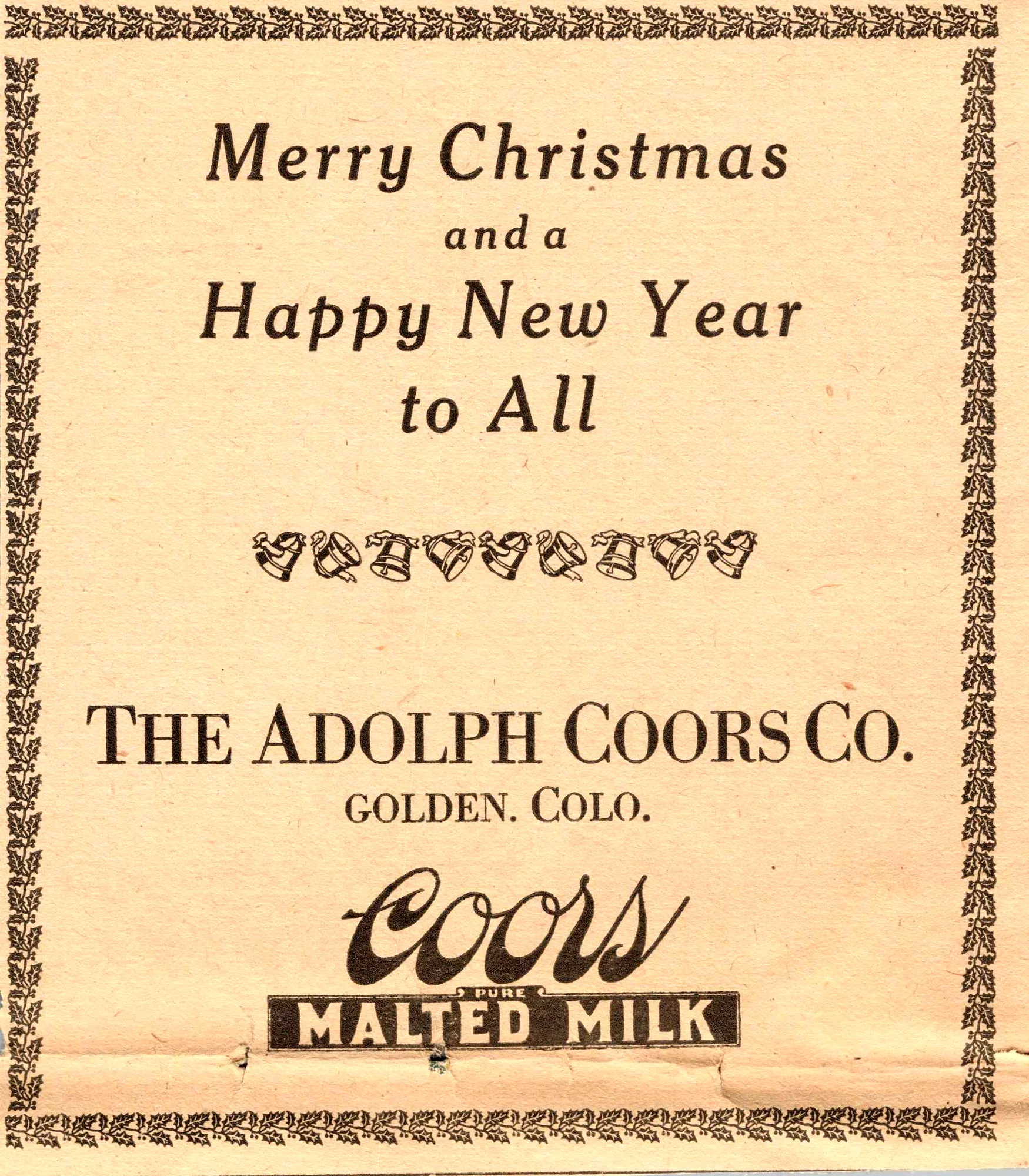
Colorado’s own prohibition law took effect on January 1, 1916, four years before national Prohibition.1 Coors kept going by turning the brewery’s malting department to malted milk, a powder made from malted barley and wheat that went into candy. The company’s own history and the Mob Museum name Mars as the big customer; a Denver7 history names Hershey.123 Coors also sold near beer, under names including Coorsal and Mannah, and leaned on its porcelain company, which turned out household dishes.2 In December 1929 the company had been out of the beer business for almost fourteen years, and legal beer was still more than three years away.
Getting around
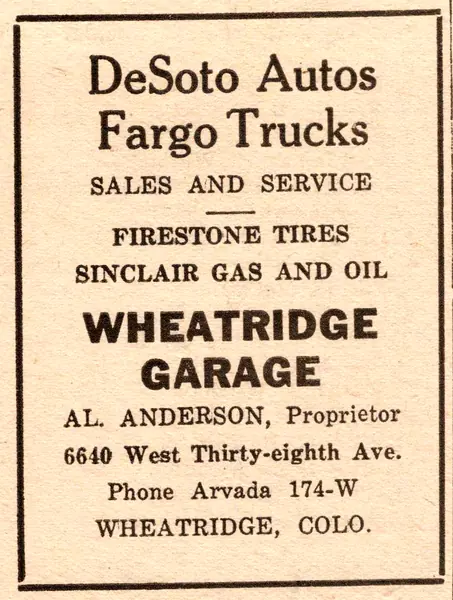
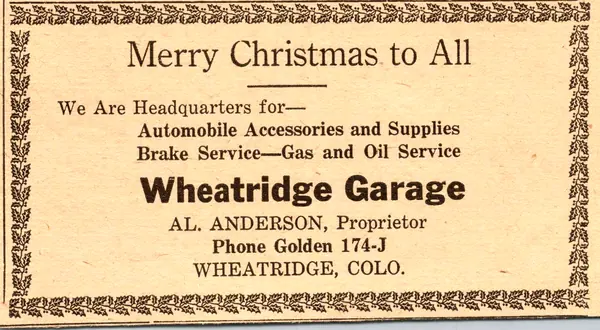
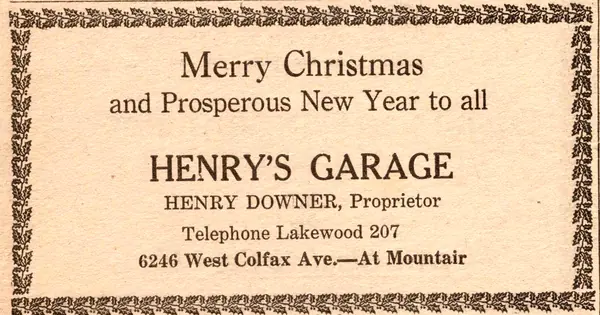
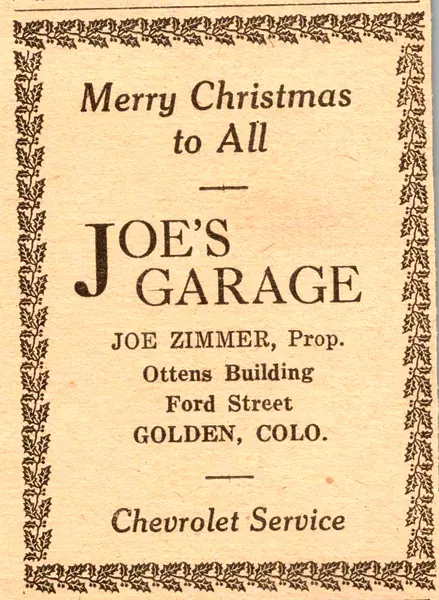
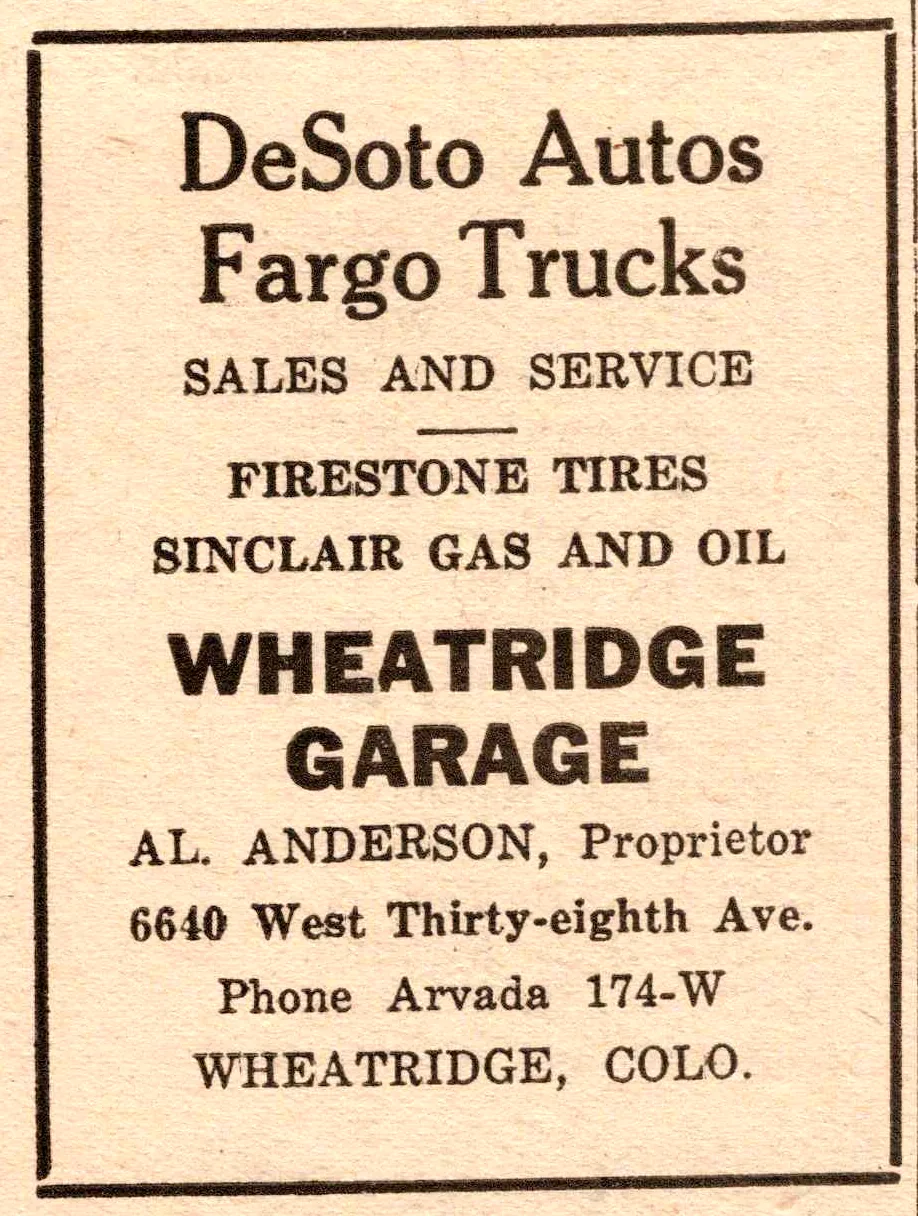
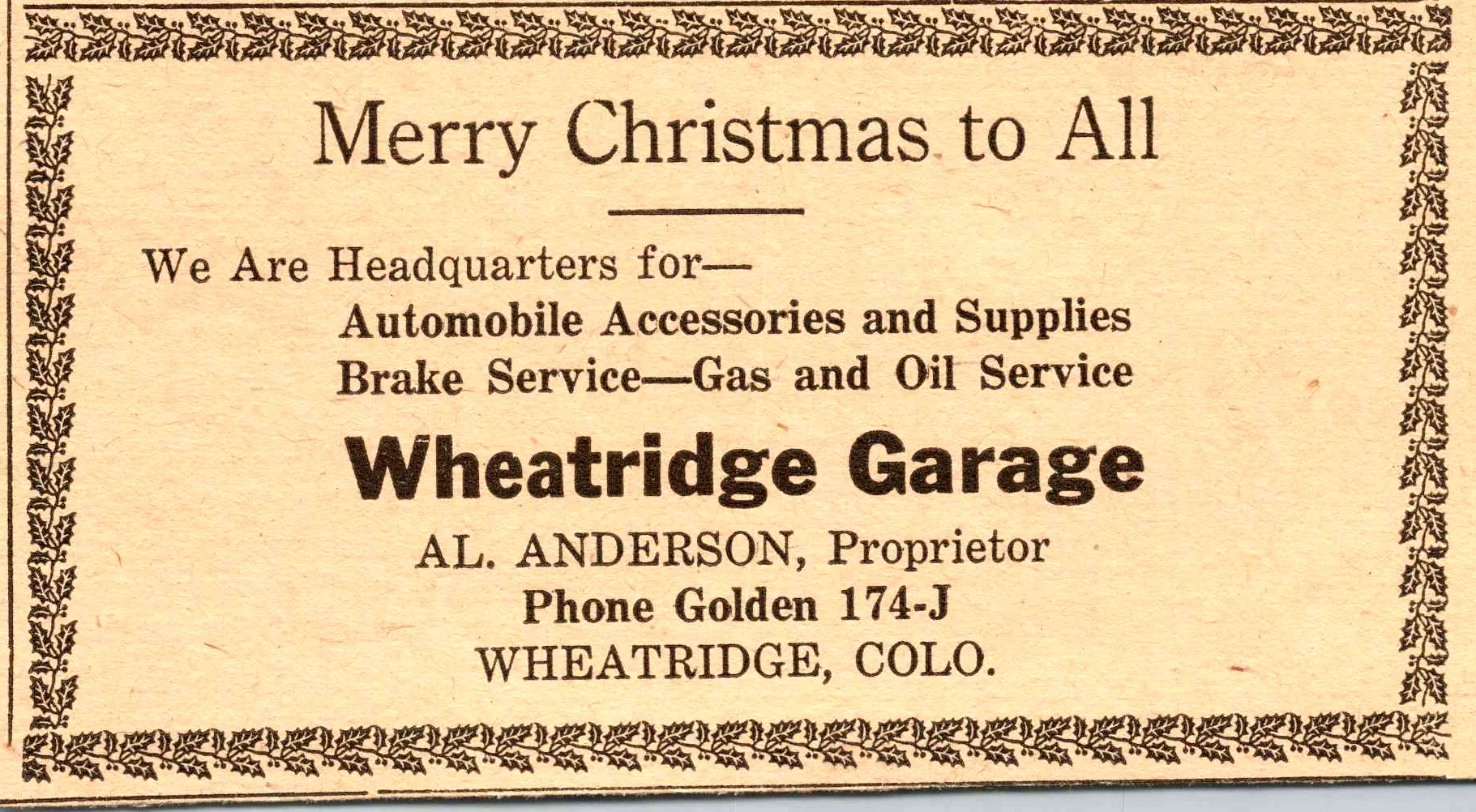
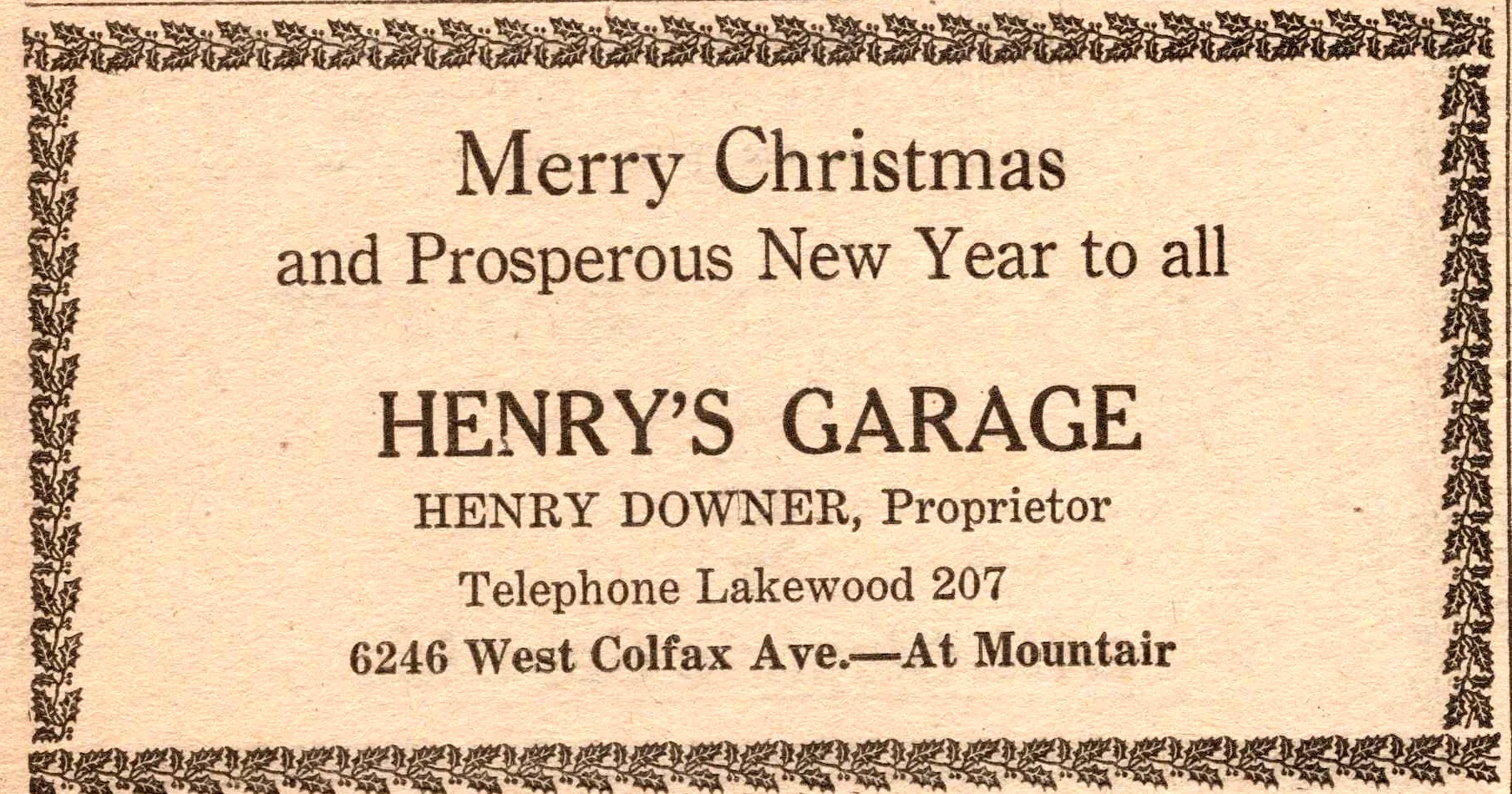
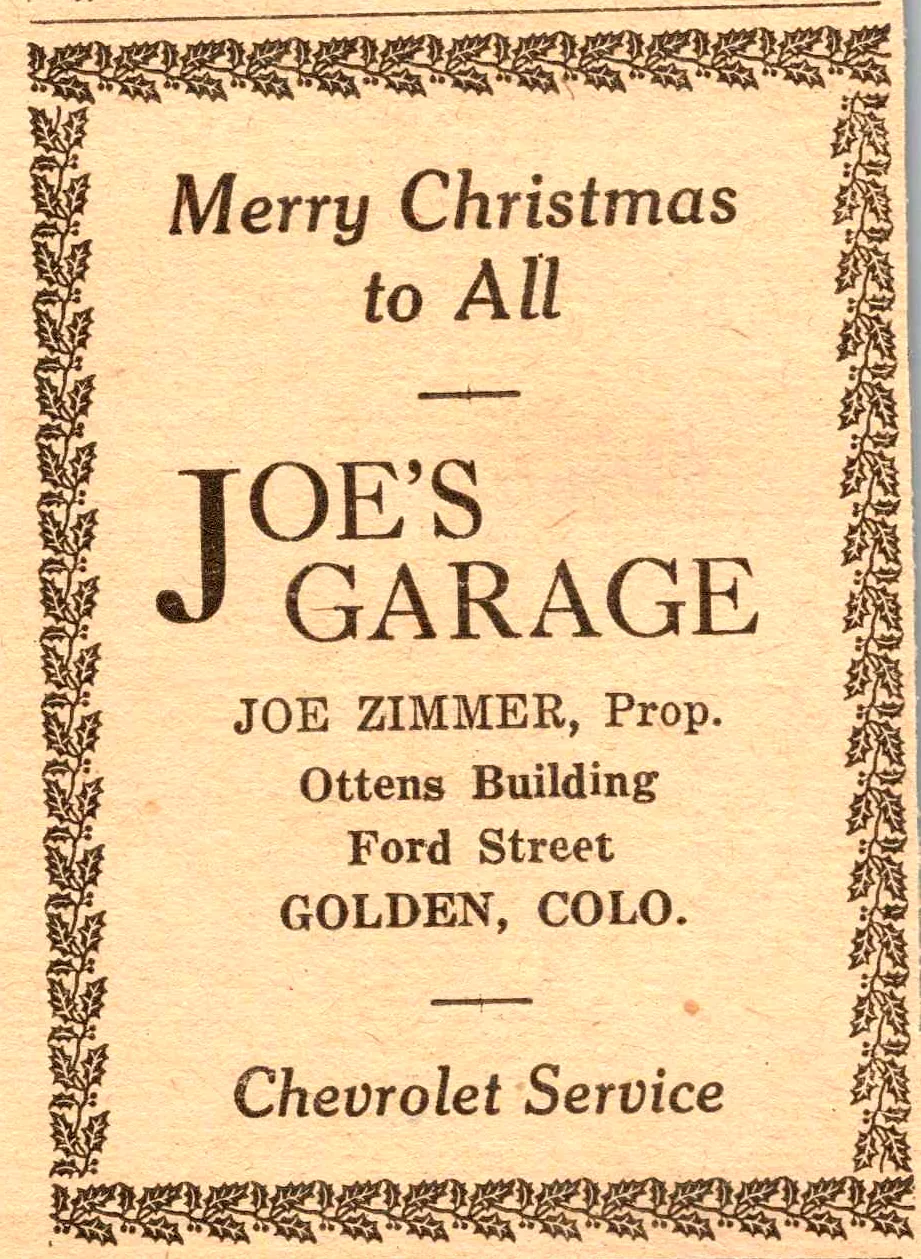
The garages tell you how the county moved. The Wheatridge Garage sold DeSoto cars and Fargo trucks, a brand Chrysler had launched only the year before, and pumped Sinclair gas.4 Henry’s Garage stood on West Colfax, Joe’s Garage in Golden offered Chevrolet service, and an agent for the Travelers sold automobile casualty insurance “on easy terms.”
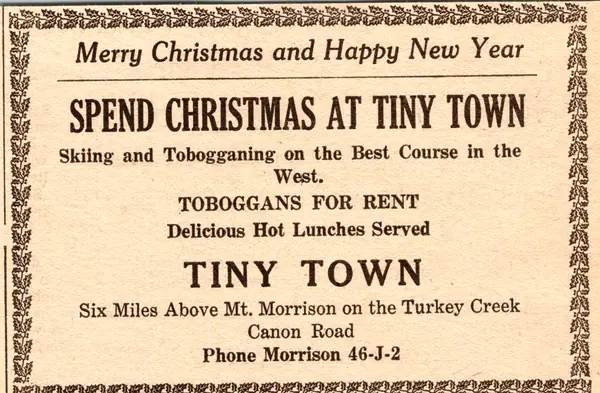
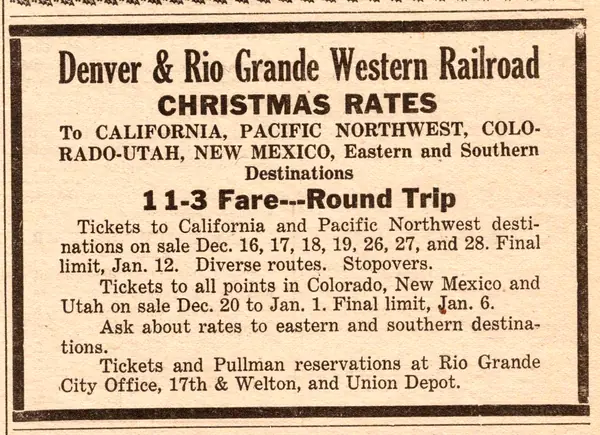
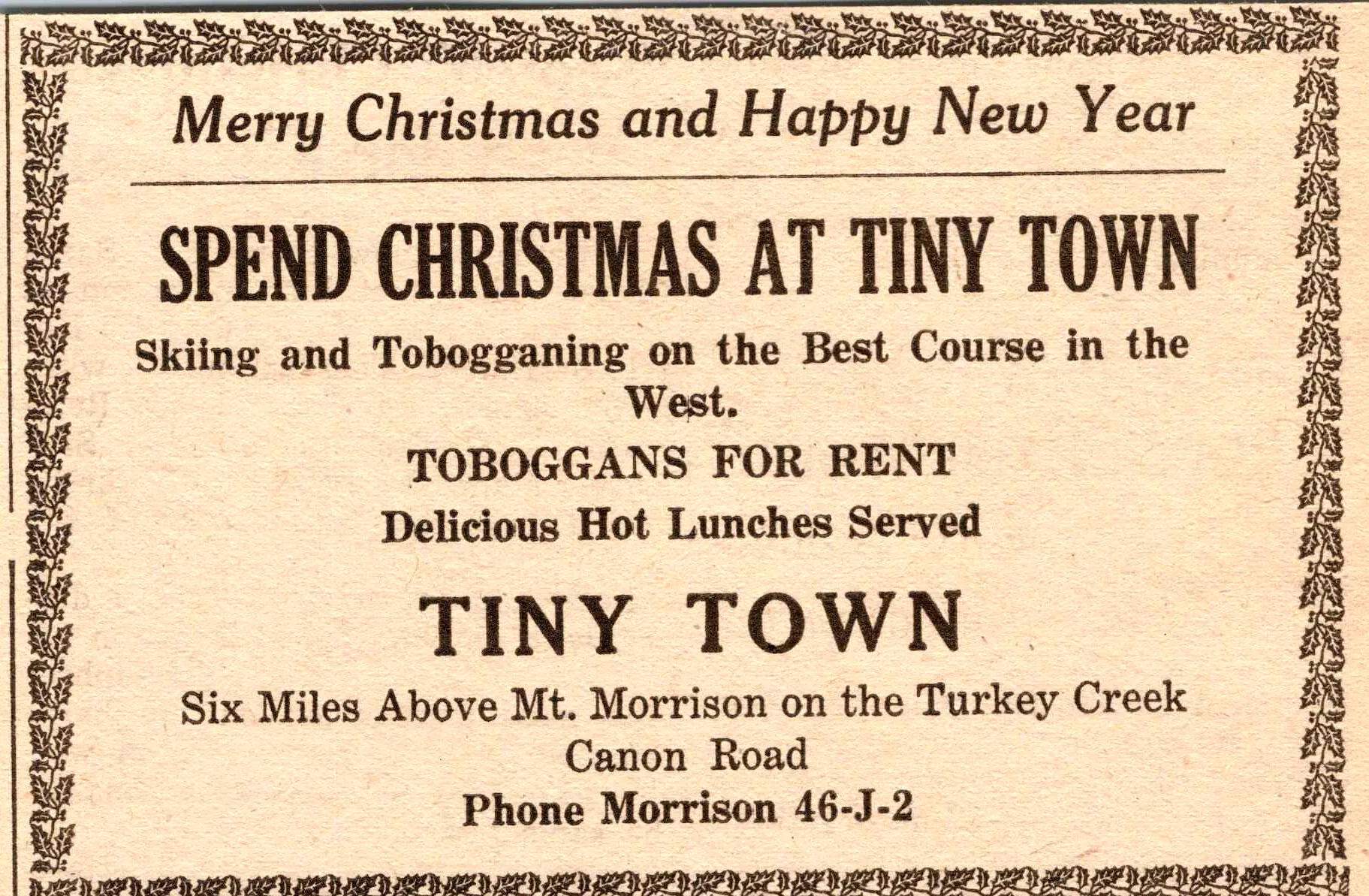
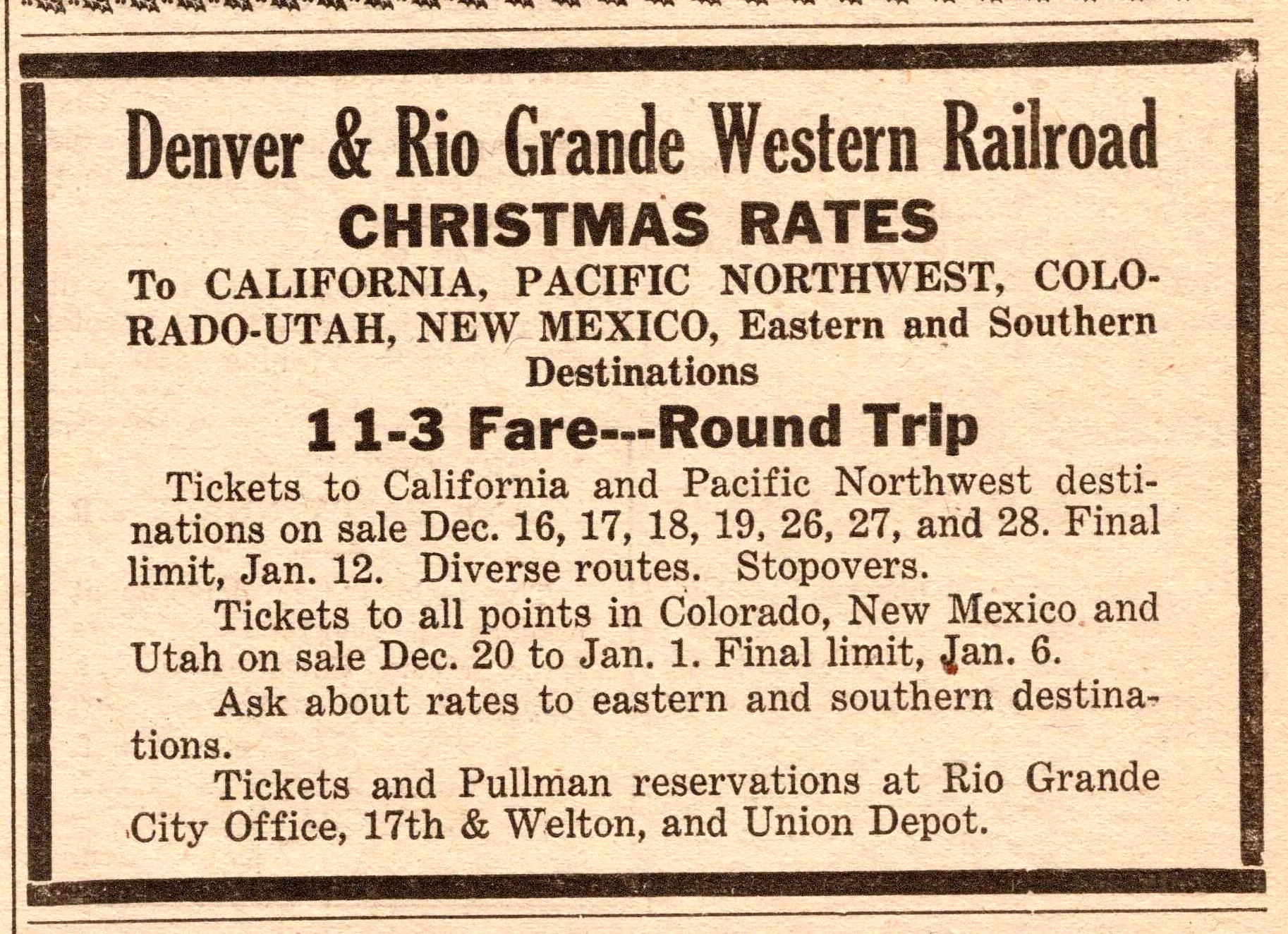
For longer trips, the Denver & Rio Grande Western offered Christmas rates of one and a third fare for the round trip to California, the Pacific Northwest and points east. And for a day out, there was Tiny Town, “six miles above Mt. Morrison on the Turkey Creek Canon Road,” offering skiing and tobogganing on what it called the best course in the West, toboggans for rent and hot lunches.
Tiny Town, and what its name tells us
Tiny Town began in 1915, when George Turner, who owned a Denver moving and storage company, started building a village of child-sized houses in Turkey Creek canyon to entertain his young daughter. It opened to the public around 1920, and by 1924 it had about 125 little buildings and something like 20,000 visitors a year. Turner sold it in 1927.5 It is still open today, run by a nonprofit foundation.
Popular histories disagree about when the place stopped being called Turnerville and became Tiny Town. Roadside America says 1927.6 Other accounts tie the new name to the miniature railroad and give 1939.7 When this story was first published, we pointed to this December 1929 advertisement as proof that the name was in use by then.
The newspapers of the time push the date back further. On August 24, 1924, the Rocky Mountain News reported that 130 members of the Advertising Club of Denver and their families had held their first annual picnic “at Tiny Town, Turner’s village, in Turkey Creek canon,” riding out from downtown on motor trucks with an orchestra in tow.8 In the state’s digitized newspapers, the place is called Tiny Town from then on; we found no paper of the 1920s calling the Colorado village Turnerville. Both of the later dates are too late.
It is a small correction, but it shows something about local history. Dates for places like this get repeated from one website to the next, and the easiest way to check them is often to go back to the papers and the ads that people read at the time.
The Jefferson County Republican covered Tiny Town all through 1929. That spring and summer it reported dances at the Tiny Town pueblo, with a new orchestra, a Memorial Day dance and a rodeo in June.9 Tiny Town’s own history records that a flood damaged it that same year.5 By December the owners were selling winter instead: skiing, toboggans and hot lunches.
The modern Christmas
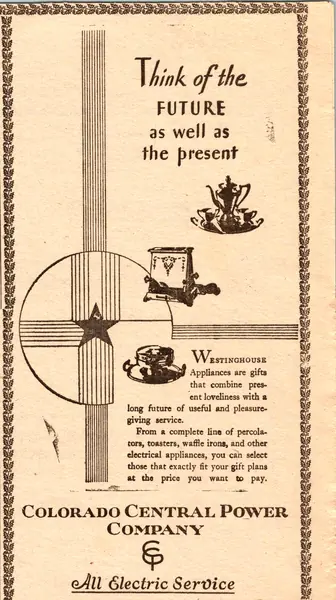
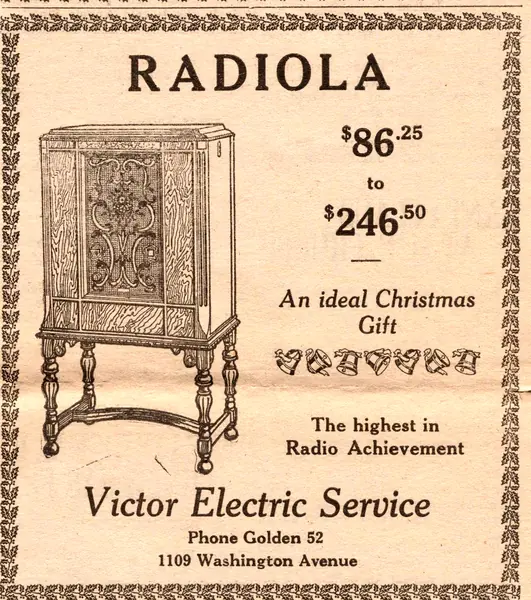
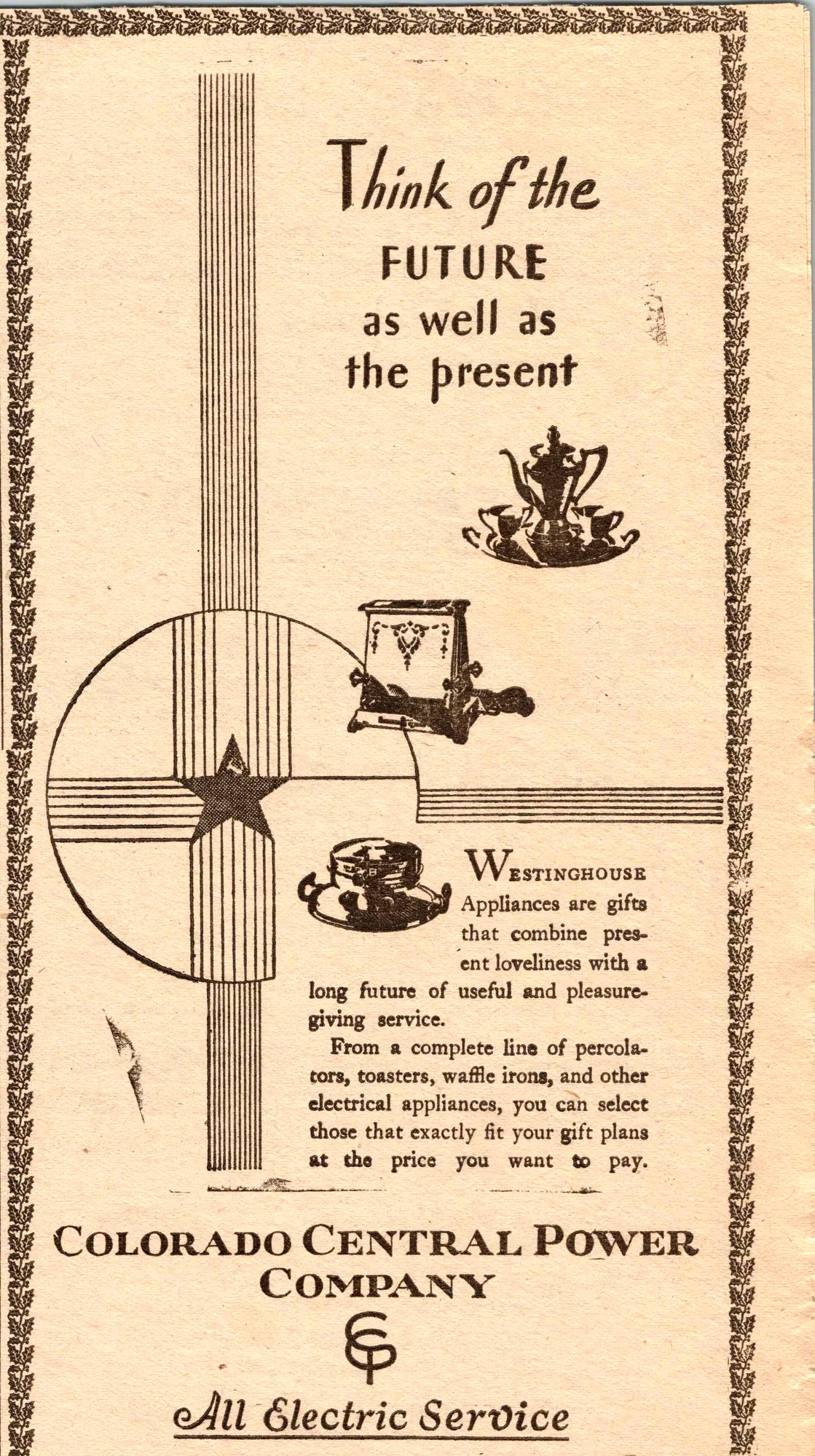
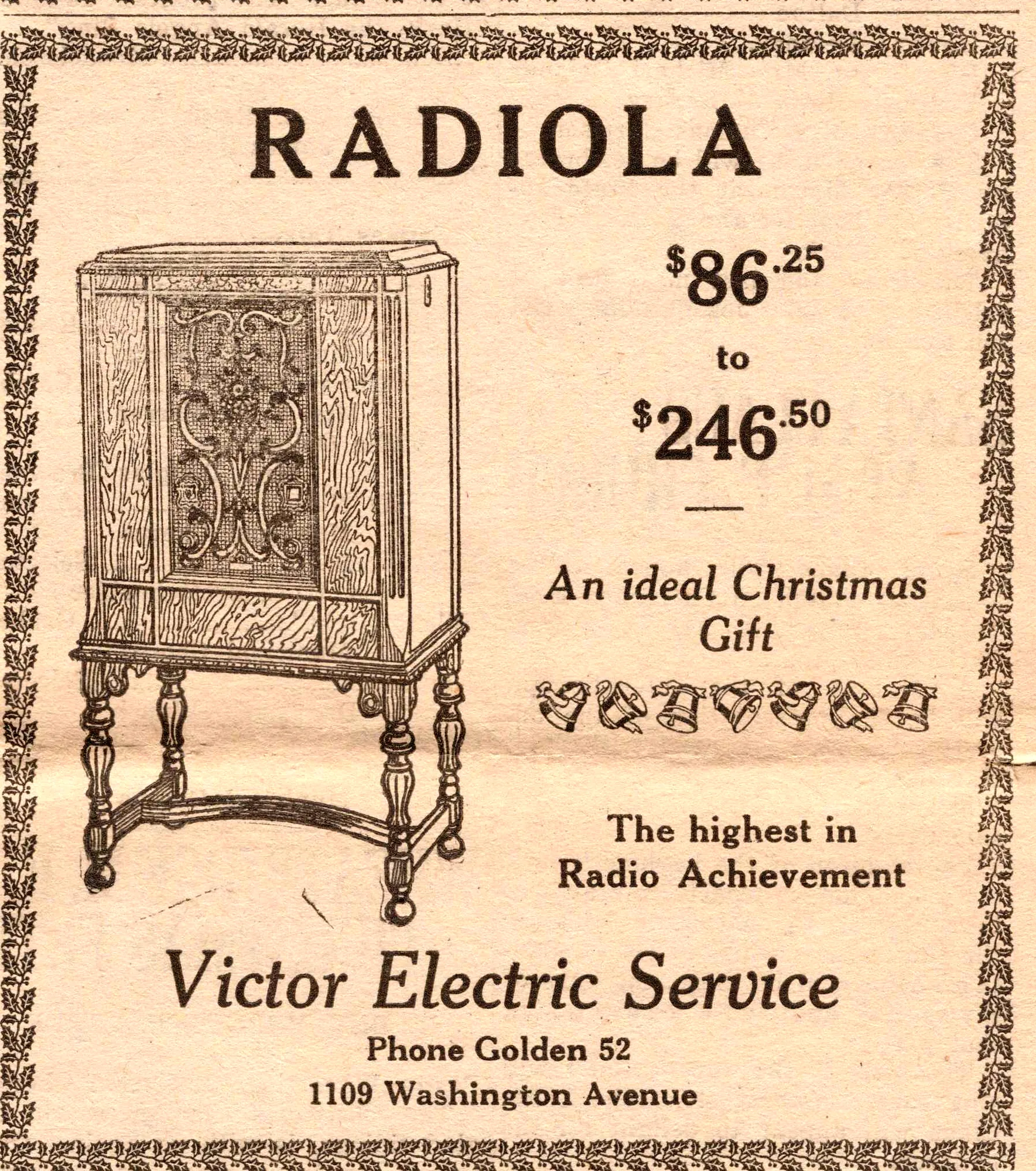
Some of the gifts on offer would have looked very new. The Colorado Central Power Company ran a handsome Art Deco advertisement for Westinghouse percolators, toasters and waffle irons, “gifts that combine present loveliness with a long future.” Victor Electric Service sold Radiola console radios from $86.25 to $246.50. At the hardware store, a genuine Flexible Flyer sled cost $5.00 and a Pyrex casserole in a frame $2.25.
Credit at cash prices. Pay next year.
James Tierney, jeweler, December 1929
That offer from James Tierney, who sold Elgin and Bulova watches from a counter in the Foss Drug Company, is the closest the issue comes to mentioning money trouble. Nobody in these pages talks about the crash, and you would never guess from them that the next few years would be among the hardest the country had seen.
The rest of the county
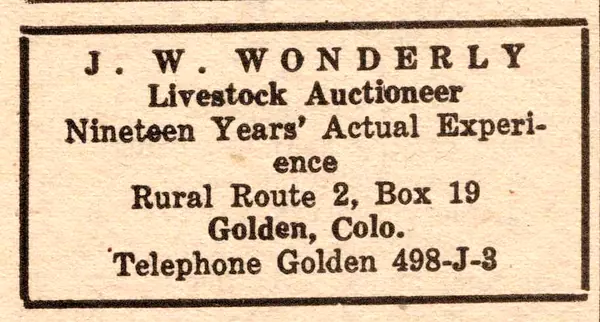
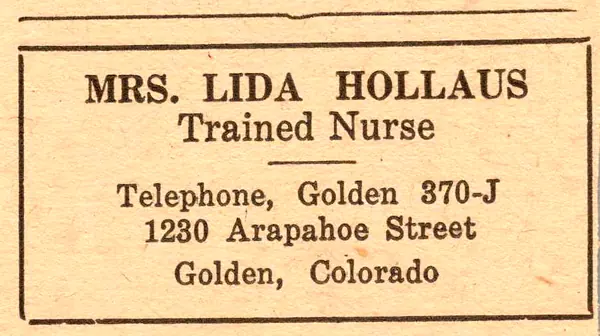
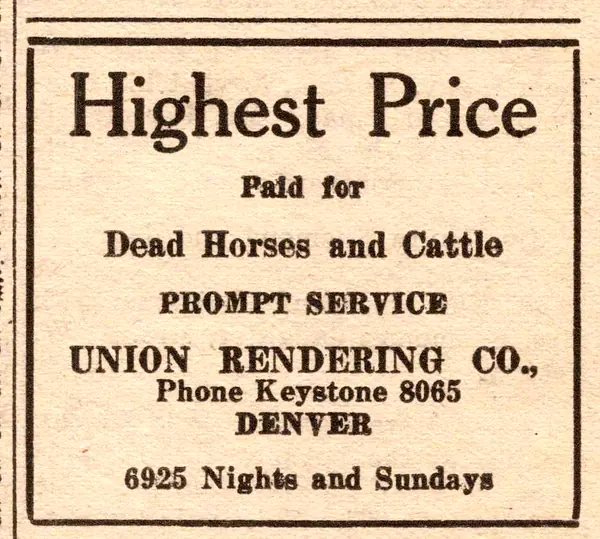
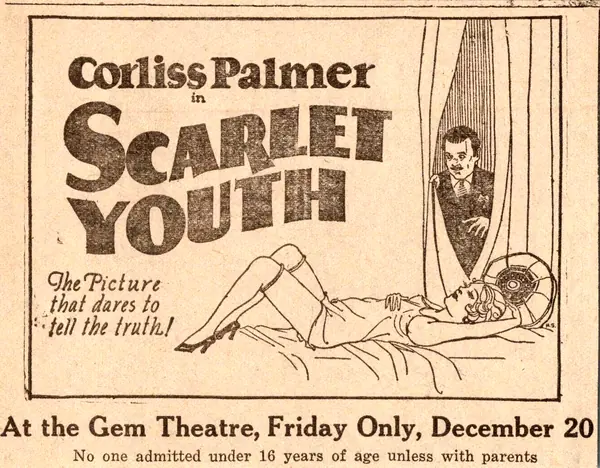
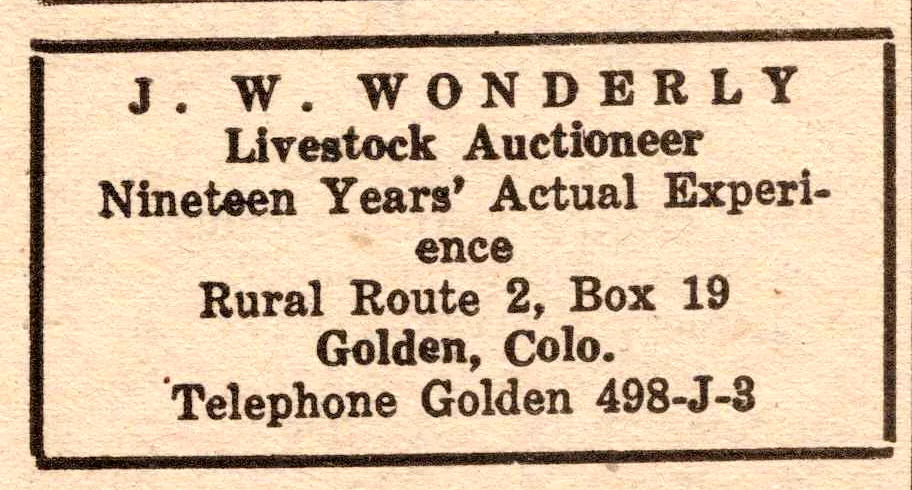
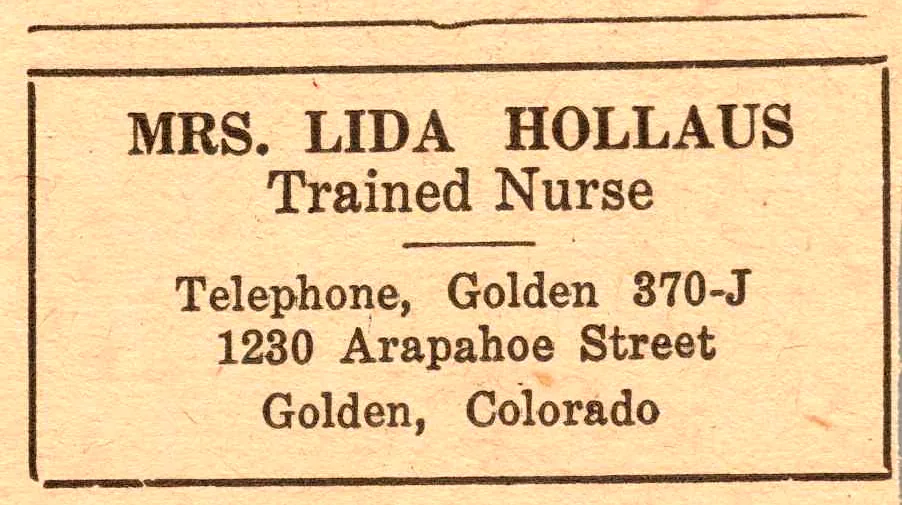
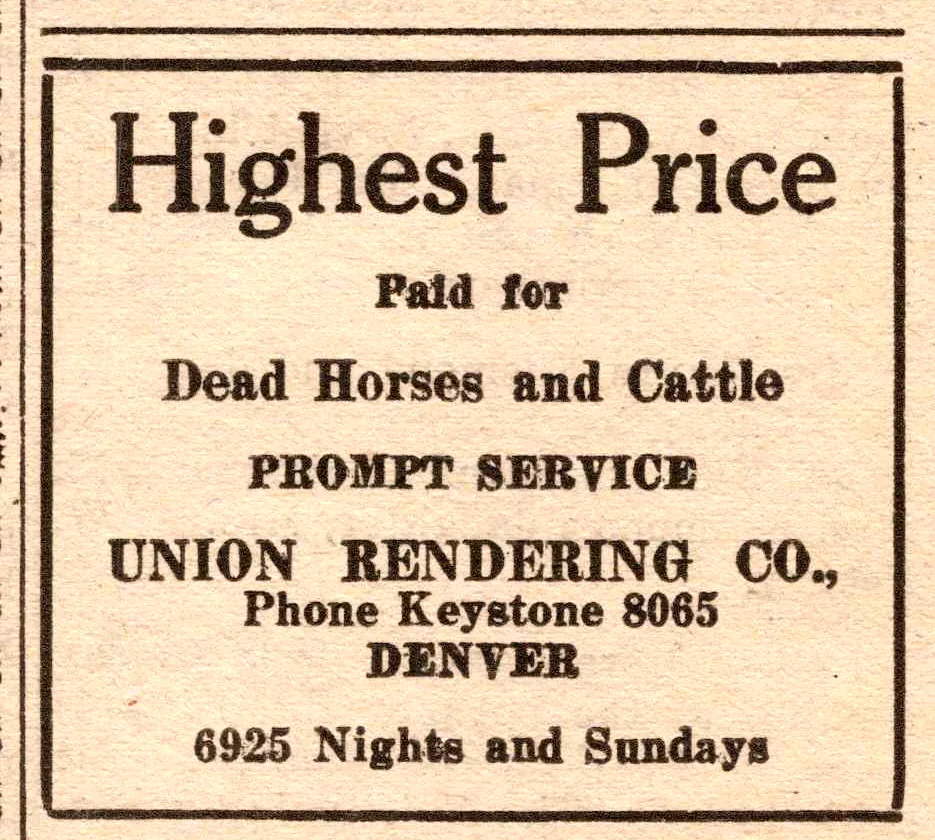
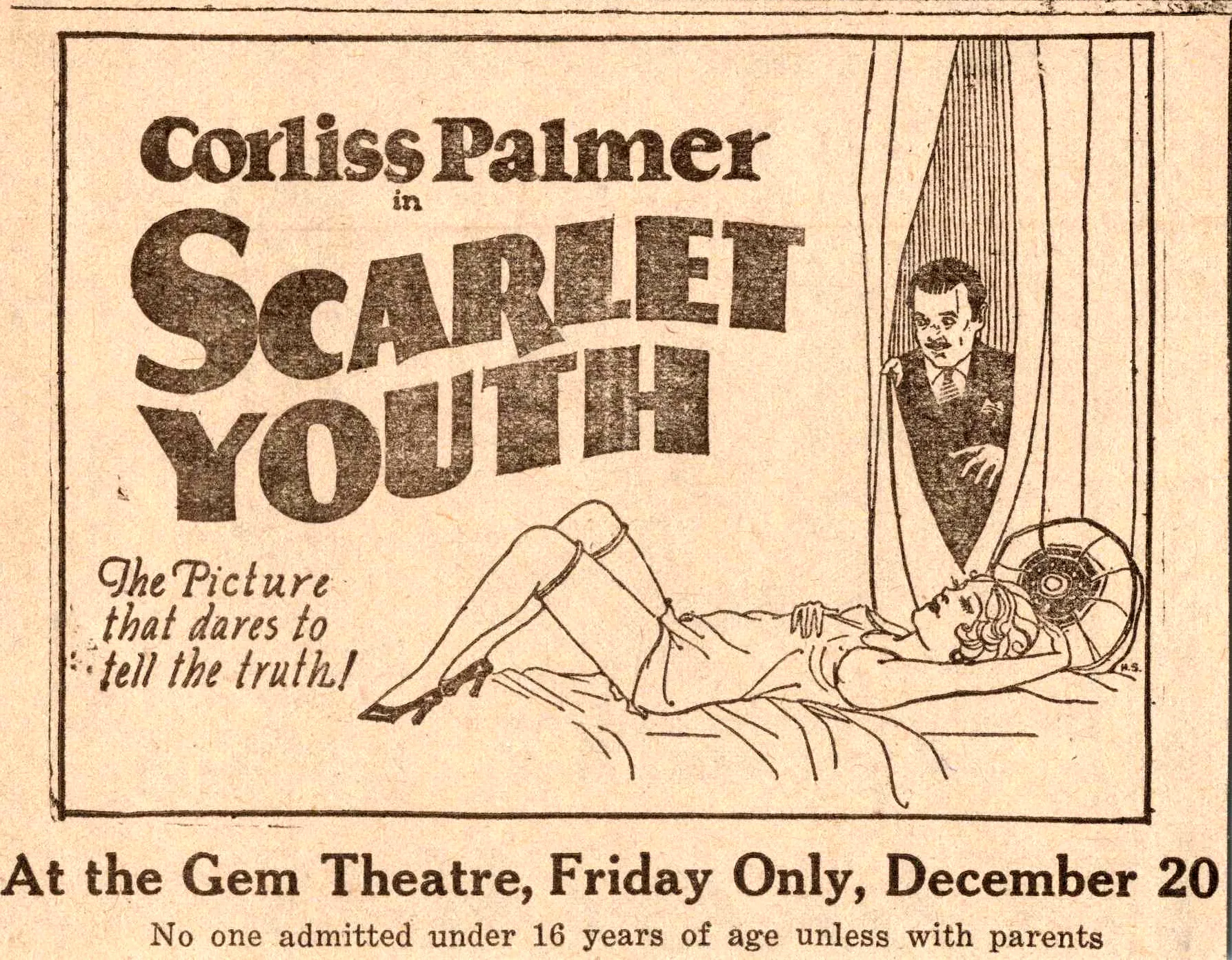
The smaller cards fill in the picture. There is a livestock auctioneer with nineteen years’ experience, a trained nurse, a chiropractor named Dr. Irene V. Ward, a physician and surgeon, a firm of funeral directors and a laundry that would do the family wash at 25 pounds for a dollar. The Union Rendering Co. of Denver paid the “highest price” for dead horses and cattle. And at the Gem Theatre, Friday only, Corliss Palmer starred in Scarlet Youth, “the picture that dares to tell the truth,” with no one under sixteen admitted without a parent.
Where they were
Many of the advertisers printed an address or a landmark, and together they sketch the county’s map. Golden’s businesses cluster on Washington Avenue and the streets around it. Lakewood’s run along West Colfax and the South Golden Paved Road. Wheat Ridge’s are on West 38th Avenue. Here they are as the ads give them; a few gave only a phone number or a town.
| Advertiser | Business | Address or location in the ad |
|---|---|---|
| Meyer’s Market and Grocery | Groceries | 1212 Washington Avenue, Golden |
| Red & White Chain Store | Groceries | 1213 Washington, Golden |
| Victor Electric Service | Radios | 1109 Washington Avenue, Golden |
| Pierce Paint and Paper Store | Paint, wallpaper | 1110 Washington Avenue, Golden |
| Dr. F. W. Brownfield | Physician and surgeon | 1314 Wash[ington], Golden |
| Harold Swena | Moving and express | 812 Washington Avenue, Golden |
| Dr. Irene V. Ward | Chiropractor | 1240 Arapahoe Street, Golden |
| Mrs. Lida Hollaus | Trained nurse | 1230 Arapahoe Street, Golden |
| Colorado Cafe | Restaurant | Opera House Block, Golden |
| Joe’s Garage | Chevrolet service | Ottens Building, Ford Street, Golden |
| James Tierney | Jeweler | At the Foss Drug Company, Golden |
| Bender Grocery | Groceries | 5150 West Colfax Avenue |
| V. Crites | Coal and wood | 5410 West Colfax Avenue, at Mountair |
| Beach Lumber Company | Lumber | 5990 West Colfax Avenue, Lakewood |
| Henry’s Garage | Garage | 6246 West Colfax Avenue, at Mountair |
| Plattner Coal Company | Coal, hay, grain, feed | South Golden Paved Road at Wadsworth Avenue |
| Lakewood Red & White Store | Groceries | South Golden Paved Road at Lakewood |
| Morningside Grocery | Groceries | At Morningside, on the South Golden Paved Road |
| Rifle Range Grocery | Groceries | At Pleasant View, on the South Golden Paved Road |
| Golden Waffle Inn | Restaurant | South Golden Paved Road, across from Rock Rest |
| Wheatridge Garage | Cars, trucks, gas | 6640 West Thirty-eighth Avenue, Wheatridge |
| La Palmarte | Italian dinners | Thirty-eighth Avenue and Reed Street, Wheatridge |
| Peinze Mercantile Co. | General store | Mt. Morrison |
| The Pacific Lumber Co. | Lumber | Mt. Morrison |
| McCracken Drug Store | Drugs and gifts | Evergreen |
| Tiny Town | Winter sports | Six miles above Mt. Morrison, Turkey Creek Canon Road |
A year later
The Republican’s Christmas issue a year later, December 18, 1930, is in the Colorado Historic Newspapers Collection, and many of the same names are back.10 Koenig’s, now signing as Koenig Mercantile Co., printed a price list for Christmas baking (dates at 15 cents a pound, candied cherries at 60 cents) and added, “We consider our Prices as Reasonable as can be Found Anywhere.” Dr. Ward and Peinze Mercantile sent greetings again. The Golden Mill & Elevator Co. was still selling Golden XXX for Christmas baking. And the Wheatridge Grocery, under the same proprietor, Earl Chambers, put a slightly different wish in its card:
If our good wishes will solve your problems as happily as your good will has solved ours this will be your Merriest Christmas and 1931 your happiest year.
The Wheatridge Grocery, December 1930
It is a gentle sentence, but it says something the 1929 pages never did: that readers had problems to solve.
Afterward
Much of this landscape has since been swallowed by the Denver suburbs. Lakewood and Wheat Ridge, which appear here as farm communities strung along West Colfax and the South Golden Paved Road, did not incorporate as cities until 1969.11 Coors went back to brewing in April 1933 and kept making malted milk into the 1950s; the Mob Museum gives 1957 as the last year.13 Tiny Town is still on Turkey Creek.
For a few weeks in December 1929, though, all of them shared the same newspaper and the same hope, printed over and over in holly borders: Merry Christmas, and a prosperous New Year.
Sources
- Malted milk and tea cups: How Coors made it through 17 years of Prohibition, Denver7.
- True grit: 5 times Coors came back from the brink, Molson Coors.
- Ten alternative products made by breweries during Prohibition, The Mob Museum.
- Fargo Trucks, Wikipedia.
- History, Tiny Town & Railroad (timeline: 1915, 1920, 1924, 1927 sale, 1929 flood).
- Tiny Town, Roadside America.
- Tiny Town & Railroad, HawkinsRails; Tiny Town (amusement park), Wikipedia.
- “Denver Advertising Club To Give Picnic in Hills,” Rocky Mountain News, August 24, 1924, via the Colorado Historic Newspapers Collection. See also the headline of August 23, 1924: “Denver Advertising Club to Hold Its First Annual Picnic at Tiny Town This Afternoon.”
- Jefferson County Republican, 1929: “Memorial Day Dance at Tiny Town Pueblo,” May 23; “Big Rodeo at Tiny Town, June 22–23,” June 13; “New Dance Orchestra at Tiny Town Pueblo,” July 11. Colorado Historic Newspapers Collection.
- Jefferson County Republican, December 18, 1930, advertisements on page 3, page 4 and page 9, Colorado Historic Newspapers Collection.
- Lakewood, Colorado and Wheat Ridge, Colorado, Wikipedia.