Then and now · Food
Breakfast Gets Serious
In 1895 a bowl of oats sold itself as cheap, wholesome and quick to cook. By 1925 cereal promised energy, regularity and the strength to close a sale. Thirty years of breakfast ads show how food became a cure.
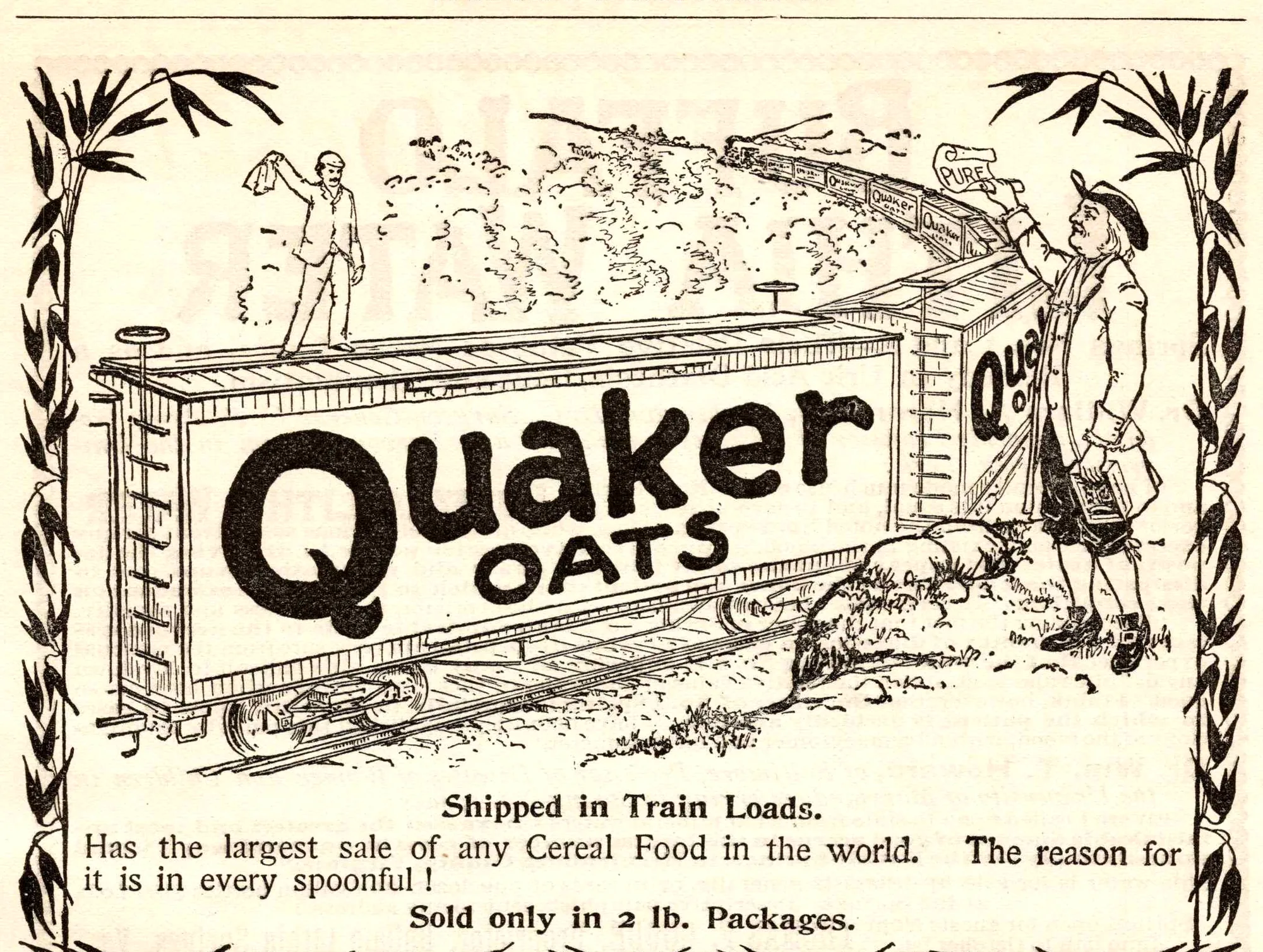
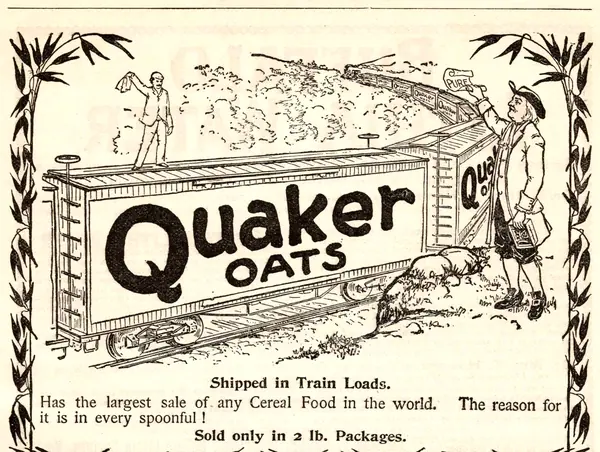
The Quaker Oats advertisement in the April 1895 issue of Munsey’s Magazine is almost all picture. A long freight car with Quaker Oats painted on its side rolls across the page, the Quaker figure beside the name. The copy is four short lines:
Has the largest sale of any Cereal Food in the world. The reason for it is in every spoonful! Sold only in 2 lb. Packages.
Quaker Oats, April 1895
The headline was Shipped in Train Loads, and that was the whole argument. Quaker Oats was big, it was popular, and it came in a package.
The 1895 breakfast
That package was the real innovation. Henry Parsons Crowell, who bought the Quaker Mill in Ravenna, Ohio, in 1881, sold his oats in a sanitary two-pound paper carton with cooking directions printed on it, at a time when oats were commonly sold loose from the grocer’s barrel. Crowell also launched what the company calls the first national magazine advertising campaign for a breakfast cereal, and in 1888 the leading oat millers merged into the American Cereal Company, which ran this ad.12
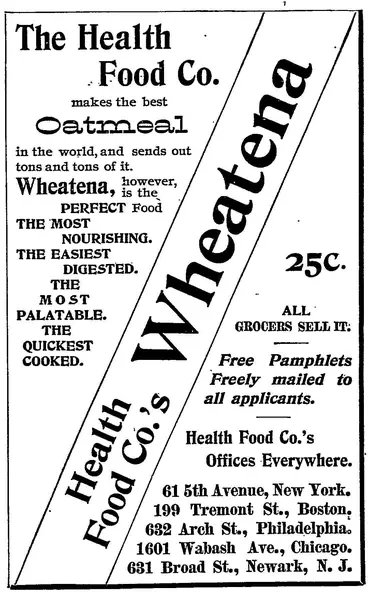
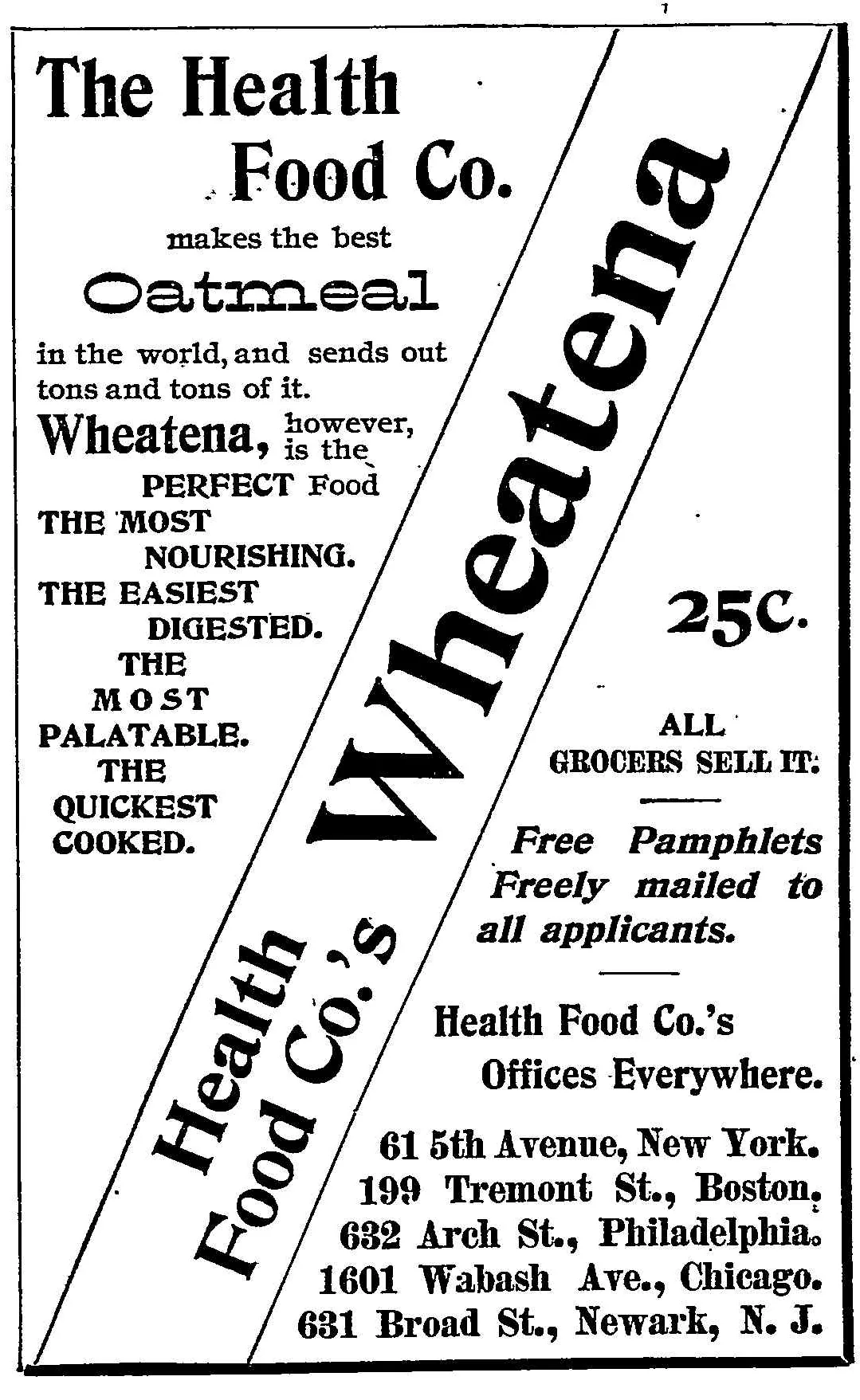
The other breakfast ads in the issue make the same kind of plain claims. The Health Food Co. of New York sold Wheatena for 25 cents, in a burst of capital letters:
Wheatena, however, is the PERFECT Food. THE MOST NOURISHING. THE EASIEST DIGESTED. THE MOST PALATABLE. THE QUICKEST COOKED.
Health Food Co., April 1895
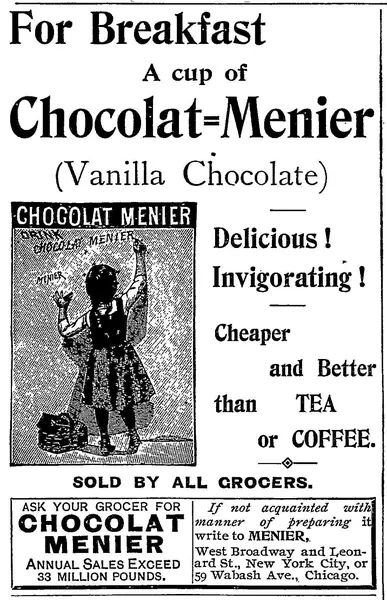
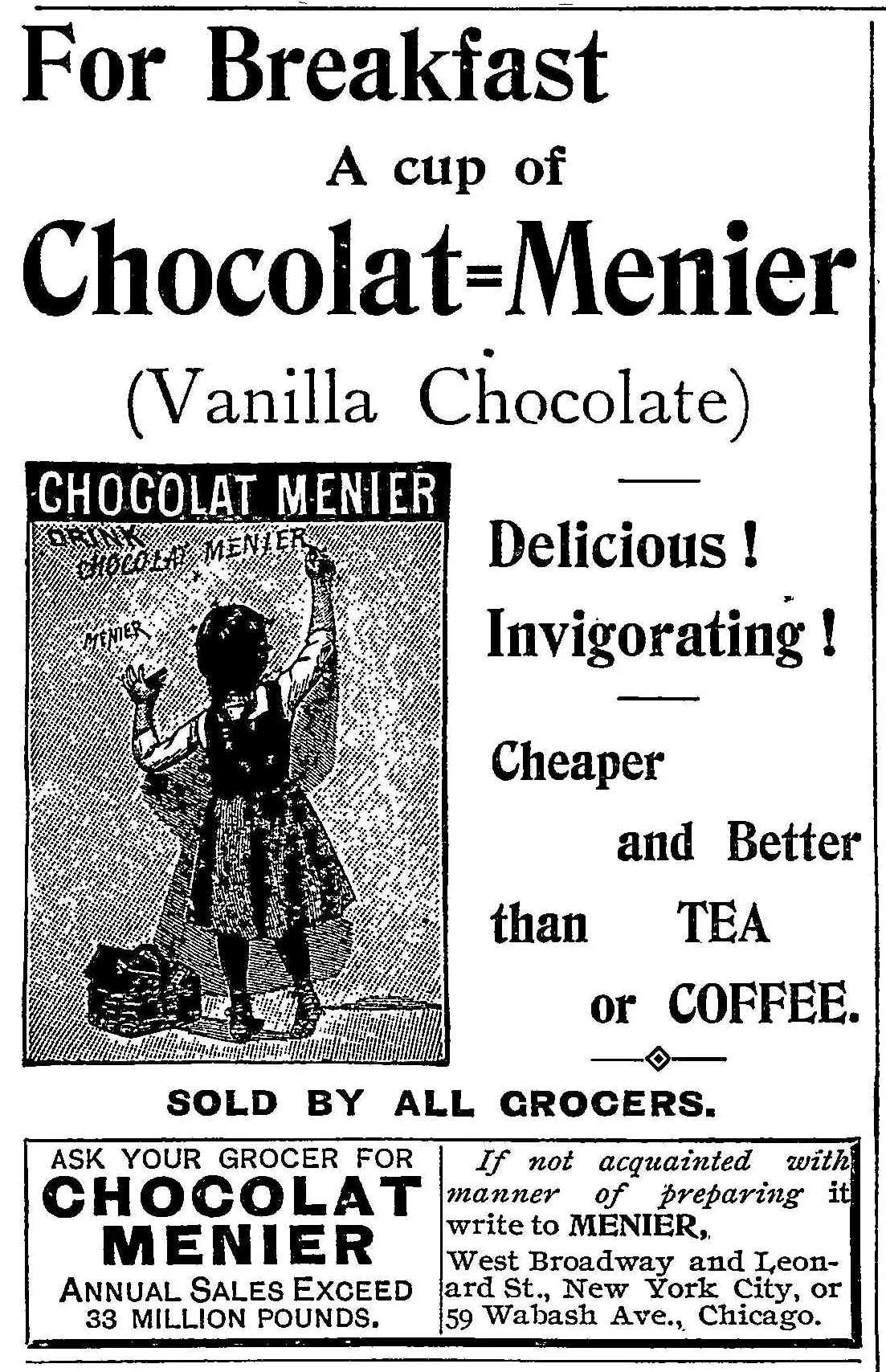
Menier, the French chocolate maker, suggested a cup of its vanilla chocolate for breakfast, “cheaper and better than TEA or COFFEE,” with annual sales of more than 33 million pounds.
Nourishing, digestible, cheap, quick, popular. Most of those are a food’s virtues, but “the most nourishing” and “the easiest digested” are already health claims, and the 1895 ads were not the whole story.
Health claims were already there
When this story was first published, it said that breakfast in 1895 was sold simply as food. That was too simple. The cold cereal itself was born as health food. It began in the sanitariums of the mid-1800s: in 1863 James Caleb Jackson of the Our Home on the Hillside sanitarium baked graham flour into a hard, crumbled cereal he called Granula, and in 1877 Dr. John Harvey Kellogg began serving his own version, Granola, at the Battle Creek Sanitarium. An 1893 ad for Kellogg’s Granola, in a medical journal, promised “the Largest Amount of Nutrient in the Smallest Bulk.”3
Quaker itself was using medical authority two years before the Munsey’s ad. In the Chicago Tribune of November 2, 1893, one of its “Quaker Chalk Talks” put a dentist at a child’s bedside.

So the change between 1895 and 1925 is not that health arrived. It is in how loud the claims became, what they were about, and how they were told.
Two different magazines
The comparison also needs a caution. The 1895 ads come from Munsey’s Magazine, a ten-cent general monthly of fiction, pictures and celebrities that had cut its price in 1893 and reached about half a million copies a month by 1895.6 The 1925 ads come from Physical Culture, Bernarr Macfadden’s magazine of exercise, diet and distrust of conventional medicine, whose readers had picked it up because they cared about their bodies.7 Advertisers write for the audience in front of them. Some of the difference between these two issues is thirty years of change, and some of it is two very different sets of readers. (The same pair of magazines appears in Thirty Years of Baldness Cures, and the 1925 issue also carried a young swami’s ad for yoga.)
The 1925 breakfast
Thirty years later, in the June 1925 issue of Physical Culture, the breakfast ads are doing something else entirely. They are selling energy, and they are selling it with stories.
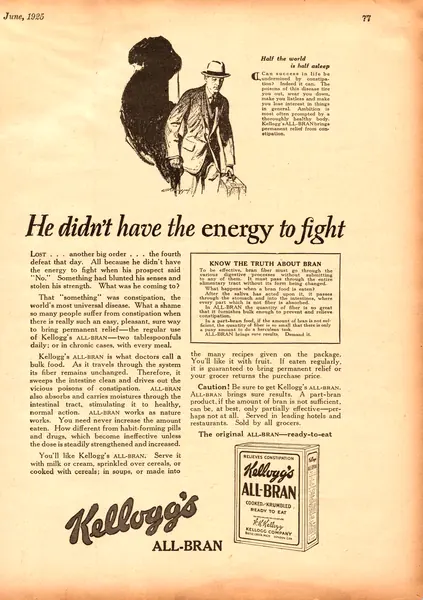
Kellogg’s All-Bran tells one about a salesman who lost “another big order . . . the fourth defeat that day,” because he did not have the energy to fight when the customer said no. Something had “blunted his senses and stolen his strength.” The cause, the ad explains, was the sluggishness that bran could cure. Its opening line is a whole theory of modern life: “Half the world is half asleep.”
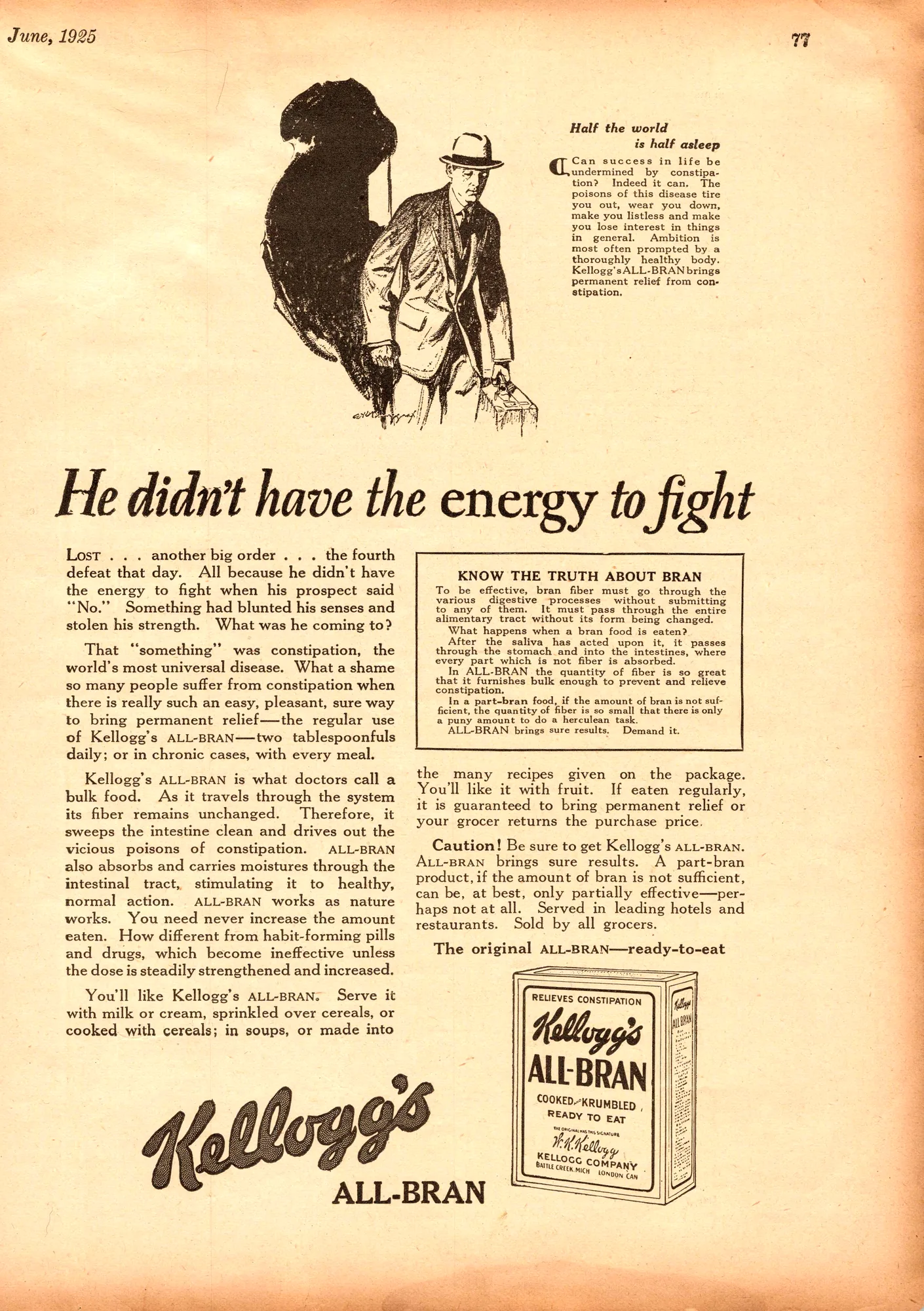
Kellogg had introduced All-Bran in 1916 and sold it, frankly, as a remedy for constipation.4 Behind that lay a medical theory that was at its height in the 1910s and 1920s: autointoxication, the idea that waste lingering in the bowel poisoned the body and caused fatigue, illness and low spirits. Doctors and health crusaders, John Harvey Kellogg among them, promoted it, and the public was sold foods, drugs and devices to fight it. The theory was later abandoned.89 That is why the 1925 ads talk so much about sluggishness and “faulty elimination.” In 1925 the remedy had also become a business tool.
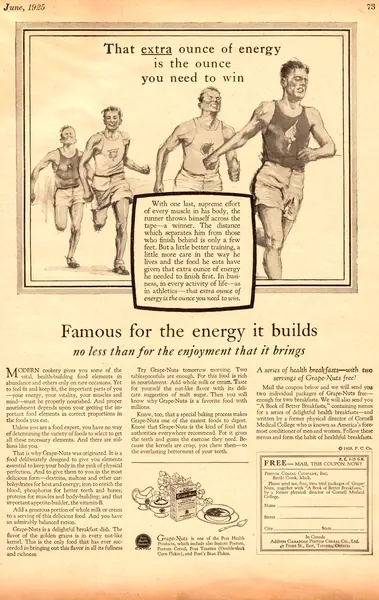
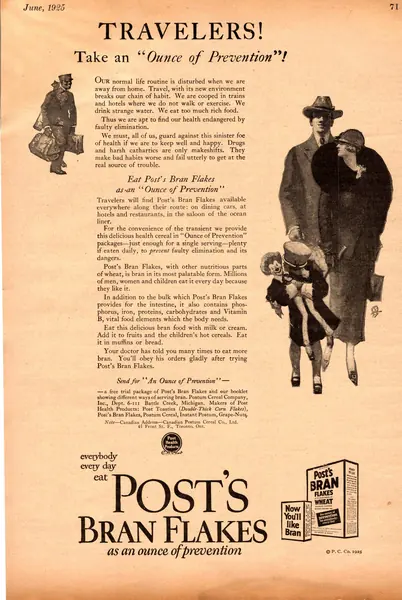
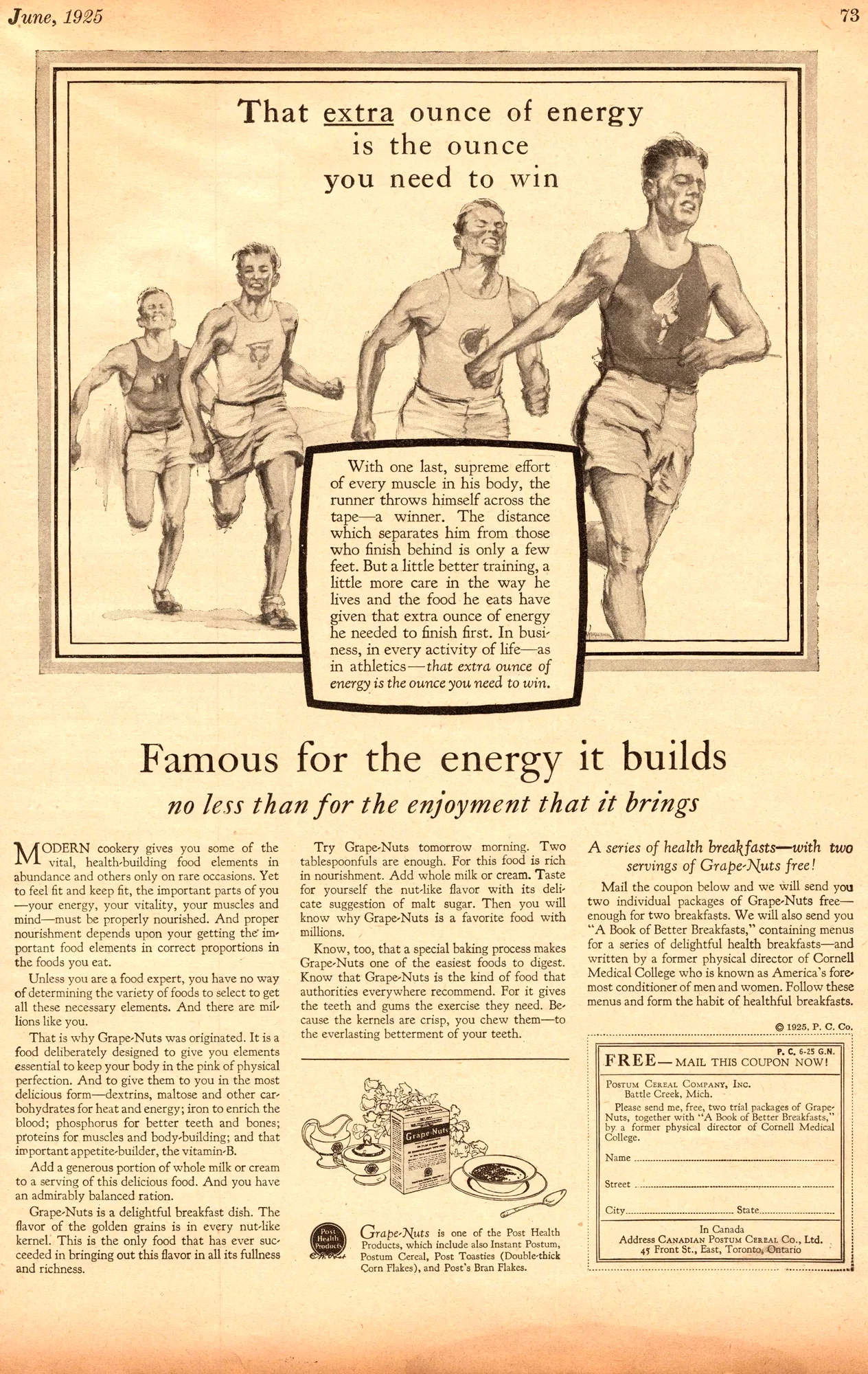
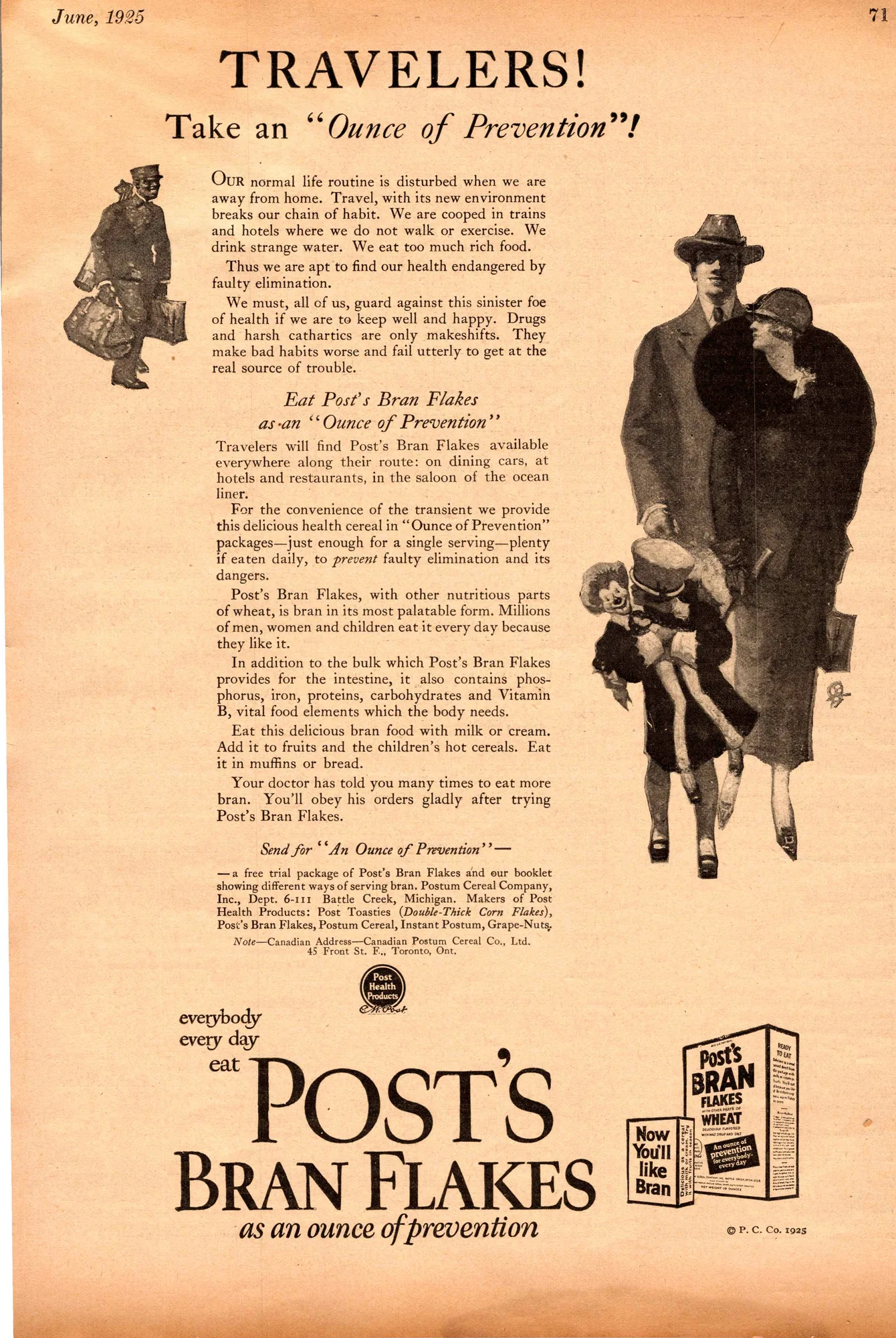
Grape-Nuts, from the Postum Cereal Co. of Battle Creek, showed a runner throwing himself across the tape “with one last, supreme effort of every muscle in his body,” under the headline That extra ounce of energy is the ounce you need to win. The same company’s Post’s Bran Flakes addressed travelers, whose routines were disturbed by trains and hotels, and urged them to take an “ounce of prevention.” The slogan ran at the bottom: “everybody every day.”
Shot from guns
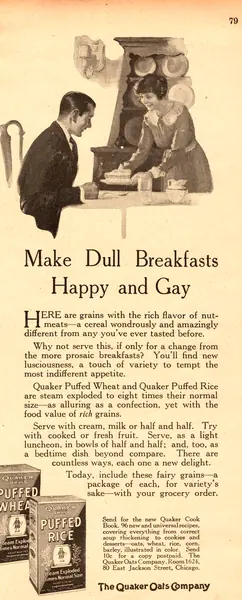
Even Quaker had changed its tune. Its 1925 ad for Puffed Wheat and Puffed Rice promised to make dull breakfasts happy and gay with grains that tasted like nutmeats, “steam exploded to eight times their normal size.” That was not just copywriting. Puffed rice came from the experiments of Alexander P. Anderson, a botanist who in December 1901 was trying to show that starch granules held tiny amounts of water. He sealed starch in glass tubes, heated them past 400 degrees Fahrenheit and cracked them open with a hammer. The pressure dropped at once, the trapped water turned to steam, and the starch puffed up. He patented the method in 1902 and signed with Quaker Oats in 1903.35
At the 1904 World’s Fair in St. Louis, Anderson loaded eight twenty-inch bronze tubes with rice, heated them, and fired the puffed grain into a big wire cage while crowds watched. Over the fair his team puffed more than 20,000 pounds of rice and sold about a quarter of a million nickel packages.3 Quaker built its advertising around the inventor and the “guns” for decades.
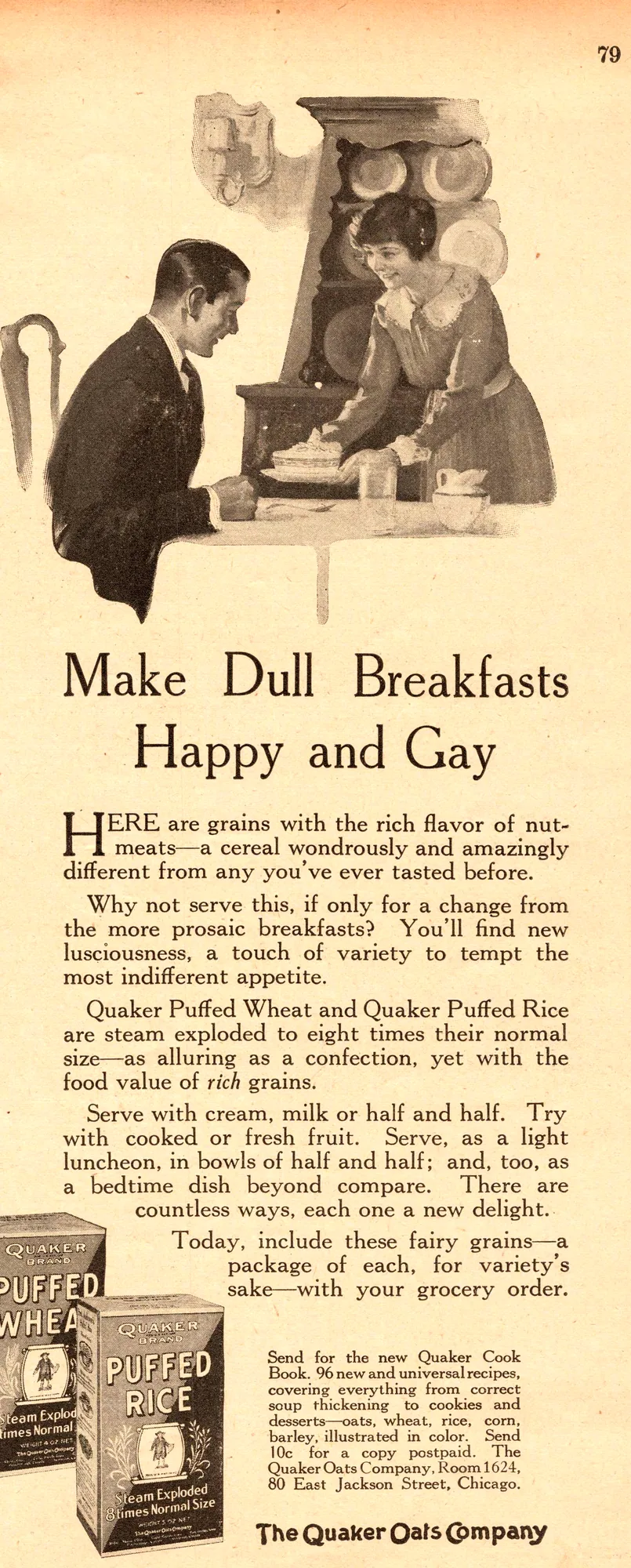
By 1925 the oat company that had once boasted of train loads was selling breakfast as fun, and its competitors were selling it as fuel.
From food to cure
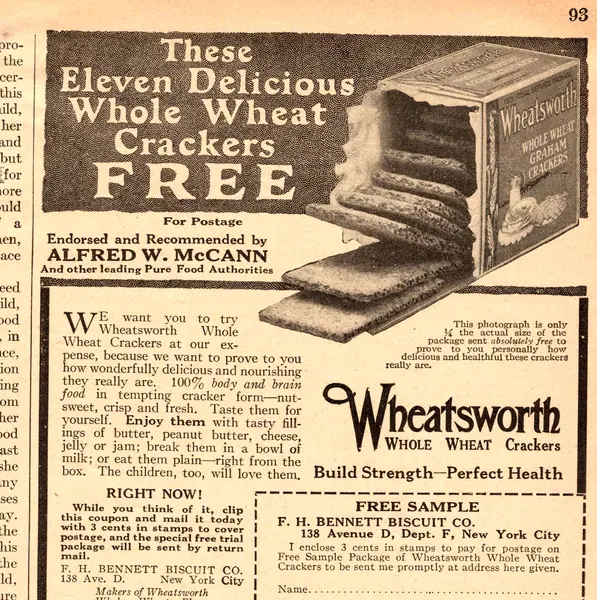
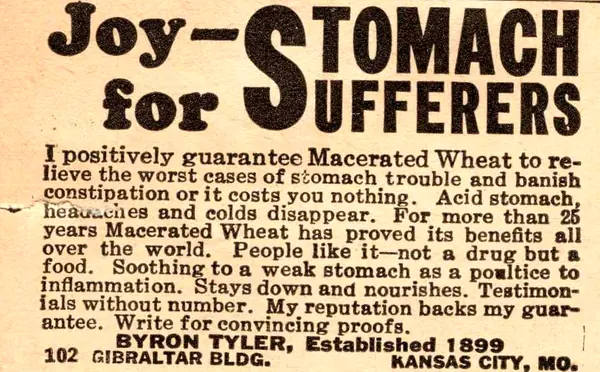
The same issue shows how far the idea could stretch. Wheatsworth whole wheat crackers came endorsed by Alfred W. McCann and “other leading Pure Food Authorities,” promising to “build strength—perfect health.” Byron Tyler of Kansas City guaranteed that his Macerated Wheat would relieve “the worst cases of stomach trouble and banish constipation,” and insisted it was “not a drug but a food.”
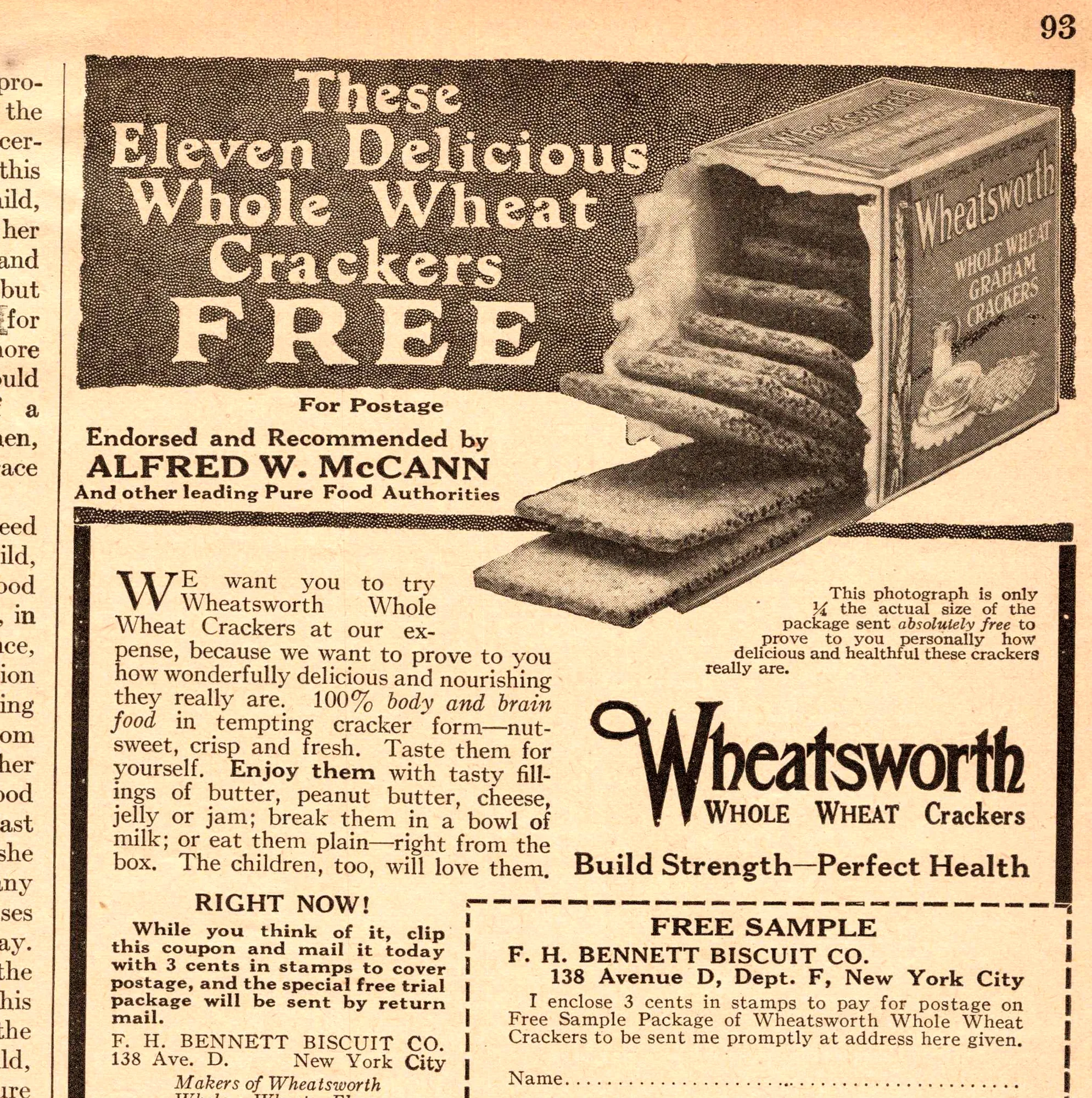
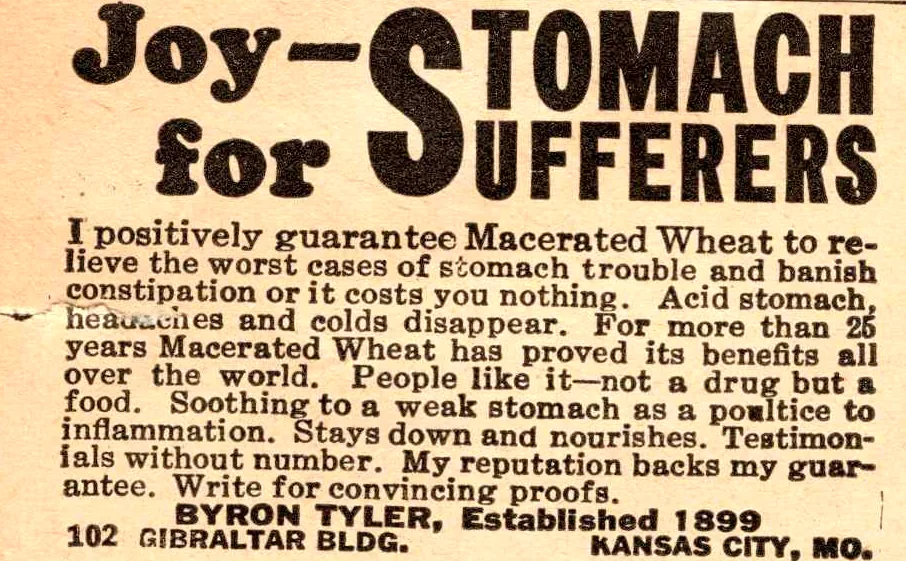
That phrase is the key to the change. In 1895 a cereal was a food that happened to be good for you. By 1925 it was something closer to a medicine that happened to come in a box, with the advertising to match: a problem, a story, a scientific-sounding explanation and a promise.
The bowl on the table looked much the same. What it was supposed to do for you had grown enormously.
Sources
- Quaker Oats Company, Encyclopedia.com.
- The Quaker Oats legacy: 150 years of innovation, nutrition and trust, PepsiCo.
- Mary Kate Robbett, “Alexander Anderson and the Cereal Shot from Guns”, Lemelson Center, Smithsonian Institution, 2017 (also the sanitarium origins of cold cereal and the 1893 Granola ad).
- All-Bran, Wikipedia; The Battle of the Cornflakes, History Today.
- Anderson, Alexander P. (1862–1943), MNopedia, Minnesota Historical Society.
- Munsey’s Magazine, Wikipedia; Munsey’s Magazine, The Encyclopedia of Science Fiction (circulation 500,000 in 1895).
- Bernarr Macfadden, Wikipedia.
- “Constipation and the germ theory: autointoxication”, in a historical review of bran and bowel health, BMJ, via PubMed Central.
- “Inner health, outer embarrassment”, University of Washington, on James C. Whorton’s Inner Hygiene: Constipation and the Pursuit of Health in Modern Society (Oxford, 2000).
- The advertisements quoted are in this archive: Quaker Oats, 1895, Wheatena, 1895, Kellogg’s All-Bran, 1925 and Quaker Puffed Wheat and Puffed Rice, 1925, among others.