Self-improvement · The 1920s
Yoga in a Bodybuilding Magazine, 1925
In June 1925, between the strongmen and the chest expanders of Physical Culture, a young Indian teacher named Swami Yogananda advertised his “Yogoda” system, with an endorsement from Luther Burbank.
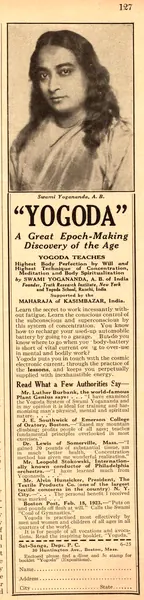
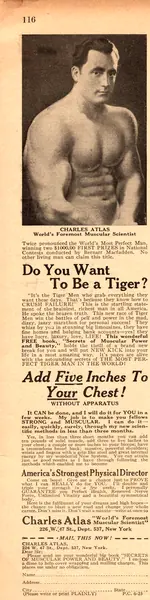
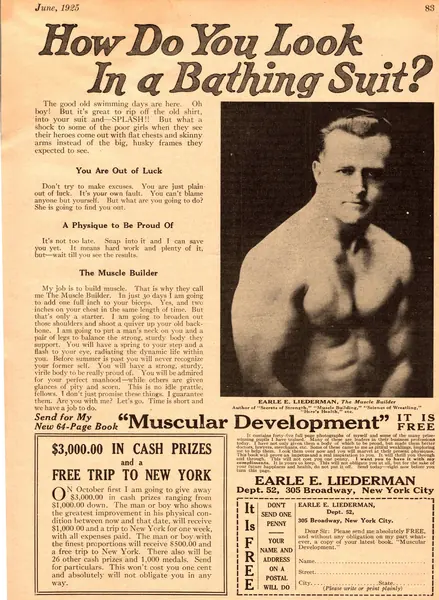
The back pages of the June 1925 issue of Physical Culture are full of men with their shirts off. Charles Atlas asks the reader if he wants to be a tiger. Earle Liederman wants to know how he looks in a bathing suit. Course after course promises a new body by mail, built with cables, bar-bells and willpower.
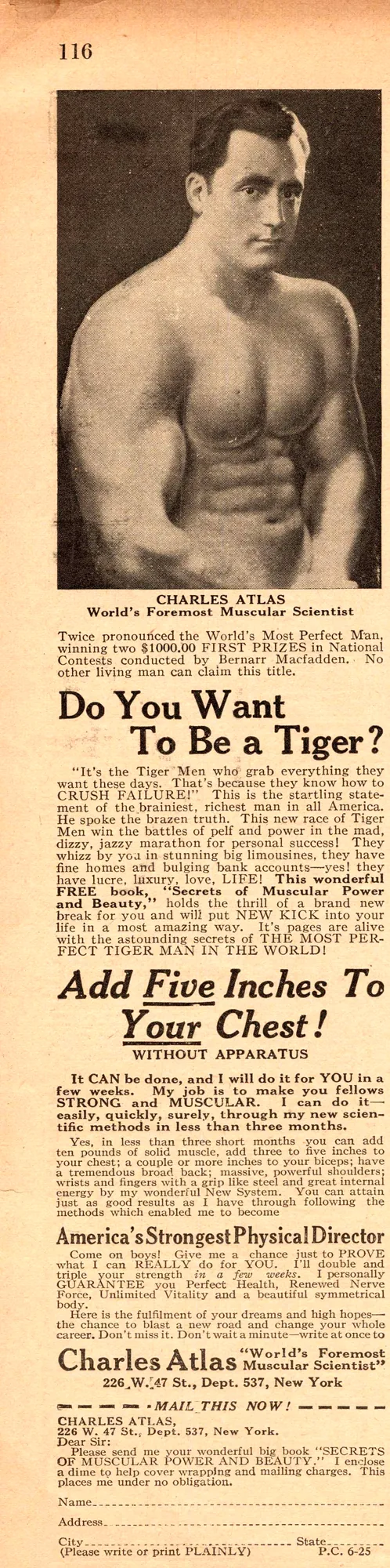
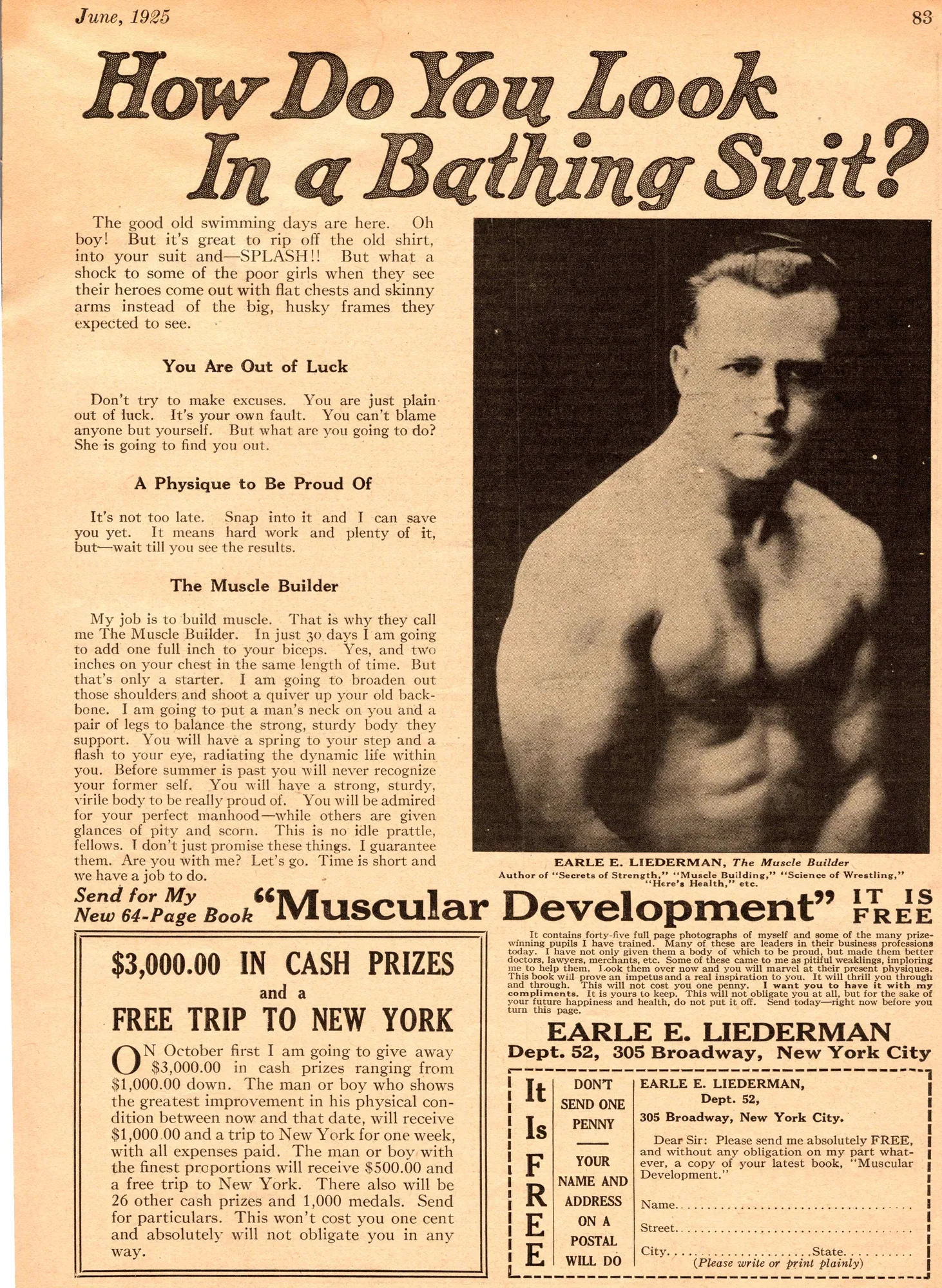
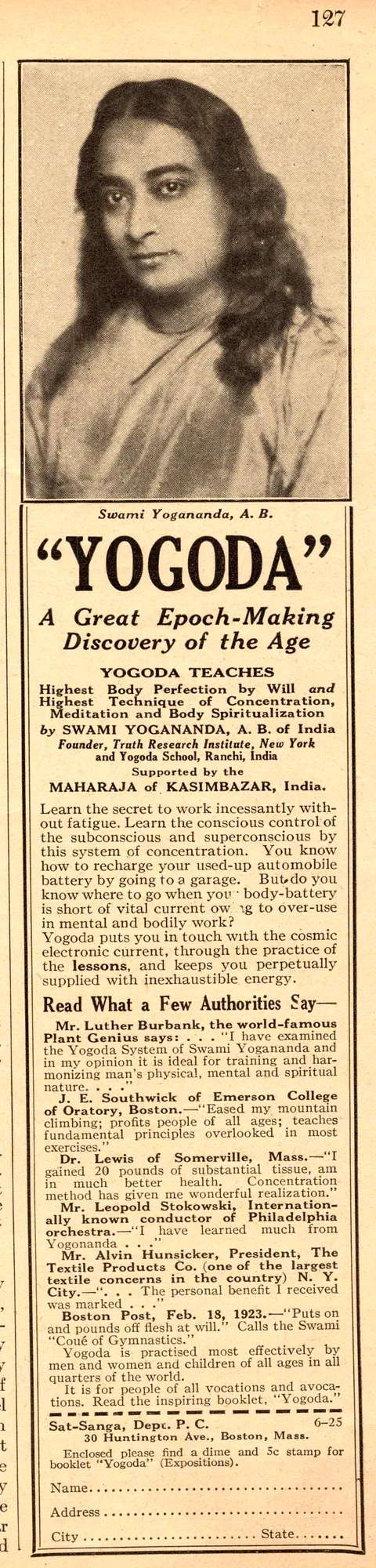
In the middle of them is a tall, narrow column topped by a photograph of a young man with long dark hair, looking straight out at the reader. Below the portrait, in heavy type, is a single word in quotation marks: “YOGODA.”7 Underneath, in italics: A Great Epoch-Making Discovery of the Age.
The advertiser was Swami Yogananda, A. B., “of India,” founder of the Yogoda School at Ranchi and the Truth Research Institute in New York, and “supported by the Maharaja of Kasimbazar.” He would later become famous as Paramahansa Yogananda, author of Autobiography of a Yogi. In 1925 he was a 32-year-old teacher building a following in America, and he had bought space in America’s most famous fitness magazine.
Who he was
The credentials in the ad were real. He was born Mukunda Lal Ghosh on January 5, 1893, in Gorakhpur, in northern India, into a well-off Bengali family. At seventeen he met the teacher Swami Sri Yukteswar Giri and spent much of the next ten years at his hermitage. He graduated from Calcutta University in 1915 (the “A. B.” after his name) and that year took vows as a monk of the Swami order, with the name Yogananda.12
In 1917 he started a “how-to-live” school for boys, combining ordinary lessons with exercise and meditation. The Maharaja of Kasimbazar lent his summer palace at Ranchi for it, which is why the ad names him as a supporter.2 The name Yogoda, which the ad treats almost as a trademark, came from this period. It was Yogananda’s name for his system of energizing exercises and the organization behind it in India.1
Why he came to America
In 1920 he was invited to serve as India’s delegate to the International Congress of Religious Liberals in Boston, held under the American Unitarian Association. He sailed on August 3 on the City of Sparta, the first passenger steamer from India to America after the First World War, and arrived on September 19.3 On October 6 he gave his first talk in America, “The Science of Religion,” to the congress.124 He then stayed and taught.
Speaking the magazine’s language
Physical Culture was Bernarr Macfadden’s magazine, founded in 1899 and devoted to exercise, diet and suspicion of conventional medicine.5 The same June 1925 issue carried the breakfast-food and hair-restorer ads discussed in Breakfast Gets Serious and Thirty Years of Baldness Cures. Yogananda’s ad was written for its readers. Yogoda, it said, taught “Highest Body Perfection by Will,” along with concentration, meditation and what it called body spiritualization. Then it reached for an image every 1925 reader would understand:
You know how to recharge your used-up automobile battery by going to a garage. But do you know where to go when your body-battery is short of vital current owing to over-use in mental and bodily work?
Yogoda advertisement, June 1925
The answer was the lessons, which put the student “in touch with the cosmic electronic current” and kept him “perpetually supplied with inexhaustible energy.” It is meditation described as a service station, and it fits the pages around it perfectly.
A list of authorities
The second half of the ad is a run of testimonials, and they are remarkable company. First is Luther Burbank, “the world-famous Plant Genius,” who had examined the Yogoda system and found it “ideal for training and harmonizing man’s physical, mental and spiritual nature.”
That endorsement is genuine. Yogananda reprinted the full statement more than twenty years later in Autobiography of a Yogi, signed by Burbank at Santa Rosa, California, and dated December 22, 1924. It opens with the same words the ad quotes.4

After Burbank in the ad comes J. E. Southwick of Emerson College of Oratory in Boston, who said it had eased mountain climbing and taught “fundamental principles overlooked in most exercises.” Then the conductor of the Philadelphia Orchestra:
Mr. Leopold Stokowski, Internationally known conductor of Philadelphia orchestra.—“I have learned much from Yogonanda . . .”
Yogoda advertisement, June 1925
The printer misspelled the swami’s name in the very line meant to endorse him. The list goes on: a Dr. Lewis of Somerville, Massachusetts, who had “gained 20 pounds of substantial tissue,” a New York textile executive, and the Boston Post, which in February 1923 had called the swami the “Coué of Gymnastics.” Émile Coué, the French pharmacist whose formula “Day by day, in every way, I am getting better and better” swept the country, had landed in New York for his first American tour on January 4, 1923, a few weeks before that article. The comparison was meant as praise.6
Stokowski’s and Southwick’s words, and the other testimonials, appear only in the ad; we have not found them in an independent source, so they should be read as the advertiser’s claims.
Caught between two cities
The ad’s small print says a good deal about where Yogananda was in 1925. After the 1920 congress he stayed in Boston for about three years, lecturing and teaching. The Dr. Lewis in the ad is probably Dr. M. W. Lewis, who met him in Boston in 1920 and with his wife helped him start his first meditation center there.2
In 1924 he set out on a speaking tour across the country. On November 22 of that year he met Luther Burbank in Santa Rosa, California, and the famous horticulturist became his student.1 Burbank signed his statement a month later, so when this ad ran it was barely six months old. On January 13, 1925, Yogananda lectured at the Philharmonic Auditorium in Los Angeles and began two months of classes there. By Easter he was holding services at the Mount Washington Estates, and that October he dedicated a new headquarters there, overlooking the city.1
Yet the coupon in June 1925 still points to Boston: Sat-Sanga, Dept. P. C., 30 Huntington Ave. A reader who enclosed a dime and a five-cent stamp would get the booklet Yogoda. The ad catches the movement in the middle of moving west. It also shows how he reached people who never heard him speak: by mail, like the correspondence schools in other magazines of the day (see A Better Life by Mail).
| Date | Event |
|---|---|
| January 5, 1893 | Born Mukunda Lal Ghosh in Gorakhpur |
| 1915 | Graduates from Calcutta University; takes monastic vows as Swami Yogananda |
| 1917–18 | Founds a boys’ school, soon moved to the Maharaja of Kasimbazar’s palace at Ranchi |
| September 19, 1920 | Arrives in the United States |
| October 6, 1920 | First talk in America, at the International Congress of Religious Liberals, Boston |
| February 1923 | The Boston Post calls him the “Coué of Gymnastics” (as quoted in the ad) |
| 1924 | Begins a cross-country lecture tour |
| November 22, 1924 | Meets Luther Burbank in Santa Rosa |
| December 22, 1924 | Burbank signs his statement on the Yogoda system |
| January 13, 1925 | Lectures at the Philharmonic Auditorium, Los Angeles |
| June 1925 | The Yogoda ad runs in Physical Culture, with a Boston coupon address |
| October 25, 1925 | Dedicates the Mount Washington headquarters in Los Angeles |
| April 11, 1926 | Burbank dies |
| 1946 | Autobiography of a Yogi published, dedicated to Burbank |
What came after
The organization Yogananda founded is known today as Self-Realization Fellowship, and its headquarters is still on Mount Washington. Burbank died in 1926. Twenty years later, Yogananda dedicated Autobiography of a Yogi to his memory, calling him “An American Saint.”4
The 1925 ad is a much more ordinary document than either of those. It is a small piece of paid space in a crowded magazine, written in the language of energy, will and self-improvement that sold everything else on the page. That is what makes it interesting. In 1925, one of the first Indian teachers of yoga to settle in America introduced himself to many readers not as a mystic but as one more answer to the question every ad around him was asking: how do you become a stronger, better version of yourself?
Sources
- The Life of Paramahansa Yogananda: Chronology of Events, Self-Realization Fellowship.
- A Beloved World Teacher, Self-Realization Fellowship.
- Centennial of Paramahansa Yogananda’s Arrival in America, The Pioneer.
- Paramhansa Yogananda, Autobiography of a Yogi (1946), dedication and chapters 37–38, Project Gutenberg. Burbank’s statement of December 22, 1924, appears at the end of chapter 38.
- Bernarr Macfadden, Wikipedia.
- “Coué, Emile (1857–1926)”, Encyclopedia of Occultism and Parapsychology, via Encyclopedia.com; “Aimée and Coué Improve Your Life”, American Heritage.
- The advertisement is in this archive: Swami Yogananda, “Yogoda,” Physical Culture, June 1925.