Self-improvement · The 1920s
A Better Life by Mail: How Americans Learned at Home in 1925
Hotel manager, lawyer, cartoonist, piano tuner, railway traffic inspector: the back pages of one 1925 magazine offered a new career to anyone who would clip a coupon. Millions did.
People have always promised themselves they will become someone better. In 1925 there was an industry ready to sell them the plan.
Turn to the back of the June 1925 issue of Physical Culture and the advertisements read like a list of New Year’s resolutions, six months late. Be a hotel manager. Study law. Learn advertising, cartooning, commercial art, photography, piano tuning. Get a government job. Fix your English. Improve your handwriting. Every one of them could be done at home, in your spare time, by mail, and almost every one ended in a coupon.
The school that started it
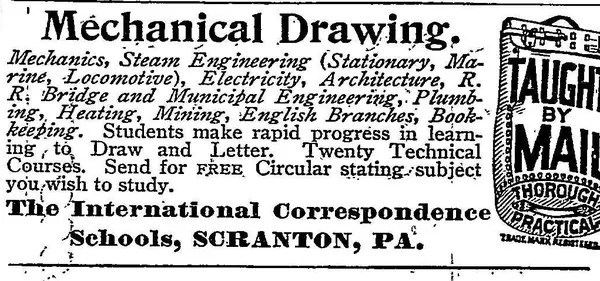
The oldest of these advertisers was already a veteran. In April 1895 the International Correspondence Schools of Scranton, Pennsylvania, ran a small ad in Munsey’s Magazine offering twenty technical courses, from mechanical drawing and steam engineering to plumbing, mining and bookkeeping.7 “Students make rapid progress in learning to Draw and Letter,” it promised.
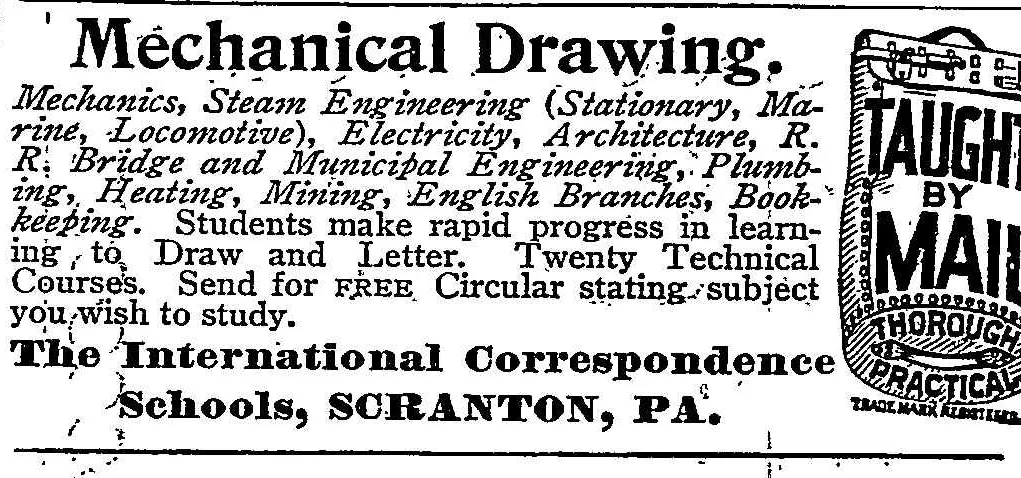
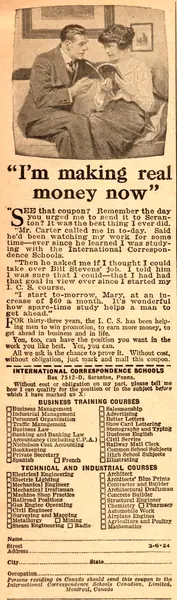
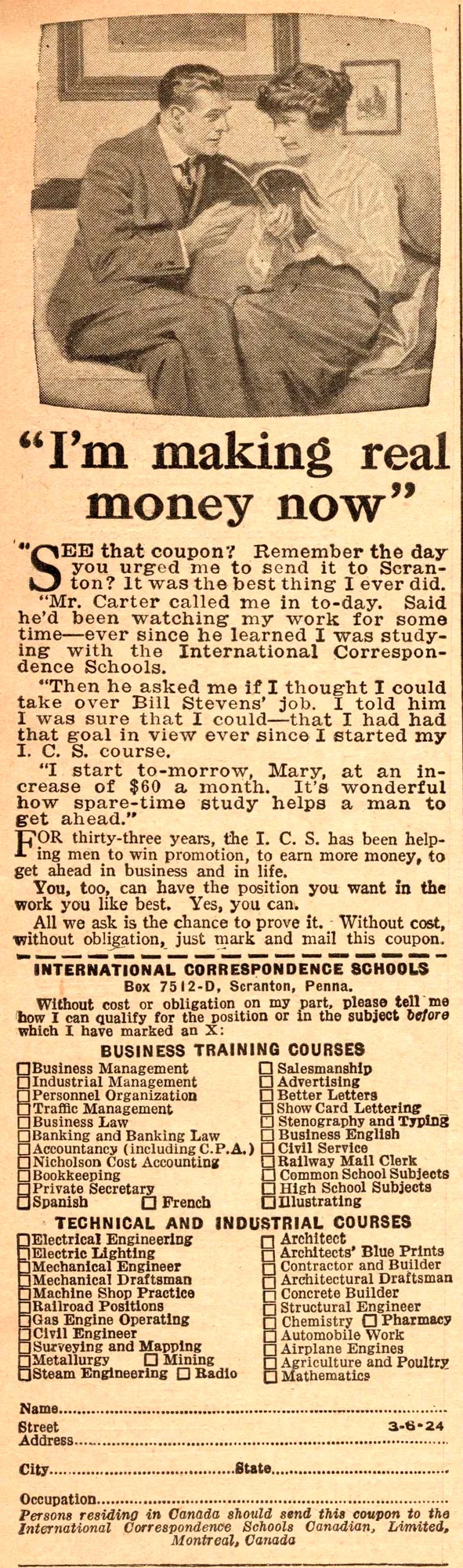
The school had grown out of a magazine column. Pennsylvania’s Mine Safety Act of 1885 required miners and inspectors to pass examinations, and in 1891 Thomas J. Foster, publisher of the mining journal Colliery Engineer, started a question-and-answer column to help readers prepare. The column grew into the schools.1 By 1925 the ICS ad in Physical Culture could say it had been helping men win promotion “for thirty-three years,” and it told its story through a grateful student:
“SEE that coupon? Remember the day you urged me to send it to Scranton? It was the best thing I ever did.”
International Correspondence Schools, June 1925
What came in the mail
A student who enrolled did not get an ordinary textbook. ICS wrote its own “instruction papers,” short printed lessons in plain language for people who had left school early, each followed by a set of questions. The student mailed back the answers, or a drawing, and the school graded them and sent the next lesson.24

The scale was industrial. In the year ending May 31, 1906, the dean of the ICS faculty reported that its instructors had corrected 517,849 instruction papers and 192,739 drawings, and listened to 6,364 phonograph records sent in by language students. A historian of the school describes rows of women at desks, five abreast, checking the work in assembly-line fashion before the principals of each school reviewed it.2
What it cost
None of the 1925 ads in this issue names the price of a course. Every one of them offers something free first: a book, a booklet, sample examination questions. The price came after the reader wrote in.
The prices were not small. An ICS booklet from 1908 shows that the Complete Architecture course cost $110 if paid in advance in 1906. Most students paid by the month instead, and the installment price was higher: $122 at $10 a month, $130 at $5, and $135 at $3.5 For a wage earner that was a large sum, more than a top-of-the-line bicycle had cost a decade earlier (see What a Bicycle Cost in 1895), which is why the monthly plan mattered so much.
A career for every coupon
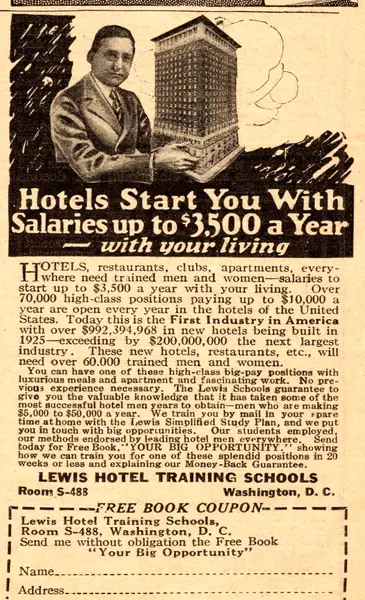
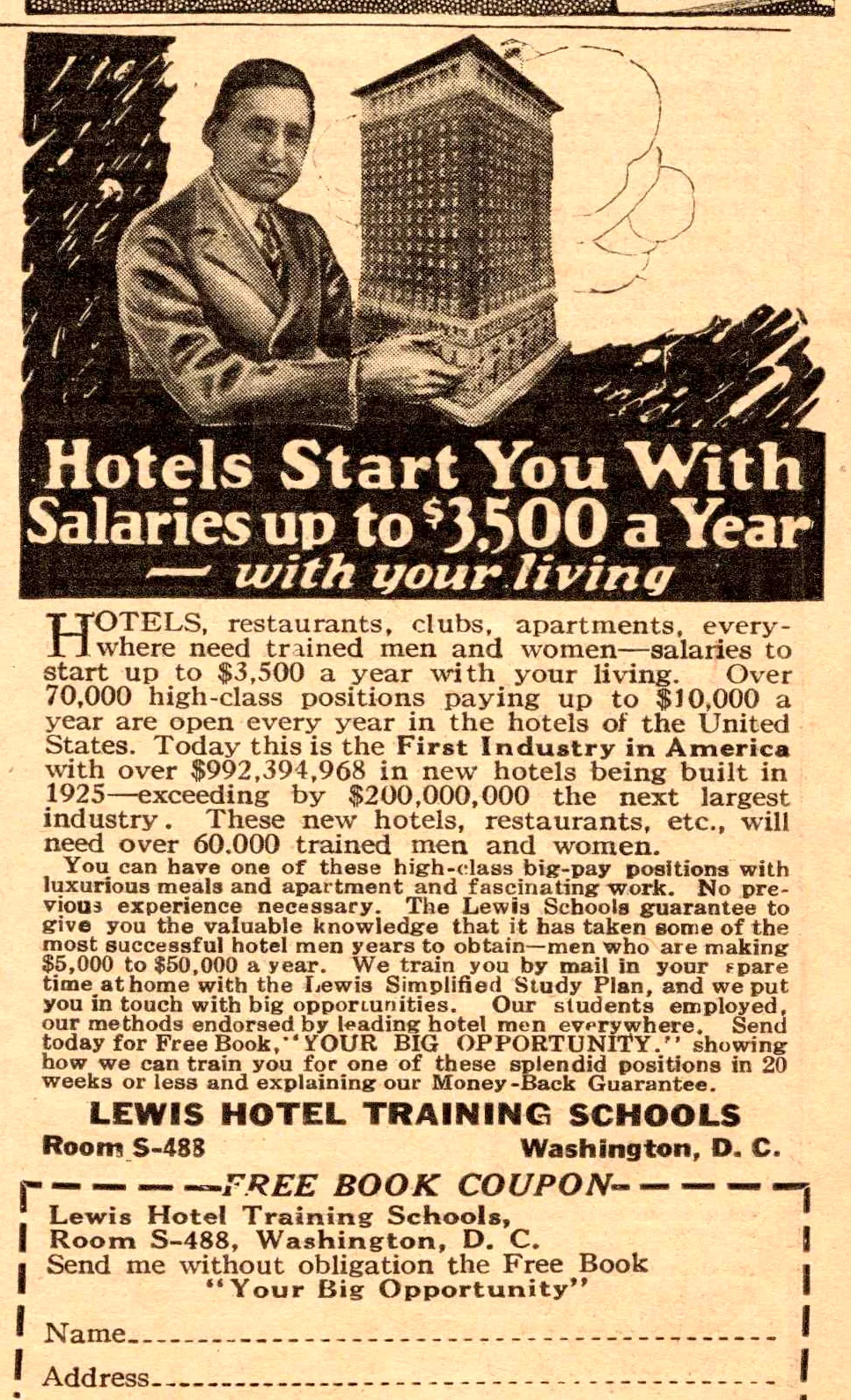
By 1925 ICS had plenty of company, and the promises had grown. The Lewis Hotel Training Schools of Washington, D.C., ran two ads in the issue, one announcing 1000 Hotel Positions Open! and the other promising salaries up to $3,500 a year “with your living.” Hotels, it said, were America’s fourth largest industry.
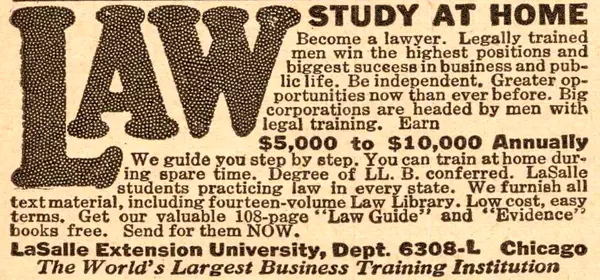
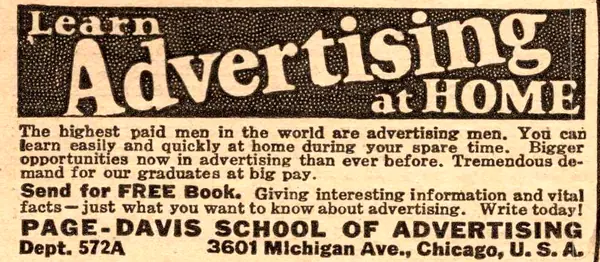
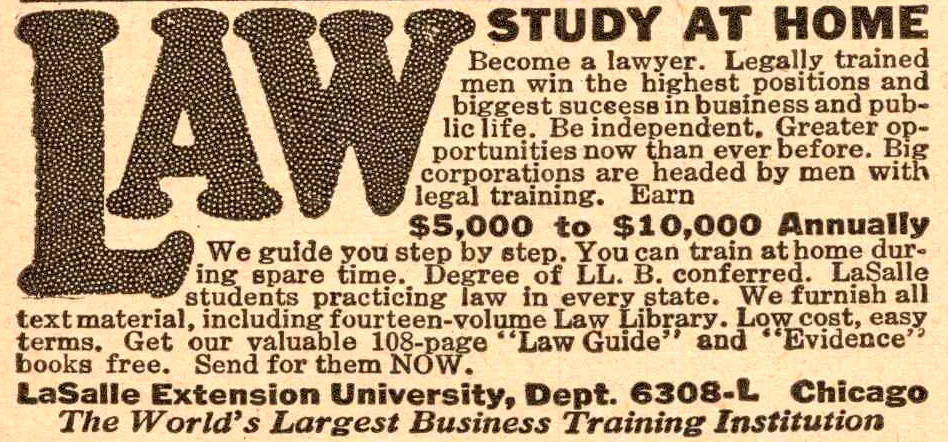
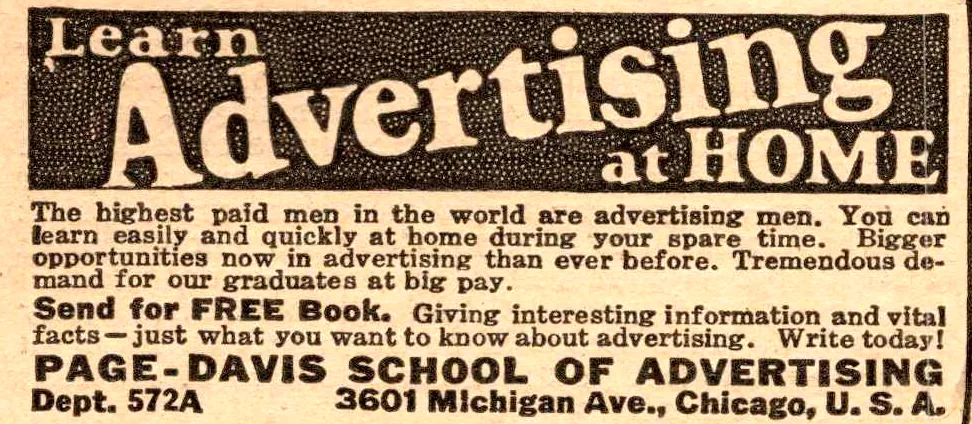
LaSalle Extension University of Chicago headlined Law Study at Home: “Big corporations are headed by men with legal training. Earn $5,000 to $10,000 Annually.” The Page-Davis School of Advertising was blunter still: “The highest paid men in the world are advertising men.”
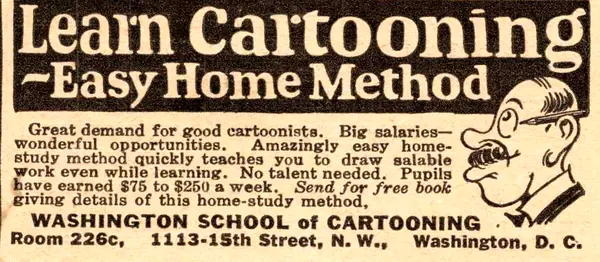
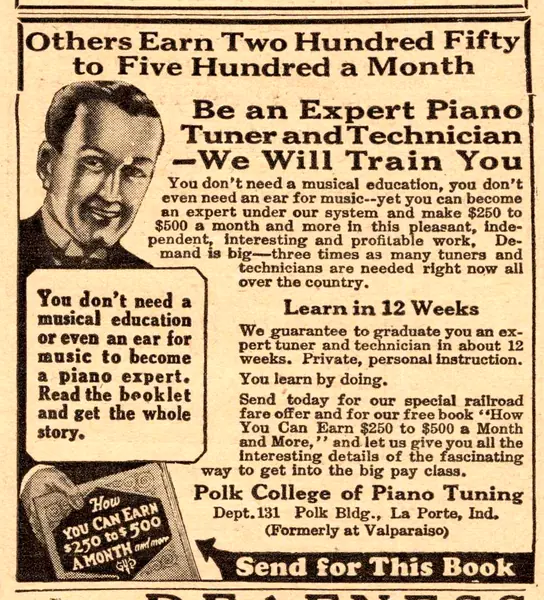
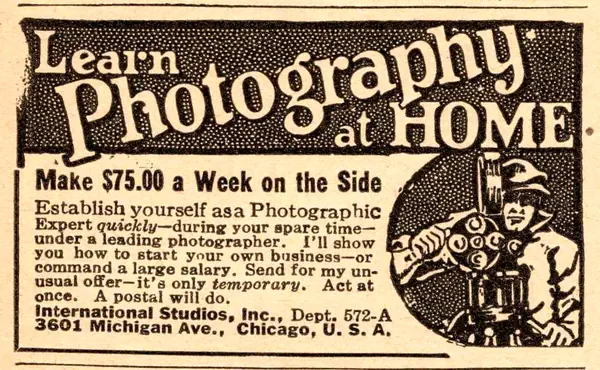
The artistic courses promised just as much and asked even less. The Washington School of Cartooning taught an “amazingly easy home-study method” with “no talent needed,” and said its pupils had earned $75 to $250 a week. The Polk College of Piano Tuning in La Porte, Indiana, went further: “You don’t need a musical education, you don’t even need an ear for music.” International Studios offered to teach photography at home so the reader could “make $75.00 a week on the side.”
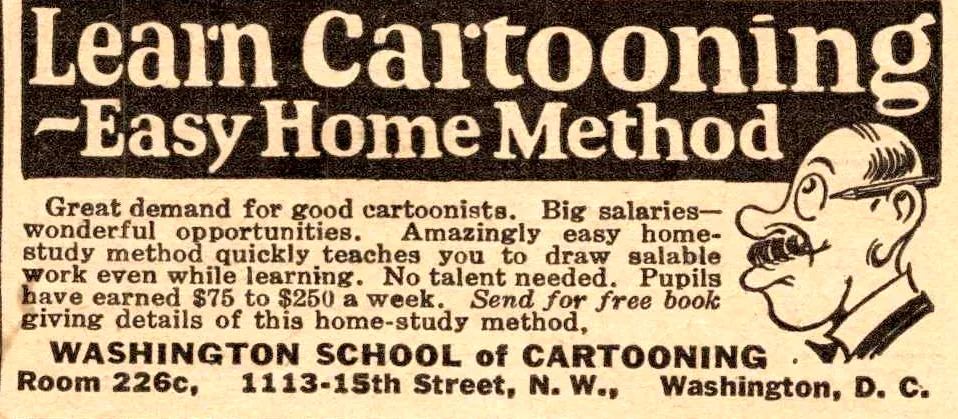
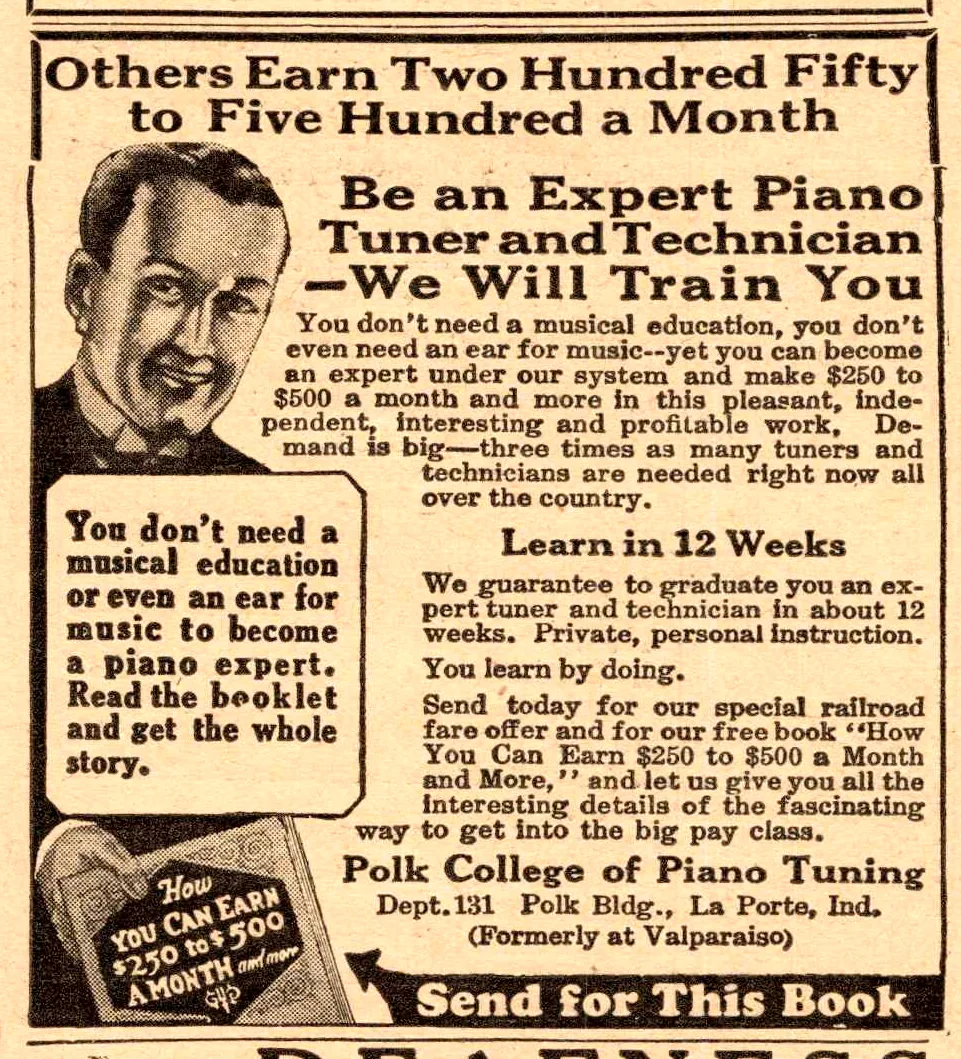
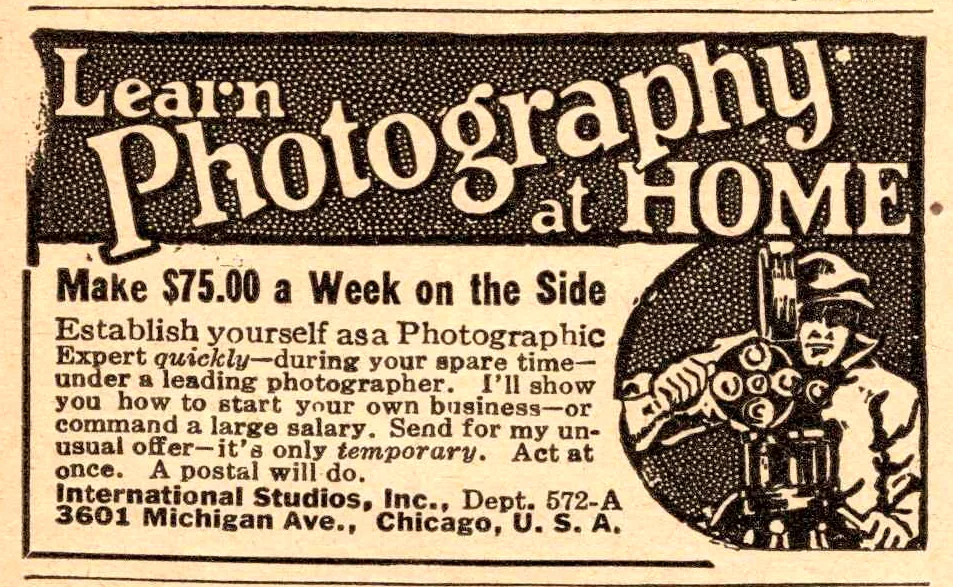
One small detail is worth noticing. International Studios and the Page-Davis School of Advertising gave the same Chicago street address, 3601 Michigan Avenue, and the same department number, 572-A. That does not by itself prove the two schools had the same owner. They may have shared a building, an office or a mail-handling service. We have not found a record that settles it, so it stays an open question.
Steady work
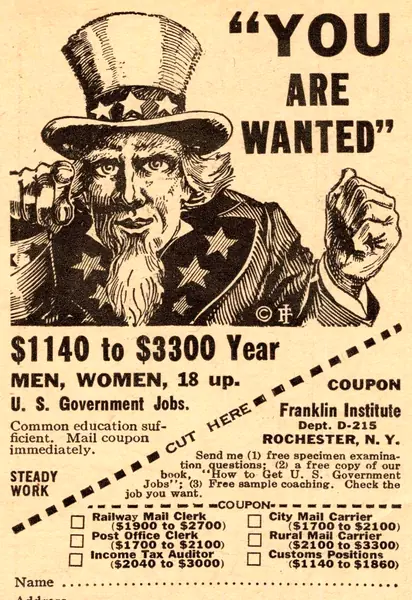
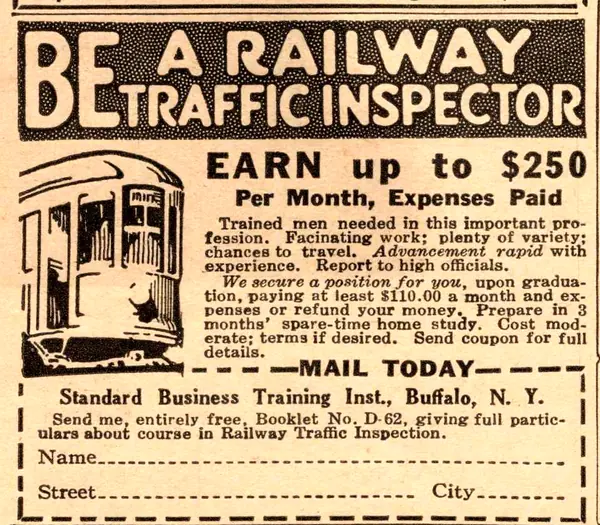
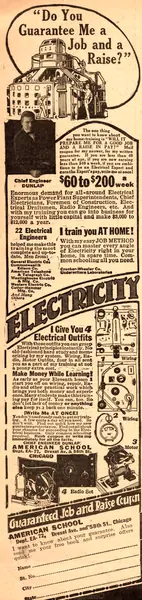
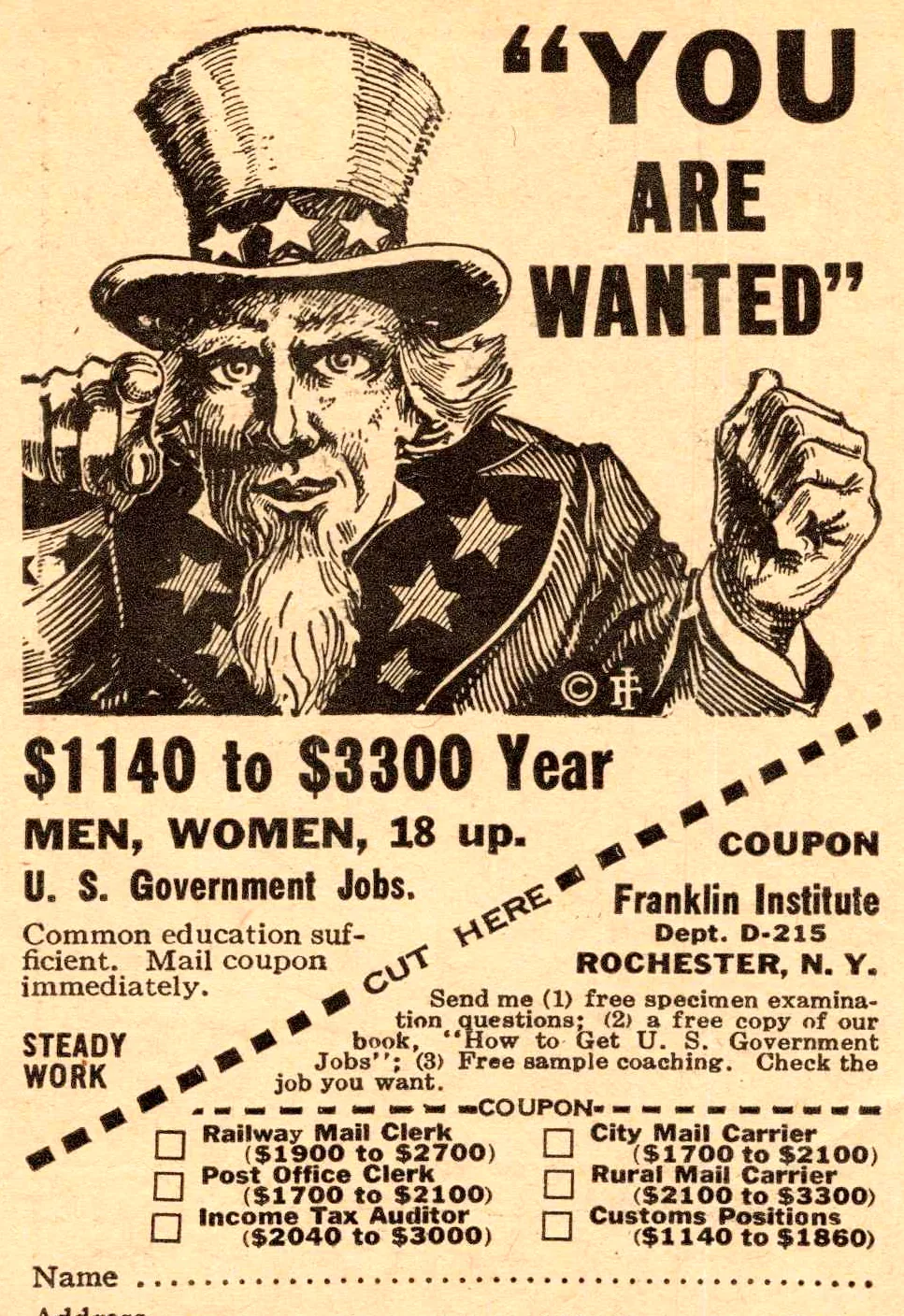
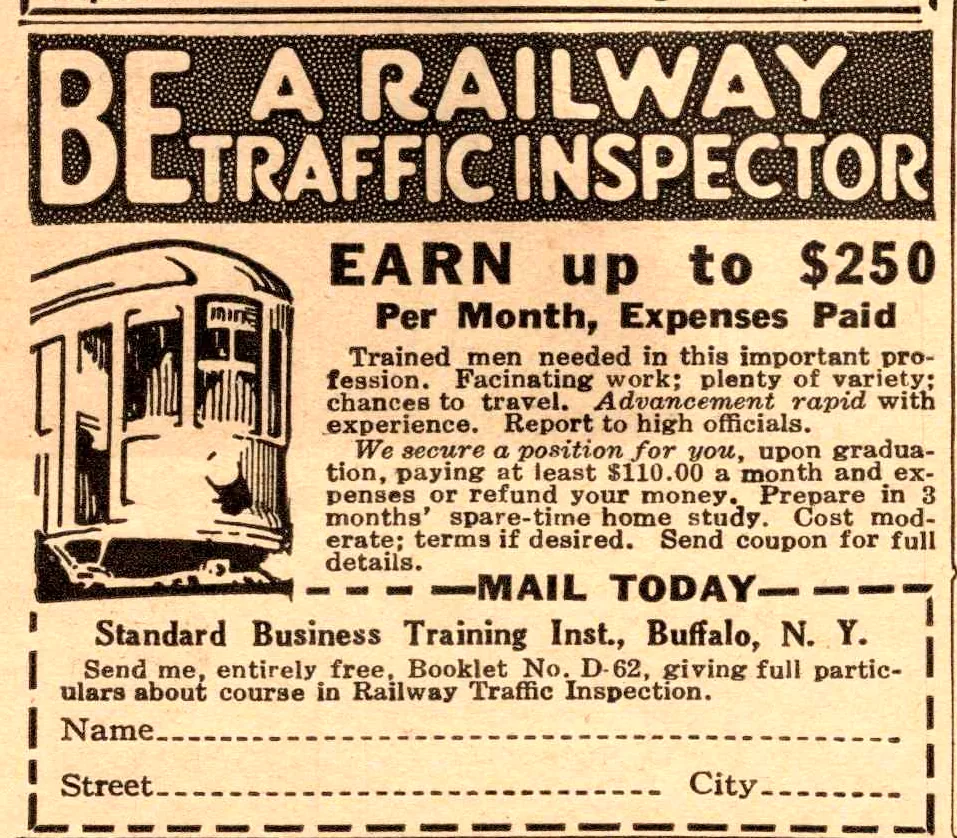
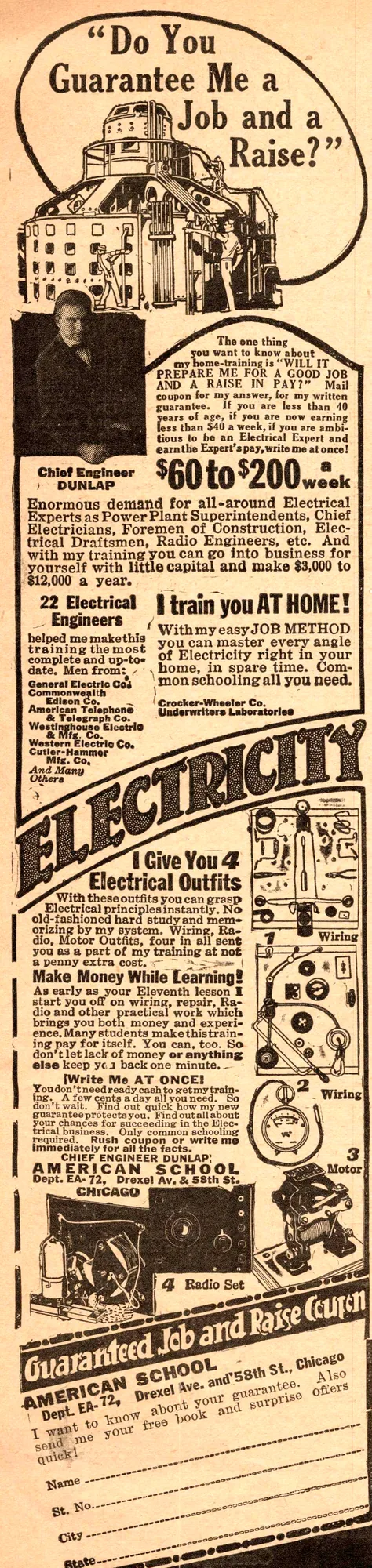
Not every ad sold glamour. The Franklin Institute of Rochester, New York, promised help getting United States government jobs paying $1,140 to $3,300 a year, such as railway mail clerk, open to “men, women, 18 up,” with “common education sufficient.” The Standard Business Training Institute would train a railway traffic inspector and, it said, find him a position paying at least $110 a month and expenses. The American School of Chicago headlined the question every reader wanted answered, “Do You Guarantee Me a Job and a Raise?”, and for students of its electrical course it answered yes, with a coupon to prove it.
Others sold self-improvement for its own sake, a tradition that went back decades; around 1900 one could even buy a course in hypnotism by mail (see The Hypnoscope). Sherwin Cody asked readers if they made these mistakes in English. F. W. Tamblyn of Kansas City wrote simply: I Teach by Mail, and promised to make a good penman of anyone “no matter where you live or how poorly you now write.”
How many enrolled, and how many finished
The numbers were enormous. One contemporary estimate, by John Noffsinger in 1926, put enrollment in correspondence schools at between 1.75 and 2 million students, at a time when the country’s colleges and universities had about 941,000.2
Most of them did not finish. A 1906 count of ICS’s 455,220 “active” students found that only 75,774, about one in six, had completed even a third of the course they had bought.2 Sinclair Lewis mocked the business’s sales methods in Babbitt in 1922.
What the diploma meant
The certificates and diplomas these schools issued were their own. In 1925 no outside body checked or accredited correspondence schools. A study funded by the Carnegie Corporation found that the field lacked standards, and in October 1926 a group of schools founded the National Home Study Council to set rules of fair practice for the industry. The council did not begin formal accreditation until 1955, and the U.S. Office of Education first recognized it as an accreditor in 1959.36 For a student in 1925, a certificate was worth what an employer thought it was worth, and the ads’ promises of jobs and raises were the schools’ own claims.
Clip the coupon
Read today, these ads are easy to laugh at, with their effortless talents and guaranteed raises. But they also describe a real hunger. For a miner in Scranton, a clerk in Peoria or a young woman on a farm in 1925, a school by mail might be the only school available, and the coupon in the corner of the page was a small, cheap act of hope.
That is still how resolutions work. You cut out the coupon, put a stamp on the envelope and decide that this is the year.
Sources
- International Textbook Company, Wikipedia.
- Jane Shaw Stroup, “American Correspondence Schools in Context”, The Independent Review, June 2022, via vLex (citing Noffsinger, Correspondence Schools, Lyceums, Chautauquas, 1926; John J. Clark in Science, 1906; and James Watkinson, Pennsylvania Magazine of History and Biography, 1996).
- Robert L. Hampel, The National Home Study Council, 1926–1942, American Journal of Distance Education.
- International Correspondence Schools, Instruction Paper, c1898, Library of Congress; ICS Learn, Wikipedia (on ICS’s “Instruction and Question Papers”).
- International Correspondence Schools, IAGenWeb, Delaware County, Iowa, transcribing ICS, Education by Mail (1908).
- DEAC History and Centennial, Distance Education Accrediting Commission (formerly the National Home Study Council); Distance Education Accrediting Commission, Wikipedia (the Carnegie study).
- The advertisements discussed are in this archive, from Munsey’s Magazine, April 1895, and Physical Culture, June 1925.