Patent medicine · The 1890s
Mrs. Winslow’s Soothing Syrup
How a best-selling teething remedy sold comfort to worried parents while giving their babies a powerful opioid.
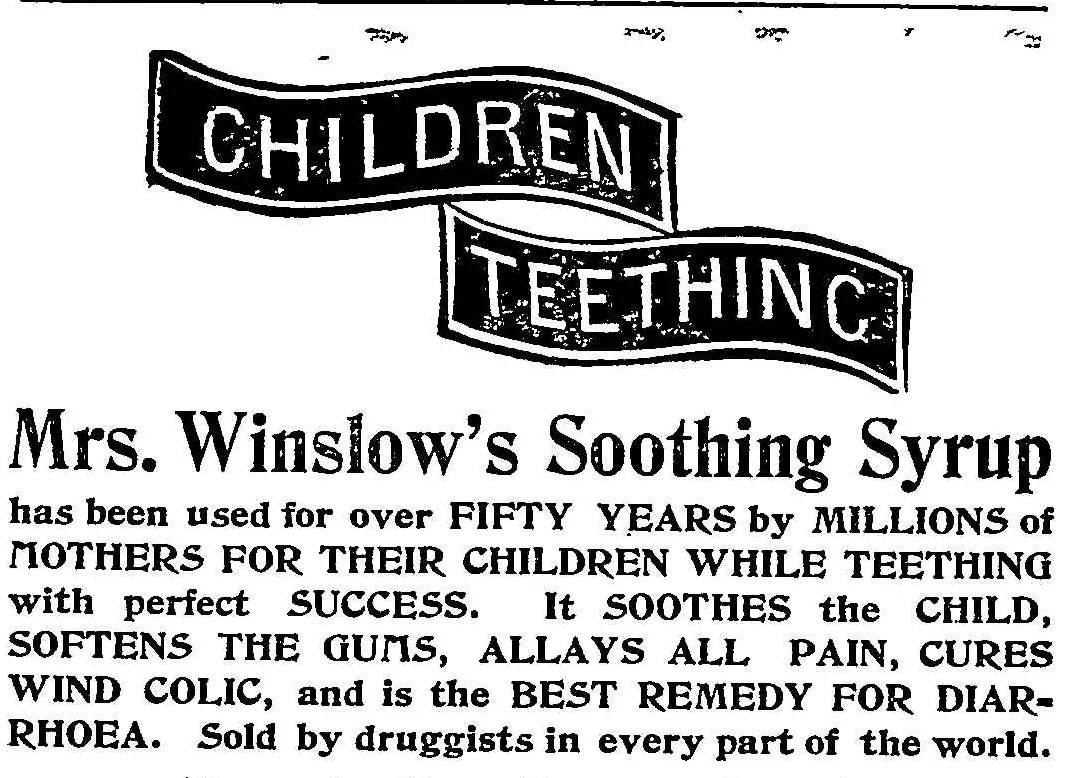
In April 1895, a small advertisement in Munsey’s Magazine offered tired parents relief in a bottle. Two curling black banners read Children Teething, and beneath them the copy made its case in capital letters: the syrup had been used “for over FIFTY YEARS by MILLIONS of MOTHERS,” with “perfect SUCCESS.”
It SOOTHES the CHILD, SOFTENS THE GUMS, ALLAYS ALL PAIN, CURES WIND COLIC, and is the BEST REMEDY FOR DIARRHŒA.
Mrs. Winslow’s Soothing Syrup, April 1895
It cost twenty-five cents a bottle and was sold by druggists “in every part of the world.” The name sounded reassuring, and the ad needed no picture to sell it. There was one terrible problem. Mrs. Winslow’s Soothing Syrup contained morphine.27
A drug that could relieve pain and quiet a child could also stop its breathing. The story of this one product, and of the warnings it drew, shows how far advertising could stray from medical evidence, and how long it took the law to close the gap.
A remedy for worried parents
The syrup is usually traced to Charlotte N. Winslow, described in later accounts as a nurse who cared for infants. Her son-in-law, Jeremiah Curtis, and his partner, Benjamin A. Perkins, began making it in Bangor, Maine, in the late 1840s; sources give either 1845 or 1849.37 The firm later moved to New York, and her name became one of the best-known brands in American patent medicine. The 1895 ad’s claim of “over fifty years” fits the earlier date.
Teething was an ideal subject for such a product. Parents could see the discomfort, hear the crying and lose sleep themselves. Nineteenth-century families and doctors also blamed teething for illnesses we now know have other causes, including fever, diarrhea and convulsions. A cheap bottled remedy offered a measure of control over something frightening.
The name did much of the selling. “Mrs. Winslow” suggested experience and a mother’s judgment, not chemistry. Families had no way to know what was in the bottle; they knew the familiar label, the endless advertising and the promise of an easier night.3
The company’s trade cards made the pitch with pictures. On one from about 1885, a mother sits up in a big bed with two children, one asleep against her, and reads a newspaper advertisement for the syrup itself. A bottle waits on the bedside table. Nothing on the card says what the syrup is; it shows only what it promised, a calm child and a mother at rest.

What was in the bottle
Historical accounts usually give the original formula as about 65 milligrams of morphine per fluid ounce, with alcohol.7 The formula changed over the years, but that figure makes plain why it was so dangerous for infants. An Australian advertisement from 1915 gave the directions for use: a few drops for a newborn, and for babies “six months old and upwards, a teaspoonful three or four times daily.”4
Some of the symptoms the ad listed really would change after a dose. Morphine dulls pain, causes drowsiness and slows the gut. A baby could fall quiet or sleep, or seem to recover from diarrhea, without any underlying illness being treated. Where diarrhea was concerned, the apparent improvement could hide dehydration or infection. Parents judged a medicine by what they could see, and a quiet baby looked like a healthy one.
The product sold enormously. In an 1868 court case, Curtis reported annual sales of more than 1.5 million bottles.3 This was not an obscure nostrum on a back shelf. It was a household brand, advertised in newspapers, magazines and colorful trade cards across North America, Britain and Australia; Queensland papers alone carried its ads from the mid-1860s into the 1920s.4
Doctors raised the alarm
The danger was known while the syrup was still selling. In 1870 a doctor named W. F. M’Nutt described a six-month-old who had been given two teaspoonfuls over about ten hours and showed signs of poisoning; analysis of the syrup found morphine.5 In 1884 a Philadelphia physician, A. B. Hirsh, reported another poisoning and argued that secret remedies were a public danger that called for government oversight.6
How many children died is not known. Death registration was patchy, diagnoses were uncertain, and the dramatic figures that circulate online cannot be verified. The lack of a reliable count does not make the syrup any safer. It means the honest history rests on documented poisonings and on what morphine does to a baby.
An industry of secret remedies
Mrs. Winslow’s was one of thousands of proprietary medicines sold in nineteenth-century America. Despite the name, most “patent medicines” were not patented, since a patent would have meant publishing the recipe. They were protected by trademarks, labels and advertising instead.38 Some were harmless and merely overpromised. Others were heavy with alcohol, opium, morphine or cocaine.
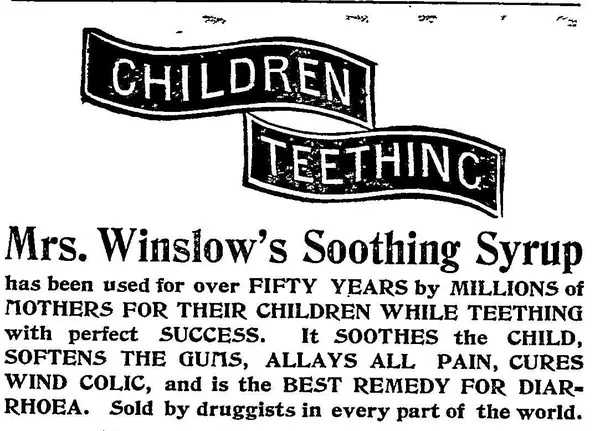
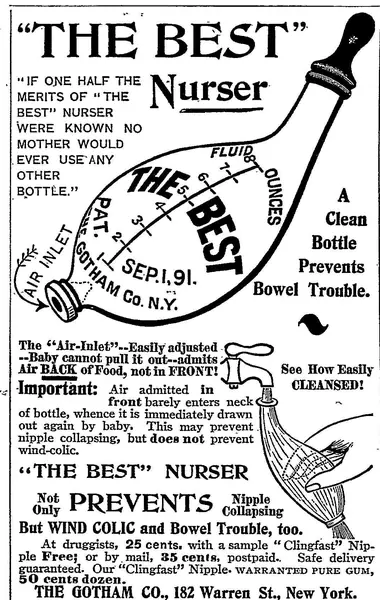
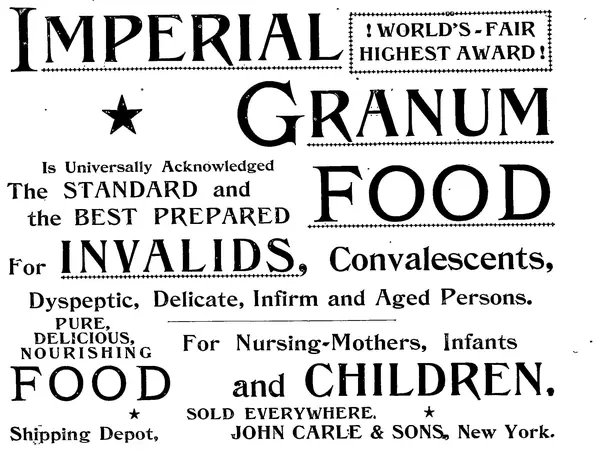
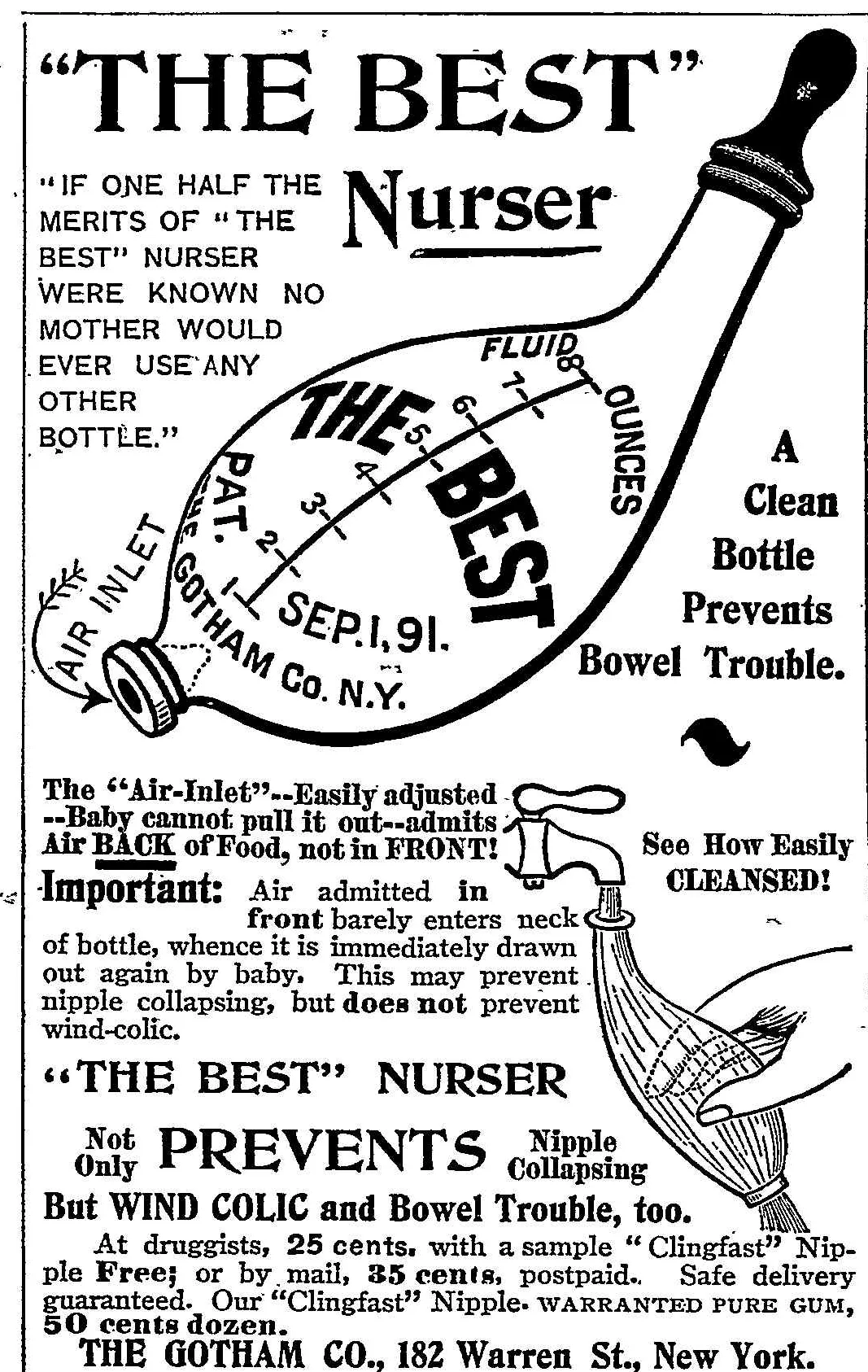
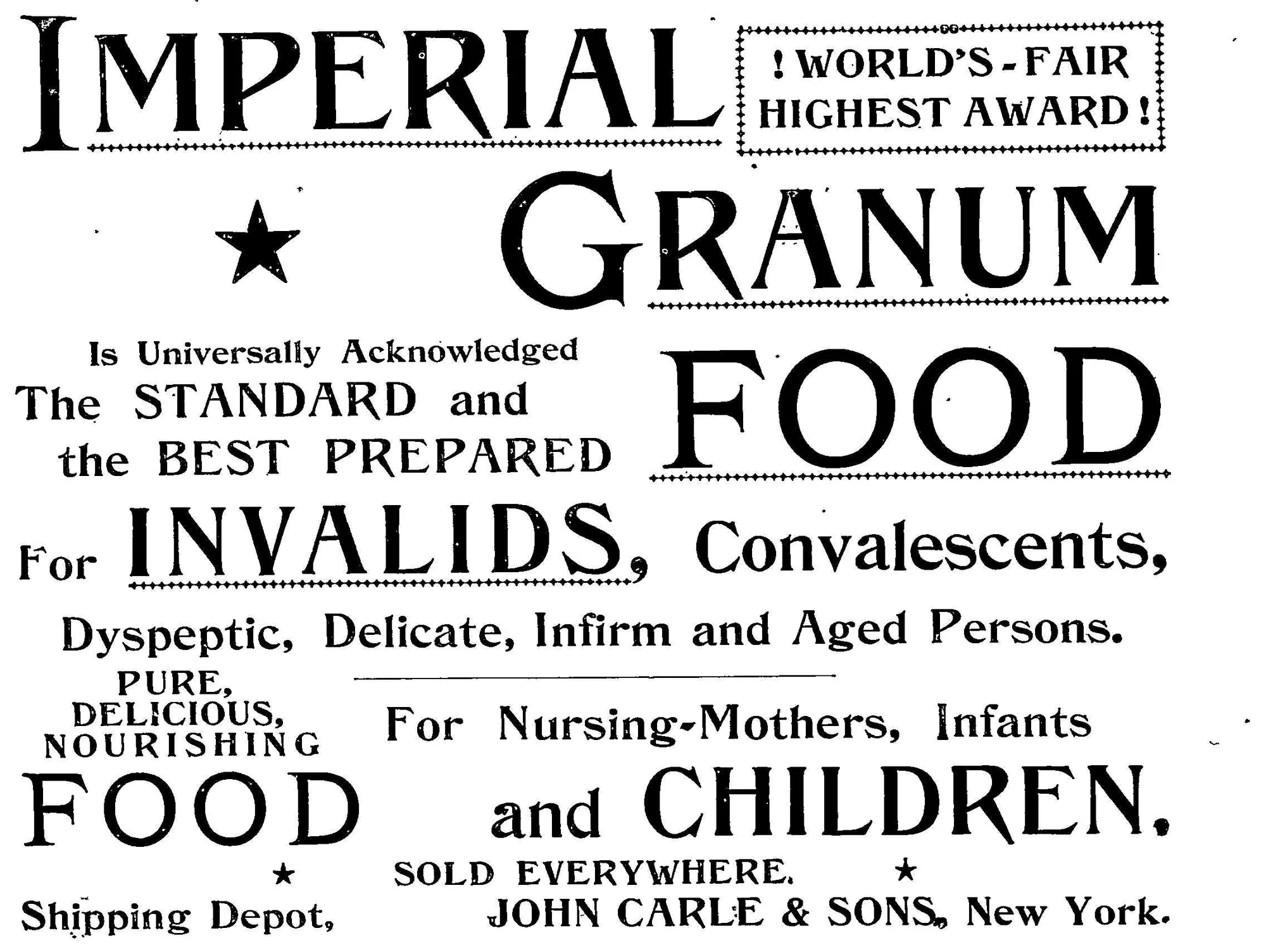
It is tempting to mock the people who bought them, but the context matters. There were no antibiotics, germ theory was new, and doctors themselves sometimes gave useless or harmful treatments. A remedy endorsed in print, issue after issue, could seem perfectly reasonable. Magazines earned money from the advertising, and the nursery was a reliable market. In the same 1895 issue, parents could also buy a feeding bottle that promised to prevent “wind colic and bowel trouble” and a prepared food for “nursing-mothers, infants and children.” Other stories in this Journal follow the same pattern with adults: the hypnoscope and thirty years of baldness cures.
The law catches up
Chemists, doctors, journalists and reformers kept up the pressure, testing remedies and publishing poisonings. Their work helped pass the Pure Food and Drugs Act of 1906, which required labels to declare certain dangerous ingredients, morphine and opium among them. It did not require medicines to be proved safe or effective, and it did not stop a maker from selling a drug that was labeled honestly.9
In 1911 the American Medical Association’s book Nostrums and Quackery named Mrs. Winslow’s in a section headed “Baby Killers.”4 Between the new law and attacks like this one, the makers eventually took out the morphine and dropped “Soothing” from the name.7 Even so, health officials were still finding the original version in shops in 1912,1 and the syrup stayed on sale in some form as late as 1930.3 A 1912 amendment, the Sherley Amendment, targeted false claims of cures, though fraud was hard to prove. The Food, Drug, and Cosmetic Act of 1938 finally required new drugs to be shown safe before they were sold.10
| Year | Event |
|---|---|
| 1845 or 1849 | Curtis & Perkins of Bangor, Maine, begin selling the syrup |
| 1868 | In a court case, Curtis reports sales of more than 1.5 million bottles a year |
| 1870 | Dr. W. F. M’Nutt reports an infant poisoned by the syrup; analysis finds morphine |
| 1884 | Dr. A. B. Hirsh reports another poisoning and calls for government oversight |
| ca. 1885 | Trade card shows a mother reading the syrup’s ad (above) |
| April 1895 | The ad in Munsey’s: “for over fifty years by millions of mothers” |
| 1906 | Pure Food and Drugs Act requires morphine and opium to be declared on labels |
| After 1906 | Morphine eventually removed and “Soothing” dropped from the name (exact year unclear) |
| 1911 | The AMA’s Nostrums and Quackery lists it among “Baby Killers” |
| 1912 | Original version still found on store shelves; Sherley Amendment targets false cure claims |
| 1915 | Australian ads still give doses for newborns |
| as late as 1930 | Still on sale in some form |
| 1938 | Food, Drug, and Cosmetic Act requires proof of safety for new drugs |
Read today, the 1895 ad gives nothing away. It promises a soothed child, softened gums and a quiet night, and it names no ingredient at all. The parents who bought it were not foolish; they were worried, in a world with few good remedies and fewer safeguards. The tragedy is that their worry made one of the most successful products of the century, long after its dangers were on record.
Sources
- Smithsonian, National Museum of American History: Rule advertising Mrs. Winslow’s Soothing Syrup
- DEA Museum: Mrs. Winslow’s Soothing Syrup
- Wood Library-Museum of Anesthesiology: Mrs. Winslow’s Soothing Syrup
- State Library of Queensland: The Baby Killer: Mrs. Winslow’s Soothing Syrup
- W. F. M’Nutt, “Mrs. Winslow’s Soothing Syrup—a Poison” (1870)
- A. B. Hirsh, “Notes on a Case of Poisoning” (1884)
- Museum of Health Care at Kingston: Mrs. Winslow’s Soothing Syrup: The Baby Killer
- Smithsonian: The Balm of America: Patent Medicine Collection
- U.S. Food and Drug Administration: The 1906 Food and Drugs Act and Its Enforcement
- U.S. Food and Drug Administration: Milestones in U.S. Food and Drug Law