Music · The 1890s
A Parlor Orchestra for $210
In 1895 an opera star endorsed a roll-playing organ that cost more than two of the best bicycles, while on the same pages a German immigrant sold a music box “cheap enough to be in every home in America.”
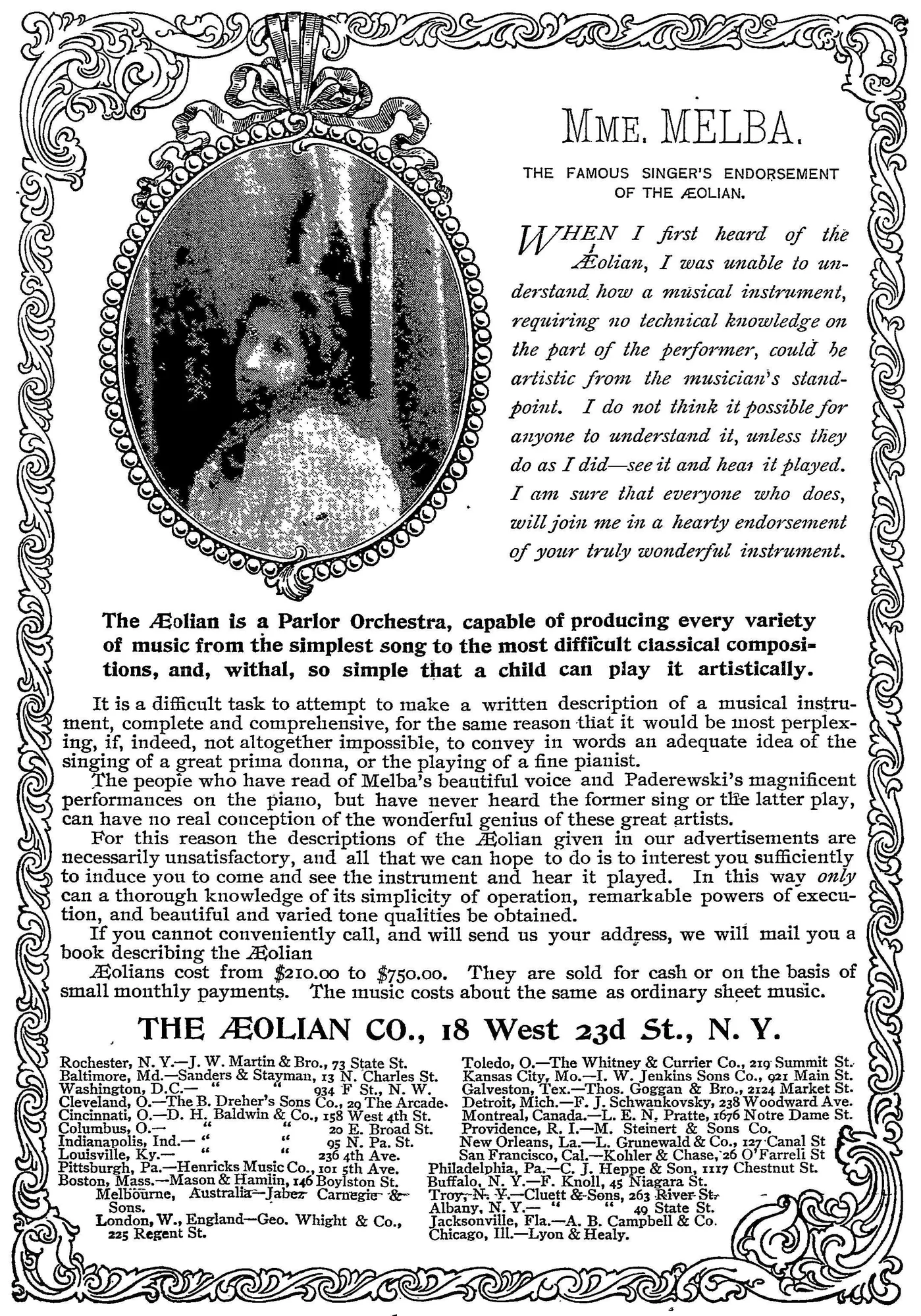
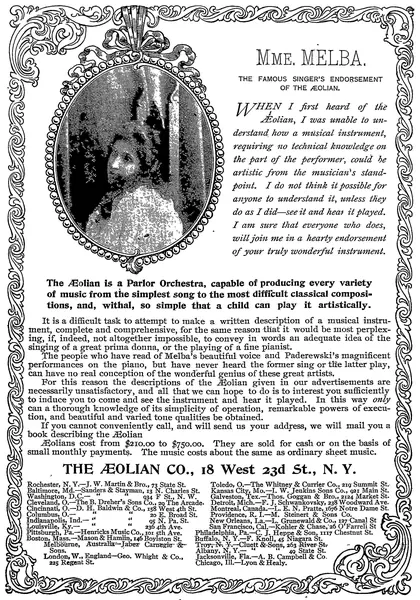
Nellie Melba made her debut at the Metropolitan Opera in New York at the end of 1893.3 In April 1895 her name headed a full-page advertisement in Munsey’s Magazine,4 over a testimonial that reads less like a celebrity endorsement than a confession.
When I first heard of the Æolian, I was unable to understand how a musical instrument, requiring no technical knowledge on the part of the performer, could be artistic from the musician’s standpoint.
Nellie Melba, April 1895
She went on to say that nobody could understand it without seeing and hearing it, as she had, and she gave the instrument her hearty endorsement. It was a clever choice of words. The Æolian Company was selling a machine that let anyone play, and one of the most famous sopranos in the world was admitting she had expected it to be a gimmick. Getting serious musicians on the record was company policy: the Pianola Institute’s history of the firm credits the Tremaines with understanding early that their instruments had to be associated with the most successful performers of the day.1
A machine that plays for you
The Æolian was a reed organ that played from perforated paper rolls. William B. Tremaine had founded the Mechanical Orguinette Company in New York in 1878 to make automatic reed organs, and in 1887 his business merged with a Boston roll maker to form what became the Æolian Company.12 Its 1895 ad called the instrument a Parlor Orchestra, “capable of producing every variety of music from the simplest song to the most difficult classical compositions, and, withal, so simple that a child can play it artistically.”
It was not cheap. “Æolians cost from $210.00 to $750.00,” the ad said, and to soften that it added that they were “sold for cash or on the basis of small monthly payments,” and that the music rolls cost “about the same as ordinary sheet music.” For comparison, the best bicycles in the same magazine were $100 (see What a Bicycle Cost in 1895).
How much was $210 to the people reading the ad? Average hourly earnings in American manufacturing in 1895 were about 14 cents, according to the National Bureau of Economic Research.5 Factory hands then worked about 60 hours a week, usually ten hours a day, six days a week.6 That comes to roughly $8.50 for a full week, so the cheapest Æolian cost about 25 weeks of wages, or close to six months. These are averages: a skilled tradesman earned more, and many readers of Munsey’s, a magazine for the middle class, were not factory workers at all. But the comparison shows why the ad led with monthly payments.

How it worked
The player sat at the Æolian like any parlor organ and pumped two foot treadles, which worked the bellows. The roll unwound past a tracker bar, a strip with one small hole for each note. Wherever a slot in the paper uncovered a hole, air moved through it and inflated a tiny leather pouch. The pouch pushed open a valve, and the valve let air reach that note’s reed. When the paper covered the hole again, the note stopped.7 The player still had choices to make. As on any reed organ, stops selected which sets of reeds sounded, so the same roll could be played with different voices. That was the room for taste the ad had in mind when it said even a child could play it “artistically.”
The rolls grew more ambitious through these years. Automatic reed organs went from 20 notes to 31 and 46 and settled on a 58-note standard, which matched a five-octave organ keyboard. By the early 1890s, making rolls was a small industry of its own, with arrangers, perforating-machine operators and spoolers.8
The company’s biggest success was still ahead. In Detroit, Edwin Votey of the Farrand & Votey Organ Company built a pneumatic “piano player,” a cabinet on casters that rolled up to an ordinary piano and pressed its keys with felt-tipped wooden fingers. He applied for a patent in 1897, and Æolian put the Pianola on the market in 1898.79 In 1895, though, the roll-playing organ was the company’s flagship, and Melba was its proof of seriousness.
Cheap enough for every home
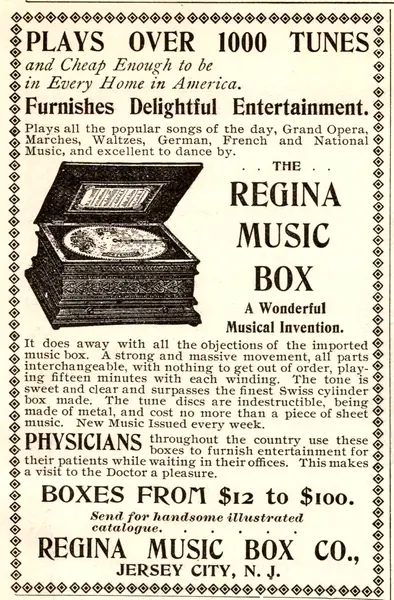
In the same issue, a very different company made the opposite pitch. The Regina Music Box Co. of Jersey City, New Jersey, promised a box that plays over 1000 tunes and was “cheap enough to be in every home in America.”
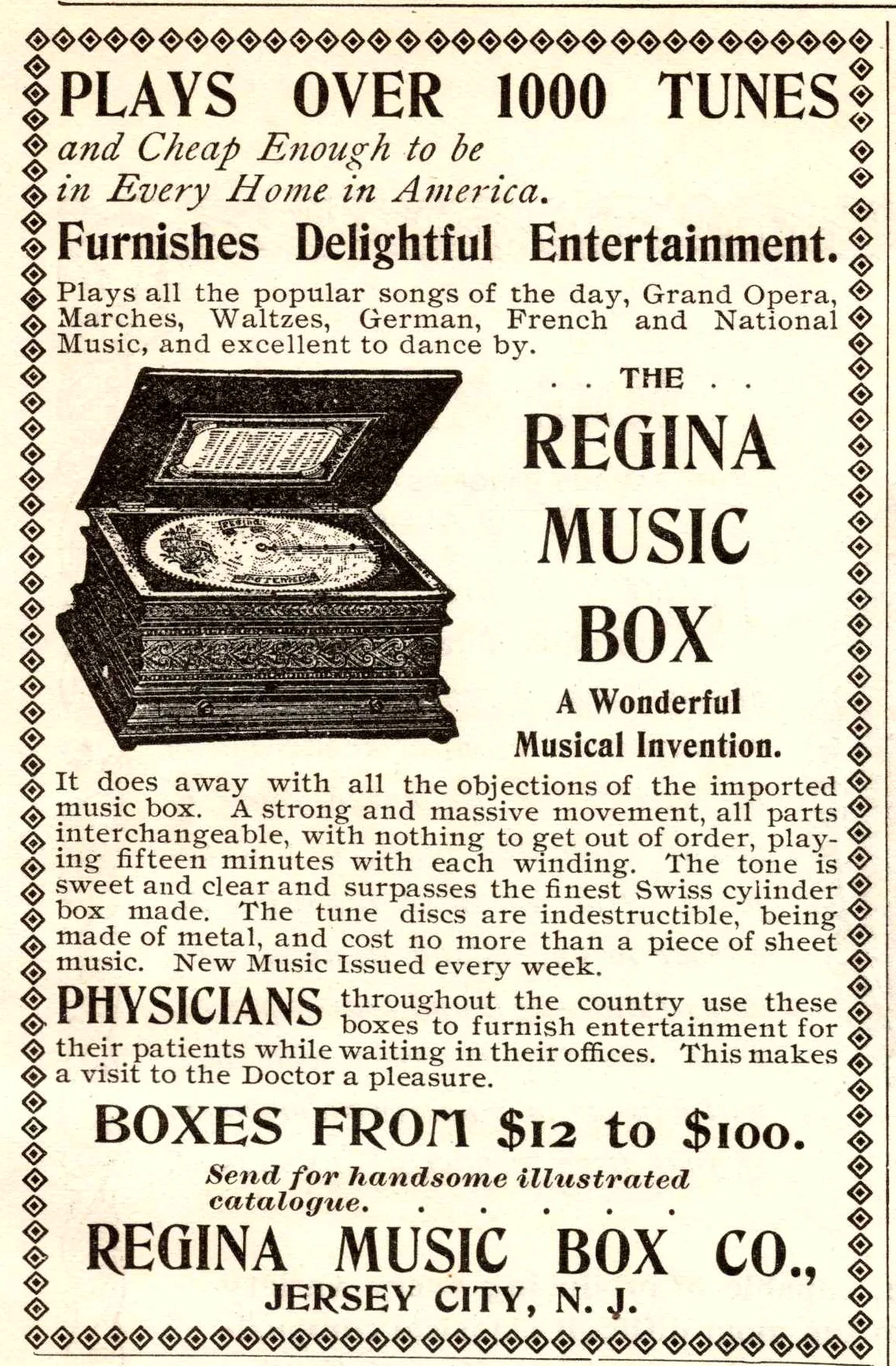
Regina was the creation of Gustave Brachhausen, who had been a foreman at the Symphonion music-box works in Leipzig and had then helped found its rival, Polyphon. He sailed for America in September 1892 and set up in rented space in Jersey City; the company later moved to its own factory in Rahway.2 Instead of the pinned cylinders of Swiss boxes, Regina played interchangeable discs. The discs were “indestructible, being made of metal,” the ad said, they cost “no more than a piece of sheet music,” and there was “new music issued every week.” The boxes themselves ran from $12 to $100.

How it worked
A disc box needed no pumping. The owner wound a coiled spring, and as it unwound it turned the disc. Small projections stamped into the underside of the disc caught a row of star wheels, and each star wheel, as it turned, plucked a tooth of a tuned steel comb. Better boxes had two combs for a fuller sound.1011 Because the music was on the disc rather than built into the machine, one box could play as many tunes as its owner cared to buy, which is how Regina could promise “over 1000.”
The ad also includes a small detail about how Americans used them:
PHYSICIANS throughout the country use these boxes to furnish entertainment for their patients while waiting in their offices.
Regina Music Box Co., April 1895
It worked. Regina shipped some 100,000 music boxes between 1892 and 1921 and dominated the American market for disc boxes.2
Music without lessons
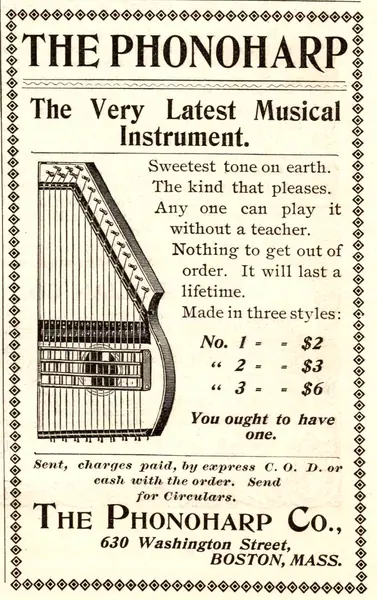
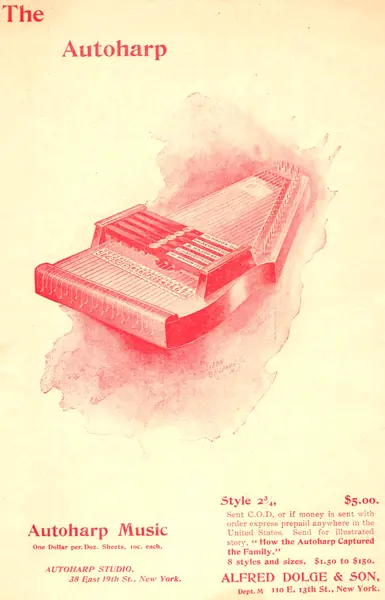
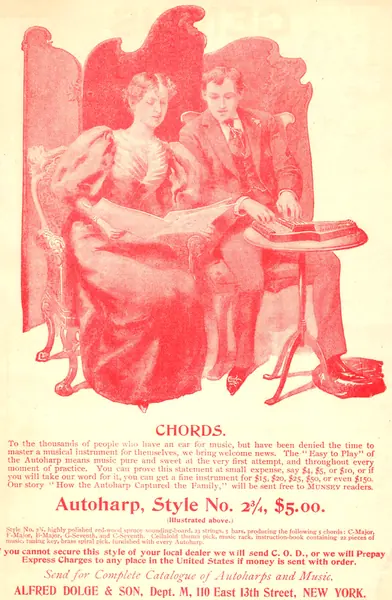
Set side by side, the Æolian and the Regina make the same promise at two very different prices: music in the home without years of practice. The smaller instruments on the same pages say it even more plainly. The Phonoharp of Boston, at $2, $3 or $6, was the “very latest musical instrument,” and “any one can play it without a teacher.” Alfred Dolge & Son’s Autoharp came in eight styles from $1.50 to $150, and the company sent out a free story called How the Autoharp Captured the Family.
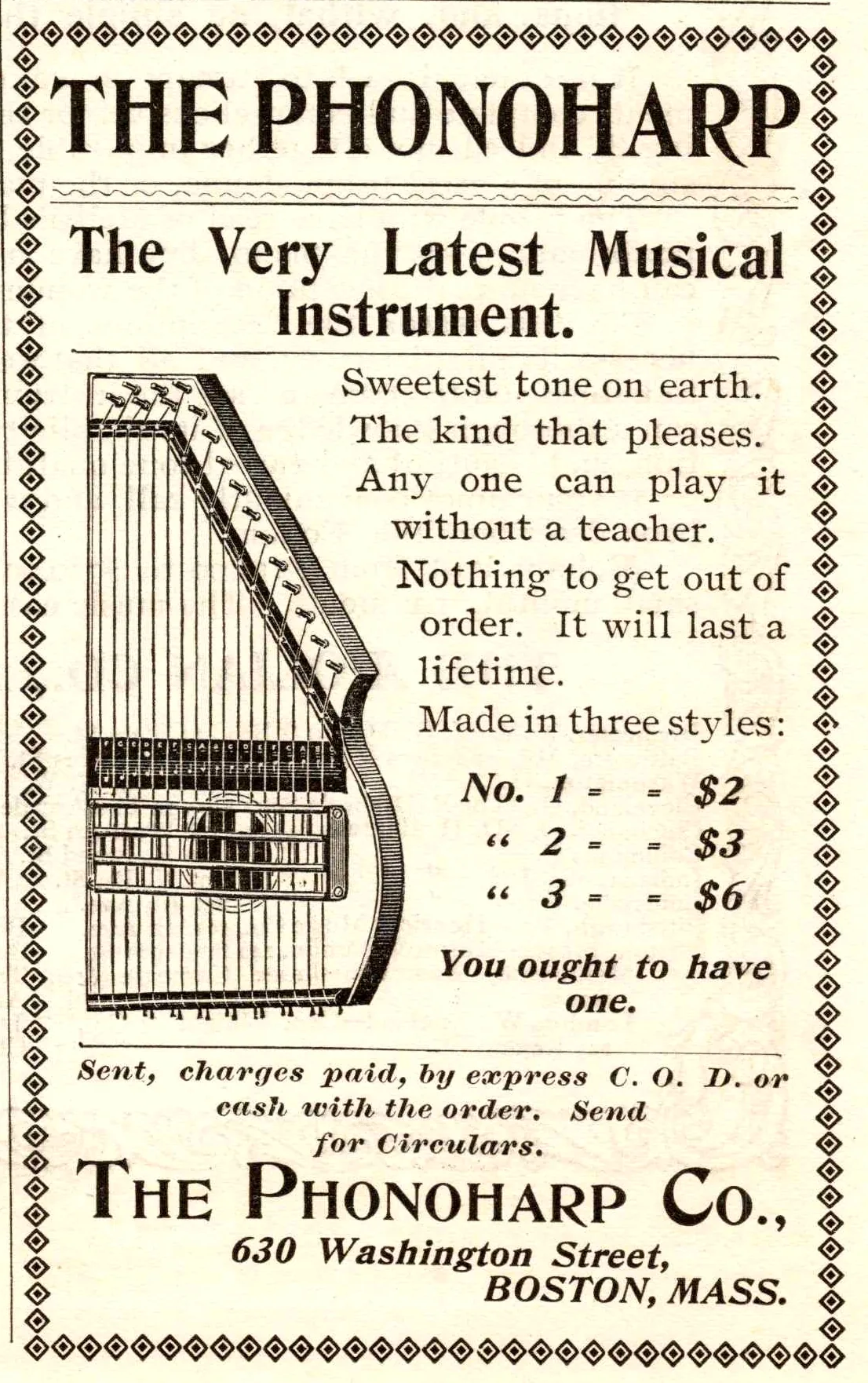
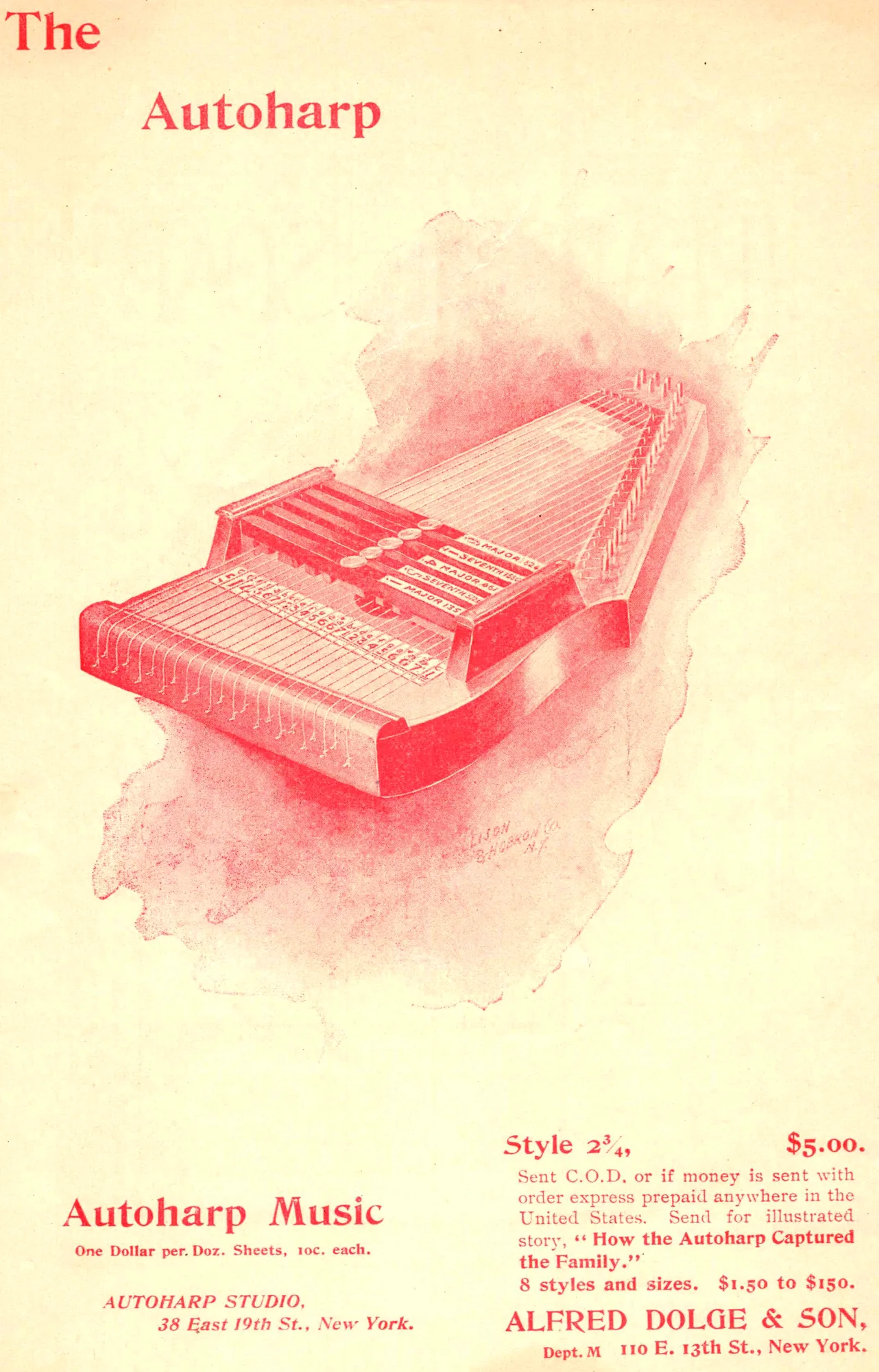
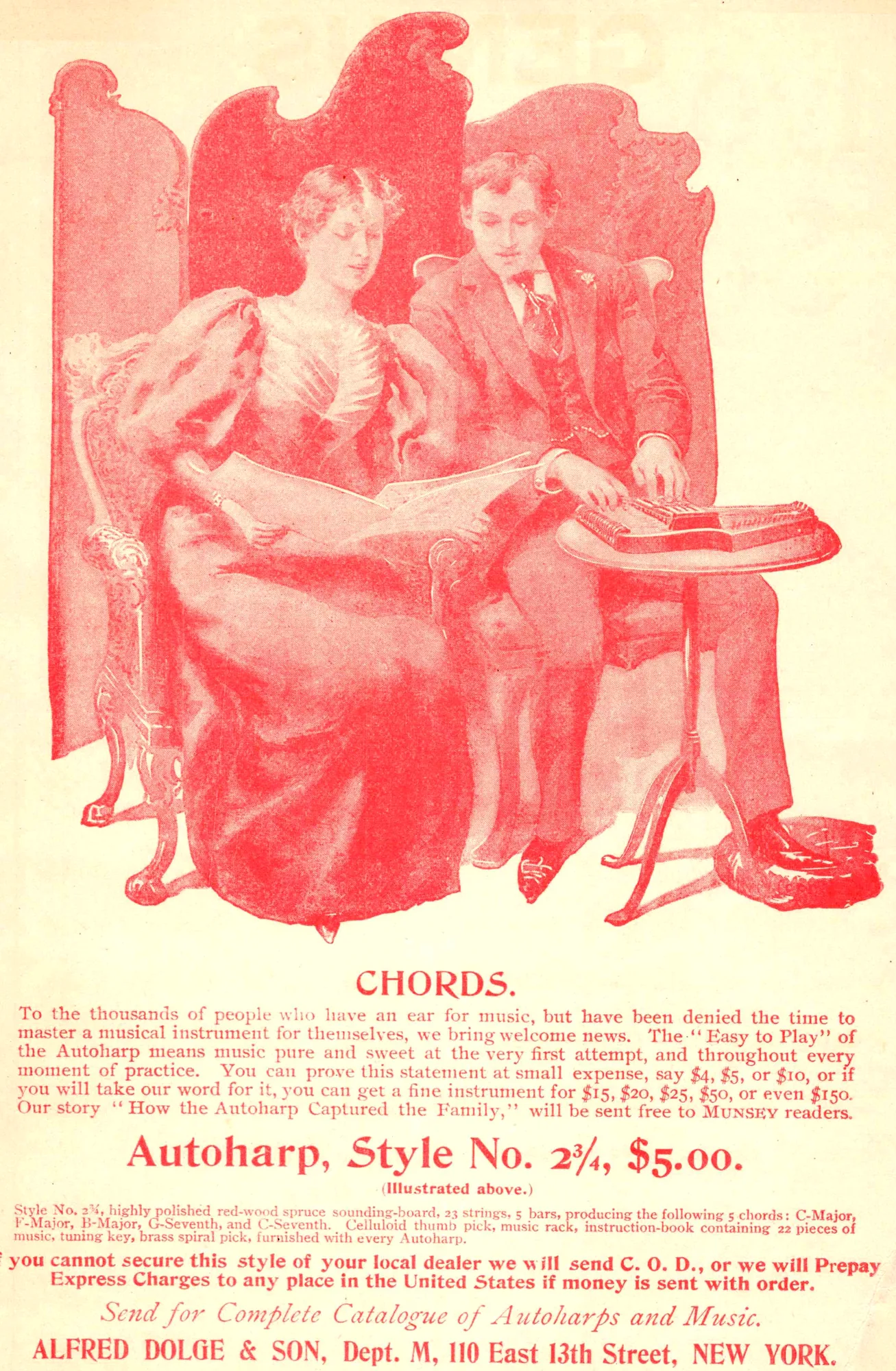
The Autoharp copy put the selling point most honestly. It was addressed to “the thousands of people who have an ear for music, but have been denied the time to master a musical instrument for themselves.”
Here is how the instruments in the April 1895 issue compare. Prices are the advertisers’ own.
| Instrument | Price in the ad | What the owner did | How the music was stored |
|---|---|---|---|
| Æolian roll organ | $210–$750 | Pumped the treadles, set the stops, controlled loudness | Perforated paper rolls, about the price of sheet music |
| Regina disc box | $12–$100 | Wound the spring, changed the disc | Metal discs, “no more than a piece of sheet music” |
| Autoharp | $1.50–$150 | Pressed chord bars and strummed | Nothing stored |
| Phonoharp | $2–$6 | Strummed; sold as playable “without a teacher” | Nothing stored |
| Piano (Chickering, Miller) | Not stated | Years of lessons and practice | Sheet music |
The piano makers answer
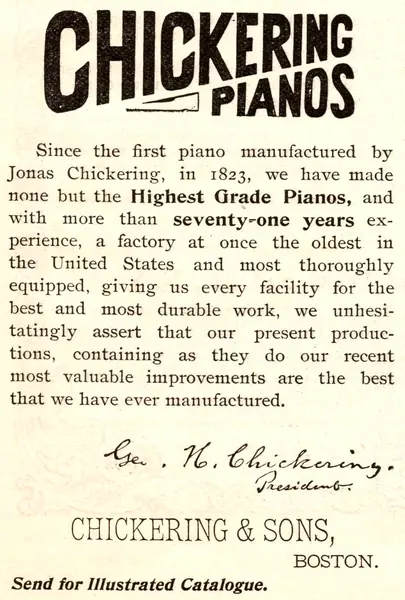
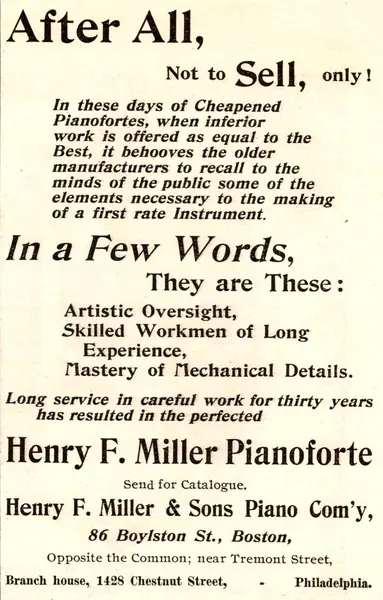
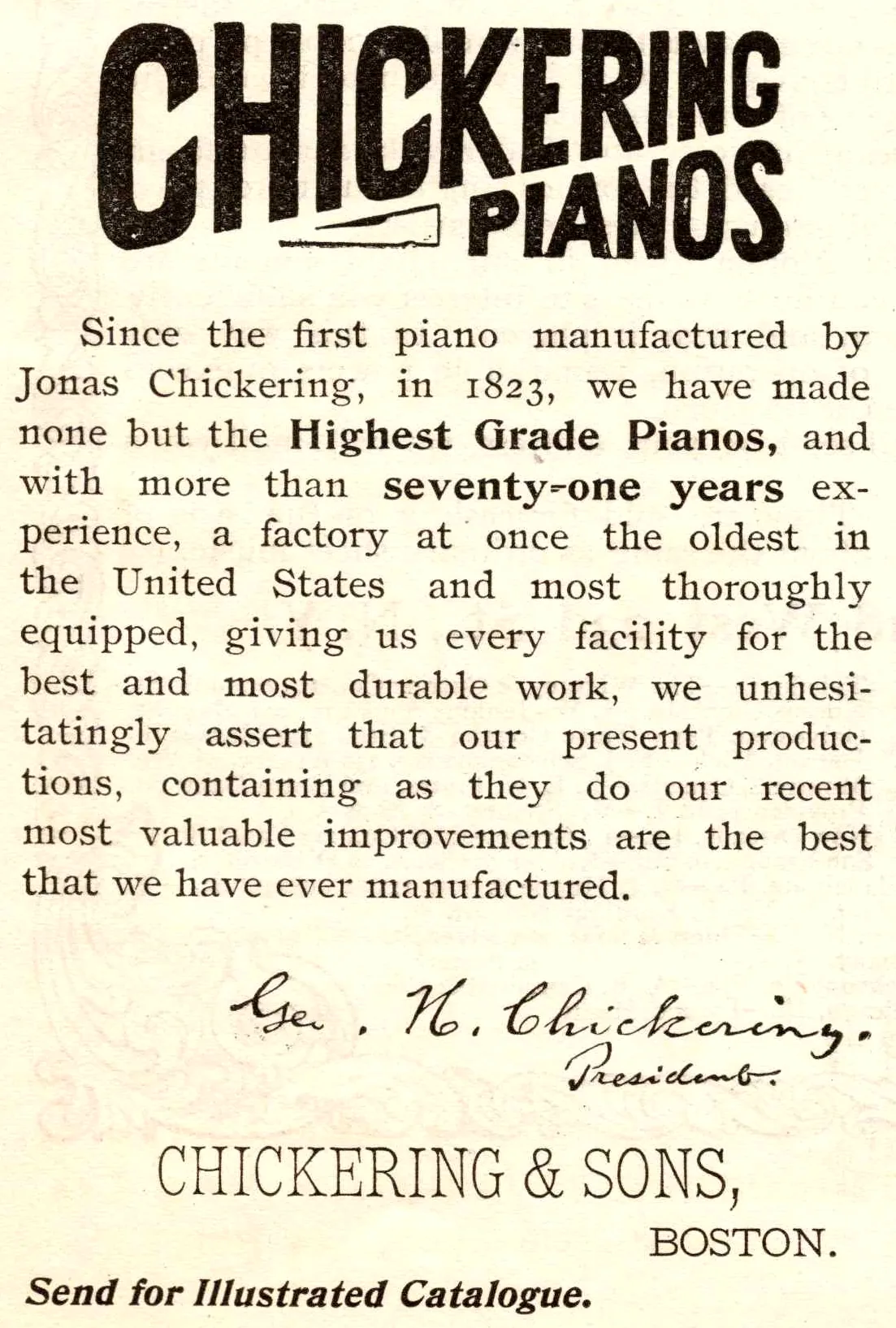
Not everyone in the issue was pleased about this. Two established Boston piano houses also advertised, and both sound defensive. Chickering & Sons reminded readers that it had made pianos since 1823, in what it called the oldest factory in the United States, and had never made anything but the highest grade. Henry F. Miller & Sons went further, with a headline that is almost a sigh: After All, Not to Sell, only!
In these days of Cheapened Pianofortes, when inferior work is offered as equal to the Best, it behooves the older manufacturers to recall to the minds of the public some of the elements necessary to the making of a first rate Instrument.
Henry F. Miller & Sons, April 1895
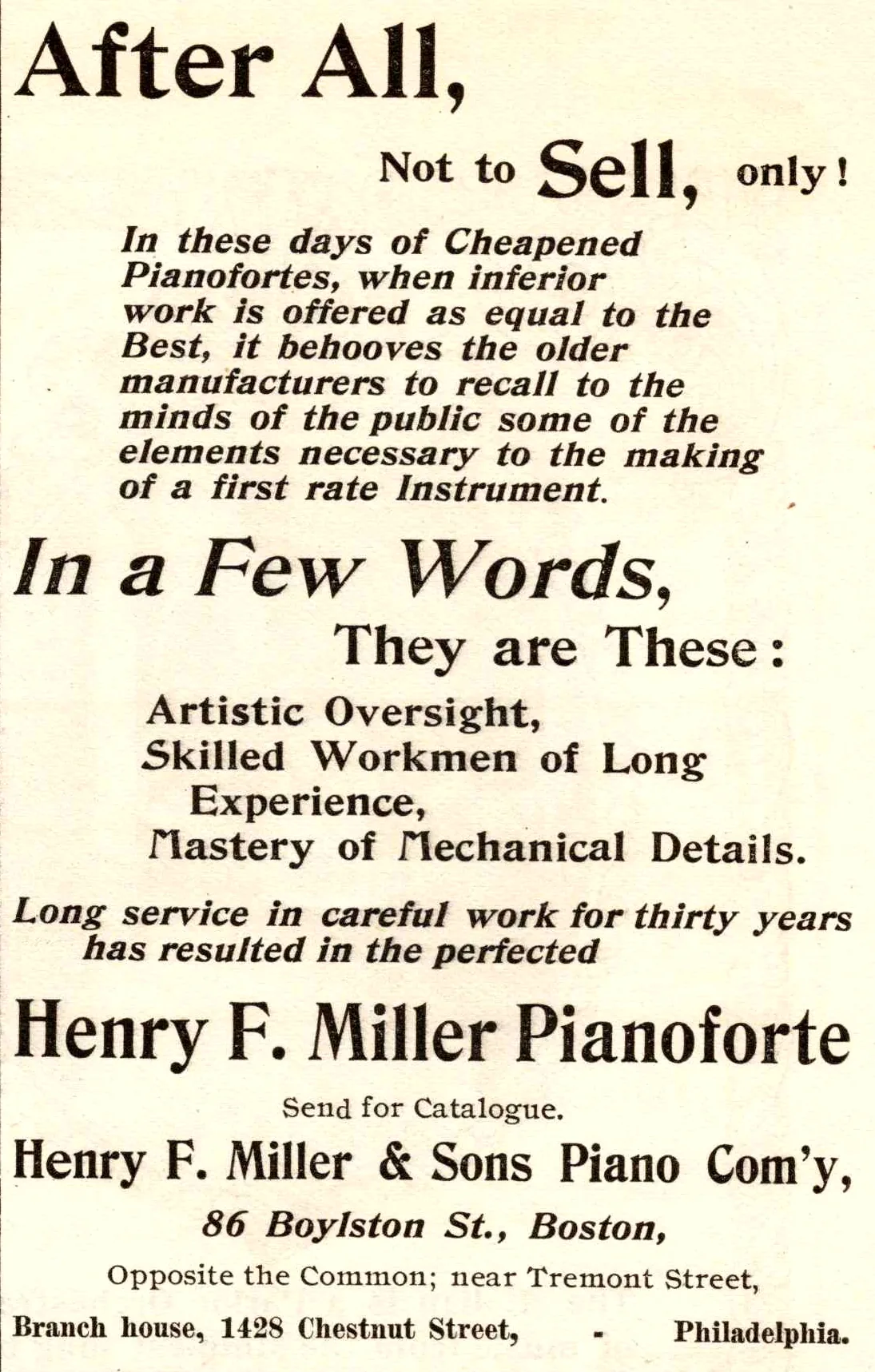
The elements, Miller explained, were artistic oversight, skilled workmen of long experience and mastery of mechanical detail. Miller was defending the craft of making a piano. The Æolian and the Regina were selling a way around the craft of playing one. Within a few years the two ideas would meet, in a Pianola rolled up to an ordinary parlor piano. In one spring issue of a popular magazine you can already hear the competition starting.
Sources
- The Aeolian Company: A Very Brief History, The Pianola Institute.
- Regina Company and Aeolian Company, Wikipedia (founding dates, Brachhausen’s career, production figures).
- Biography: American Debut, Dame Nellie Melba Museum.
- The advertisements quoted are in this archive: the Æolian, Regina, Phonoharp, Autoharp, Chickering and Henry F. Miller, all from Munsey’s Magazine, April 1895.
- Average Hourly Money Earnings in Payroll Manufacturing Industries for the United States, NBER Macrohistory Database, via FRED.
- Robert Whaples, “Hours of Work in U.S. History”, EH.Net Encyclopedia (average manufacturing workweek of about 60 hours in 1890 and 1900). See also Historical Statistics of the United States, series Ba4545–4574, on the six-day manufacturing week.
- “The Day of the Player Piano”, American Heritage; Howard Wyman, “Organ Reeds and Air Pressure”, Mechanical Music Digest, 1995 (a restorer’s description of an 1895 Æolian player organ’s pouch-and-valve action).
- The Birthplace of the Music Roll, The Pianola Institute.
- Aeolian Co., Pipe Organ Database, Organ Historical Society (Tremaine, Votey and the Farrand & Votey connection).
- Purchasing an Antique Disc Music Box, Intertique (how the disc, star wheels and comb work).
- Disc music box, glossary, Musical Box Society International.