Home & decoration · The 1890s
Three Cents a Roll: Buying Wallpaper by Mail in 1895
In one spring issue of Munsey’s, five wallpaper dealers competed for the same reader with free samples, cut rates and a dig at the trust. The mail-order wall had arrived.
Spring was papering season. In April 1895, a reader of Munsey’s Magazine who wanted to freshen up the parlor didn’t have to visit a decorator or trust whatever the local store had in stock. Turning to the back pages, she could choose among five wallpaper dealers, all promising to send samples through the mail.
Wallpaper was one of the great democratic luxuries of the late nineteenth century. Paper made by machine in continuous rolls, and from the 1850s paper made partly from cheap wood pulp, had brought the price down steadily. By the 1880s, according to a National Park Service study, wallpaper was the standard finish for American walls, and production reached 100 million rolls in 1890.1 The cheap papers had a cost of their own: wood-pulp paper tended to turn brittle and brown.1 The magazines that reached those households had become the obvious place to sell it.
Describe your rooms
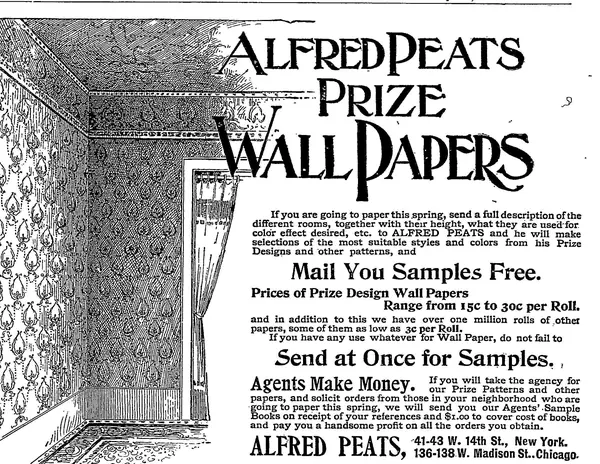
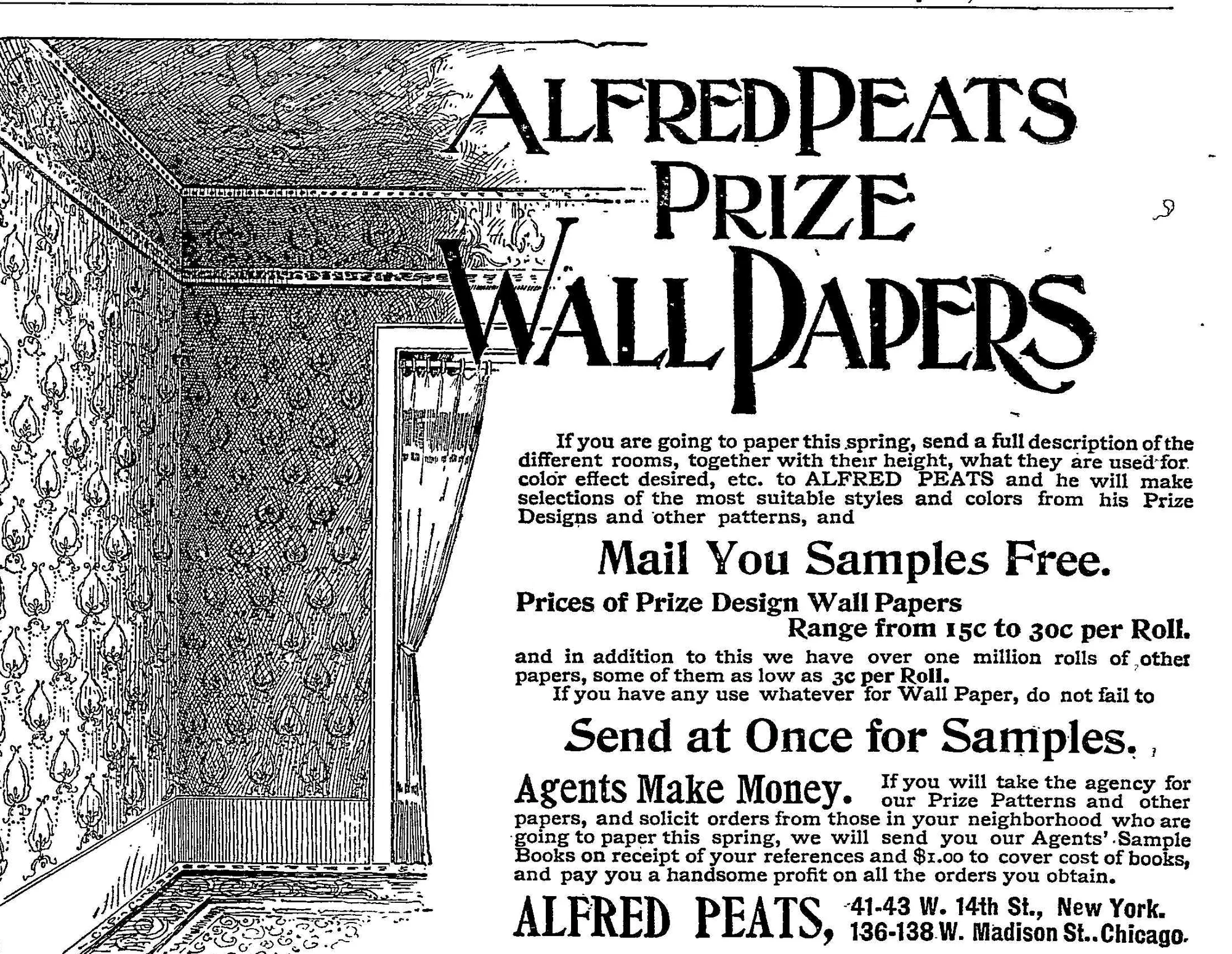
The largest advertisement belonged to Alfred Peats of New York and Chicago, with an engraving of a papered room corner and a draped doorway beside the words Prize Wall Papers in tall decorative letters. His offer was a kind of design service by post. A customer sent “a full description of the different rooms, together with their height, what they are used for, color effect desired,” and Peats picked suitable patterns from his “Prize Designs and other patterns” and mailed the samples free.
Peats did not print wallpaper himself. Later sample books from his firm, now in the collection of Cooper Hewitt, Smithsonian Design Museum, carry the names of several different manufacturers on their edges. Peats was a jobber, buying from the mills and selling under his own name and his own “Prize” label.2 His business was choosing, packaging and mailing, which is exactly what the 1895 ad sells.

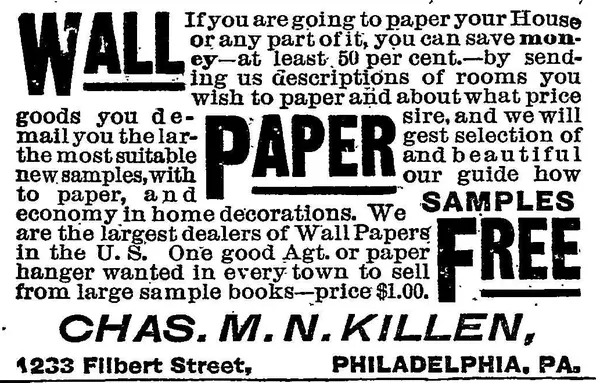
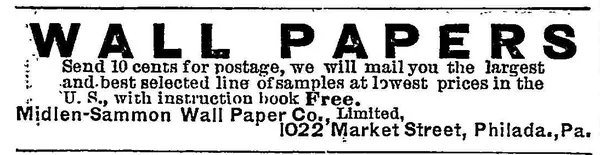
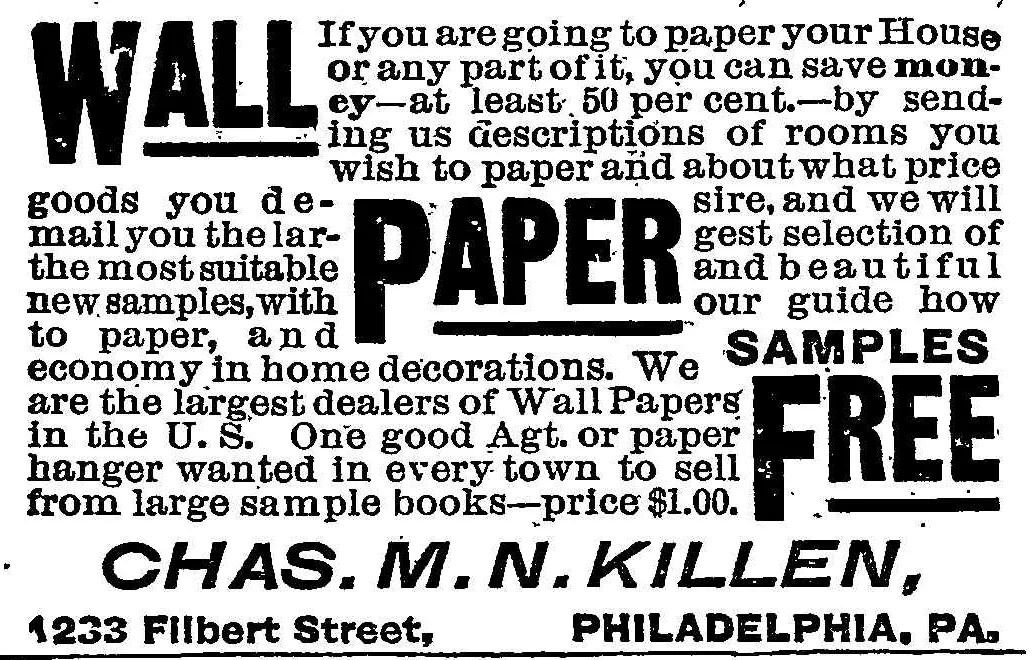
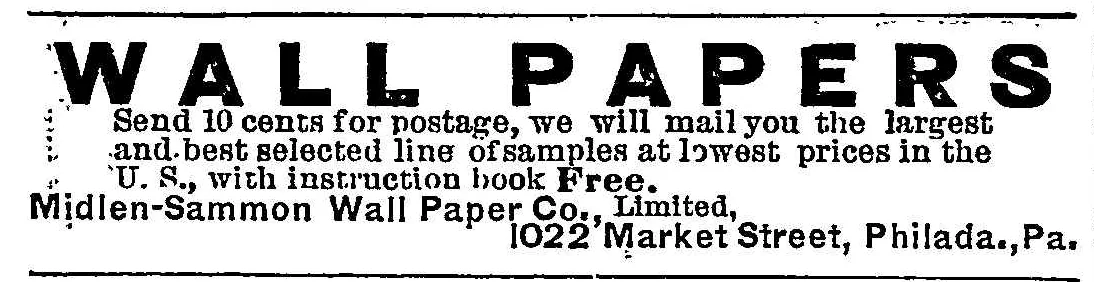
Chas. M. N. Killen of Philadelphia made the same pitch with bigger type. “Wall,” “Paper” and “Free” are set in huge condensed letters among the copy, and the promise was a saving of “at least 50 per cent” to anyone who described the rooms they wanted papered and roughly what they meant to spend. Killen also mailed a guide to hanging paper yourself. He claimed to be the largest dealer of wall papers in the United States. A few blocks away, on Market Street, the Midlen-Sammon Wall Paper Co. made nearly the same boast in the same magazine: “the largest and best selected line of samples at lowest prices in the U. S.” Neither claim can be checked, and both are the advertisers’ own.
The price of a wall
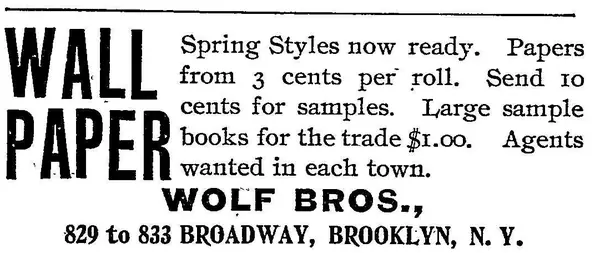
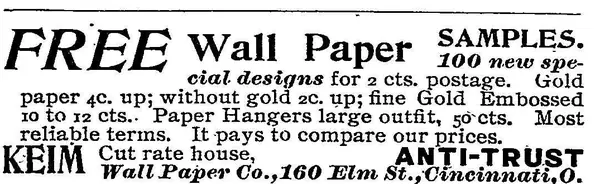
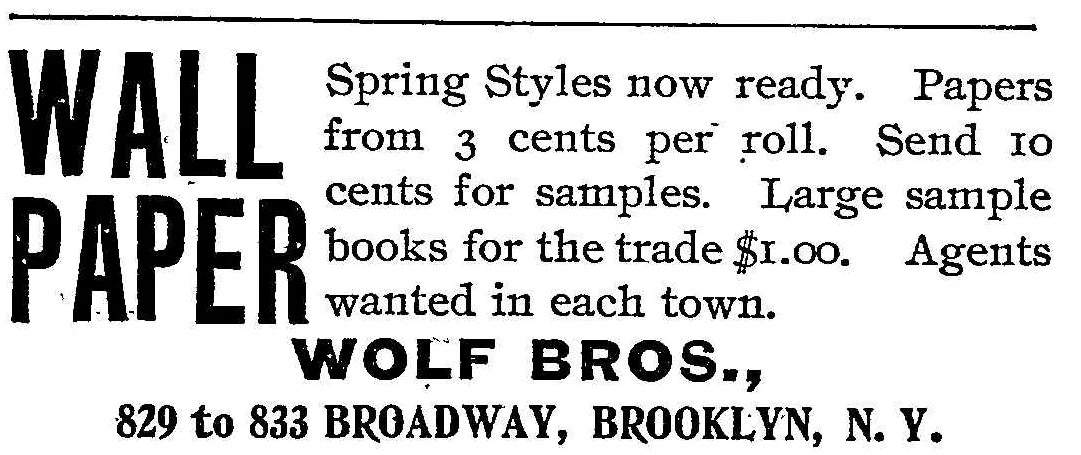
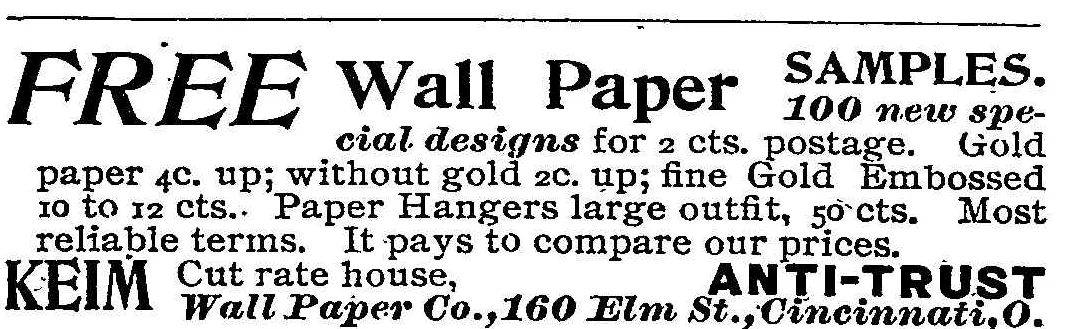
The prices are startlingly low. Wolf Bros. of Brooklyn announced spring styles “from 3 cents per roll.” Peats’s prize designs ran from 15 to 30 cents a roll. The Keim company of Cincinnati offered plain papers from 2 cents, gold papers from 4 cents and fine gold-embossed papers at 10 to 12 cents a roll.
What did a “roll” mean? None of the 1895 ads says. American wallpaper was usually about 20 inches wide by then,1 but lengths varied, and sellers had every reason to quote the smallest unit they could. A Sears, Roebuck wallpaper catalog of about 1900 spelled out the convention it used: a single roll was 8 yards long and a double roll 16 yards, and Sears quoted its prices, “3 to 35 cents,” by the double roll.3 The same catalog printed a table for working out how many rolls a room needed, and sold borders by the yard and ceiling papers separately.3 Unless the family hung it themselves, a paper hanger had to be paid too. A three-cent roll was real, but a papered room cost more than the headline suggested.
Samples were the real product. Midlen-Sammon and Wolf Bros. both charged 10 cents for postage. Keim sent 100 new designs for 2 cents. The trick was to get a sample book into the house, where the family could look through it at leisure.
The anti-trust house
Keim’s small advertisement has the most interesting name on the page: the Anti-Trust Wall Paper Co., a “cut rate house.” In June 1892 many of the country’s leading wallpaper manufacturers had been bought up and combined into a single New York corporation, the National Wall Paper Company.4 Calling yourself “anti-trust” in 1895 was both a political stance and a price promise. In the decade of the Sherman Antitrust Act of 1890 and the great industrial combinations, a small Cincinnati dealer was betting that readers would recognize the word and like what it said.
The trust did not go quietly. In 1898 the National Wall Paper Company and other manufacturers set up a joint selling company, the Continental Wall Paper Company, which bound wholesalers to buy from it on its terms. When an Ohio jobbing house stopped paying its bill, Continental sued, and the case went to the U.S. Supreme Court. According to the facts the Court accepted, the combination made and sold “upwards of ninety-eight per cent of all the wall paper manufactured and sold” in the United States. In 1909 the Court ruled that the combination was illegal under the Sherman Act and refused to help it collect, over a dissent by four justices led by Oliver Wendell Holmes.5 The National Wall Paper Company itself had already been dissolved by its directors in 1900.6
Agents in every town
Nearly every dealer also wanted agents. Killen sought “one good Agt. or paper hanger” in every town to sell from large sample books at $1.00. Wolf Bros. sold the same books “for the trade.” Peats simply wrote, “Agents make money.” Keim offered paper hangers a “large outfit” for 50 cents. The magazine advertisement found the customer, and a local paper hanger carrying a thick book of samples closed the sale.
Beyond paper
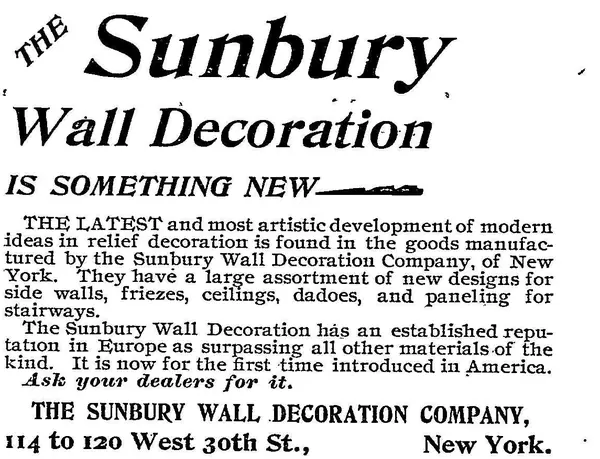
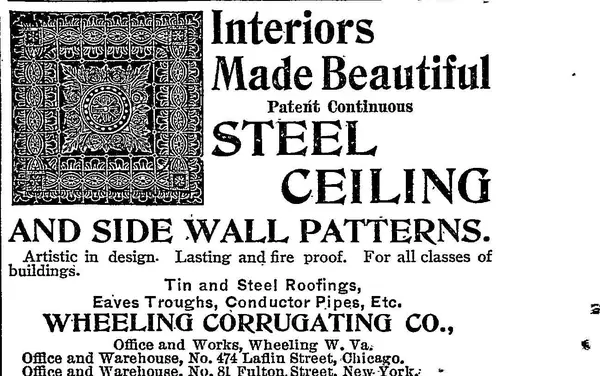
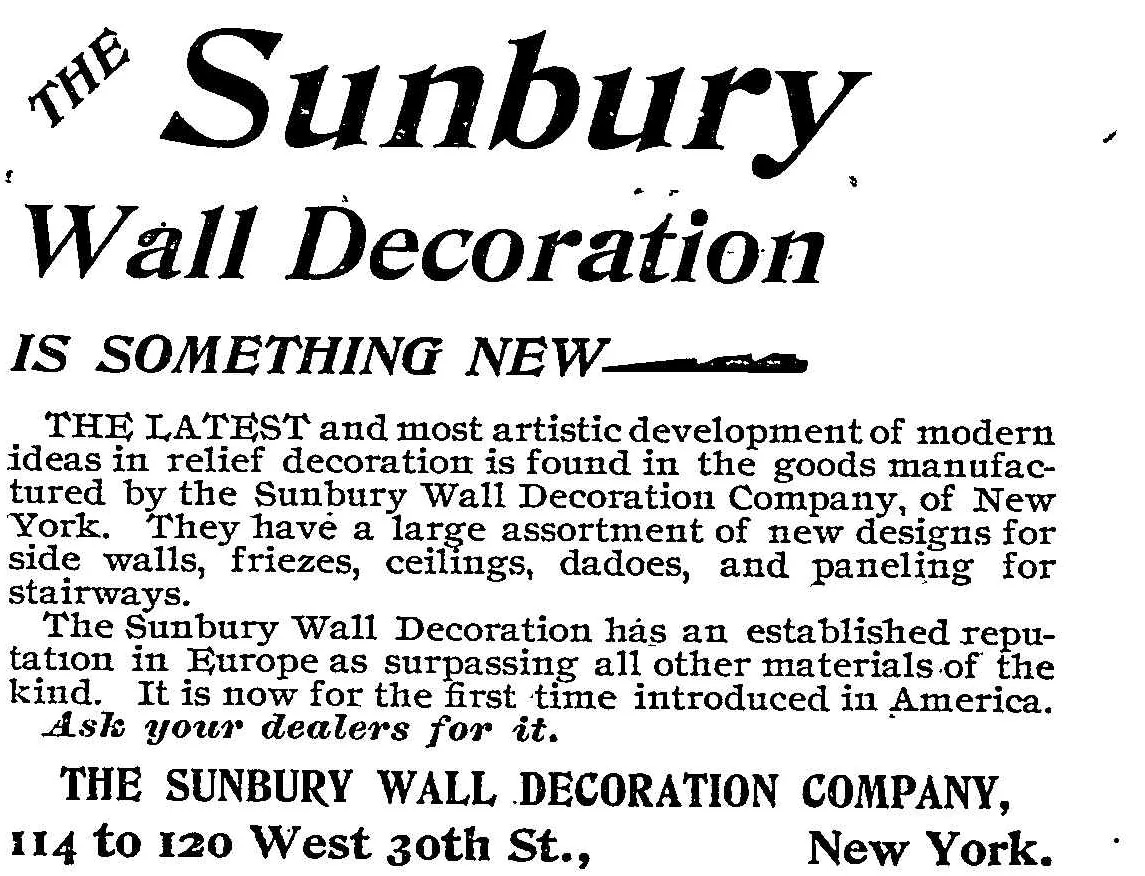
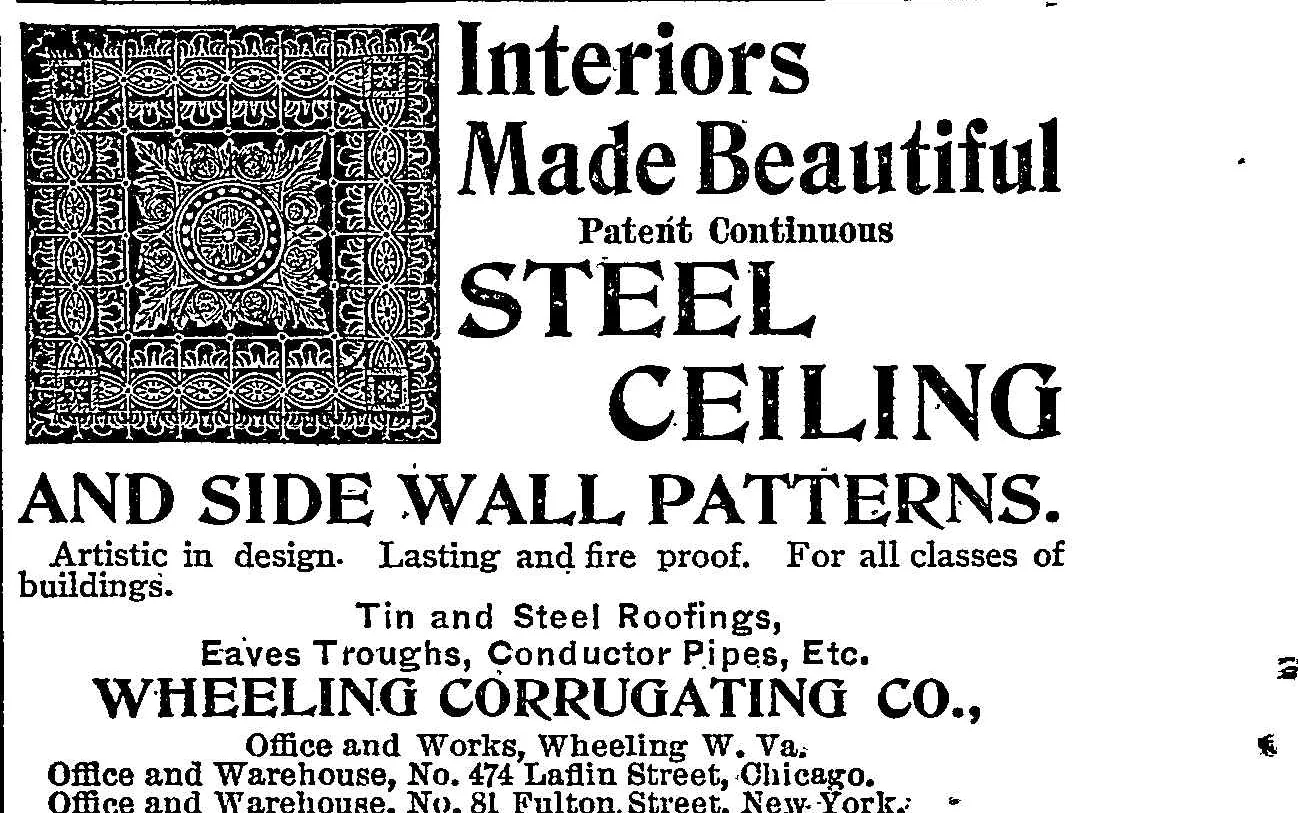
Not every advertiser on the page was selling paper. The Sunbury Wall Decoration Company of New York introduced relief decoration for walls, friezes, ceilings and stairways, said to have an established reputation in Europe and “now for the first time introduced in America.” The Wheeling Corrugating Co. of West Virginia offered patent steel ceilings (“Artistic in design. Lasting and fire proof.”), the pressed-metal panels that still survive overhead in old shops and saloons.
Together, these few column inches capture a moment when decorating a house stopped being a local craft and became a national market, sold by mail at a few cents a roll. The same reader could choose her house plans by mail, too: see Ordering a House by Mail, 1895. The patterns have faded from most American walls. The advertisements that sold them are still here.
Sources
- Catherine Lynn Frangiamore, Wallpapers in Historic Preservation, National Park Service, Technical Preservation Services, 1977, pp. 1, 6.
- Sample Book, Alfred Peats Wallpaper, No. 1 (1915), Cooper Hewitt, Smithsonian Design Museum, catalog note.
- Sears, Roebuck and Co., Wall Paper, Chicago, ca. 1900. Internet Archive, from the University of Maryland Libraries.
- Washburn v. National Wall-Paper Co., federal court opinion by Circuit Judge E. Henry Lacombe, via CourtListener.
- Continental Wall Paper Co. v. Louis Voight & Sons Co., 212 U.S. 227 (1909), Legal Information Institute, Cornell Law School.
- Alfred D. Chandler Jr., The Visible Hand: The Managerial Revolution in American Business (Harvard University Press, 1977), chapter on mergers, 1890–1903.