Ancient Lystra
- Date
- 1883
- Publication
- The Bible-Work: The New Testament, Vol. II
- Imprint
- Prepared by J. Glentworth Butler, D.D. · Funk & Wagnalls Company, New York and London, 1883
- Page
- 103
- Black & White
Description
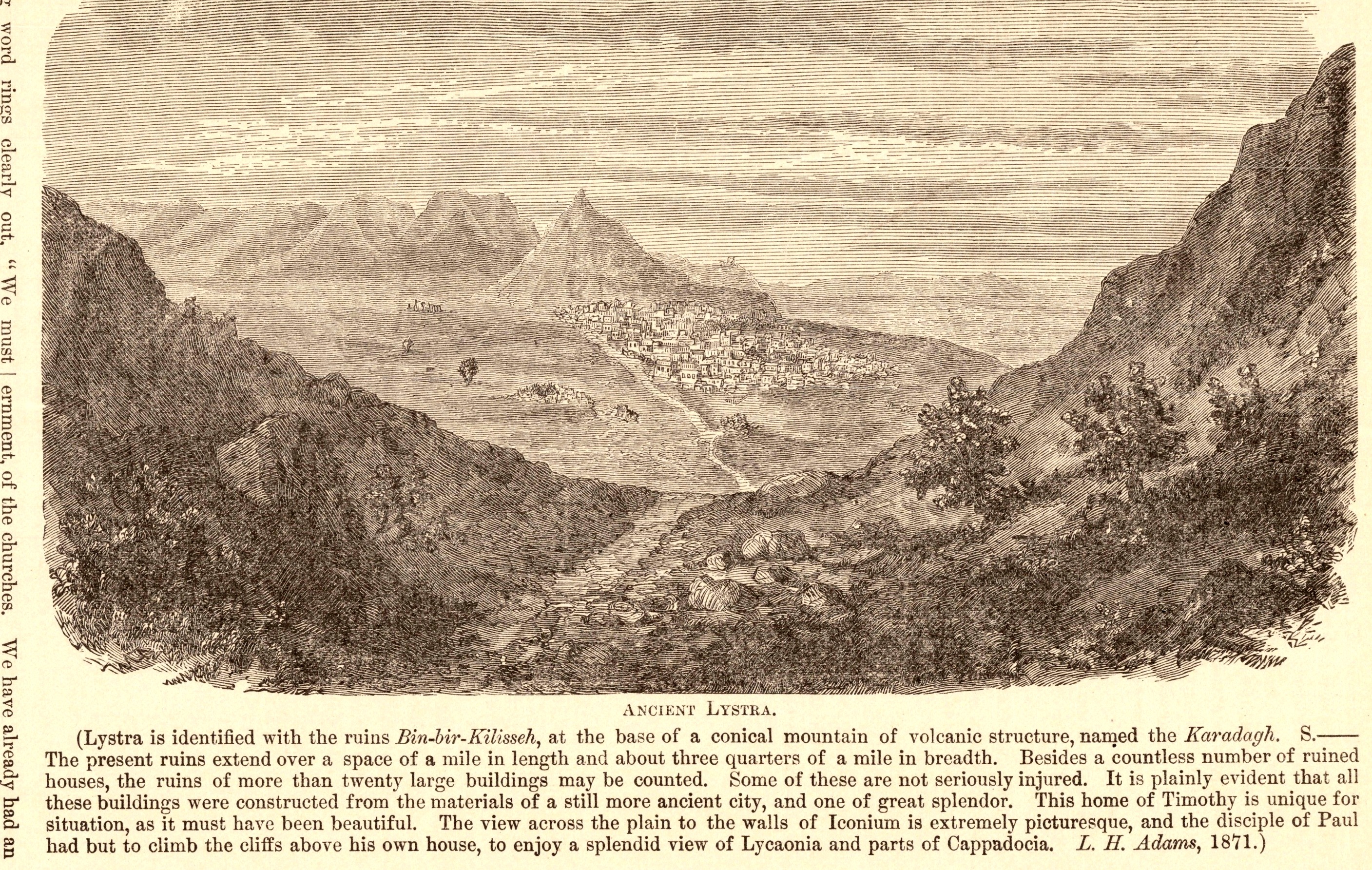
A full-page engraving, printed sideways on the page, looking out from beneath overhanging trees and cliffs to a small town on a plain, identified in the long note as the site of ancient Lystra, home of Paul’s disciple Timothy. The note, signed L. H. Adams, 1871, places Lystra at the ruins called Bin-bir-Kilisseh below the volcanic Karadagh. Modern scholars locate Lystra elsewhere, near Hatunsaray.
As printed
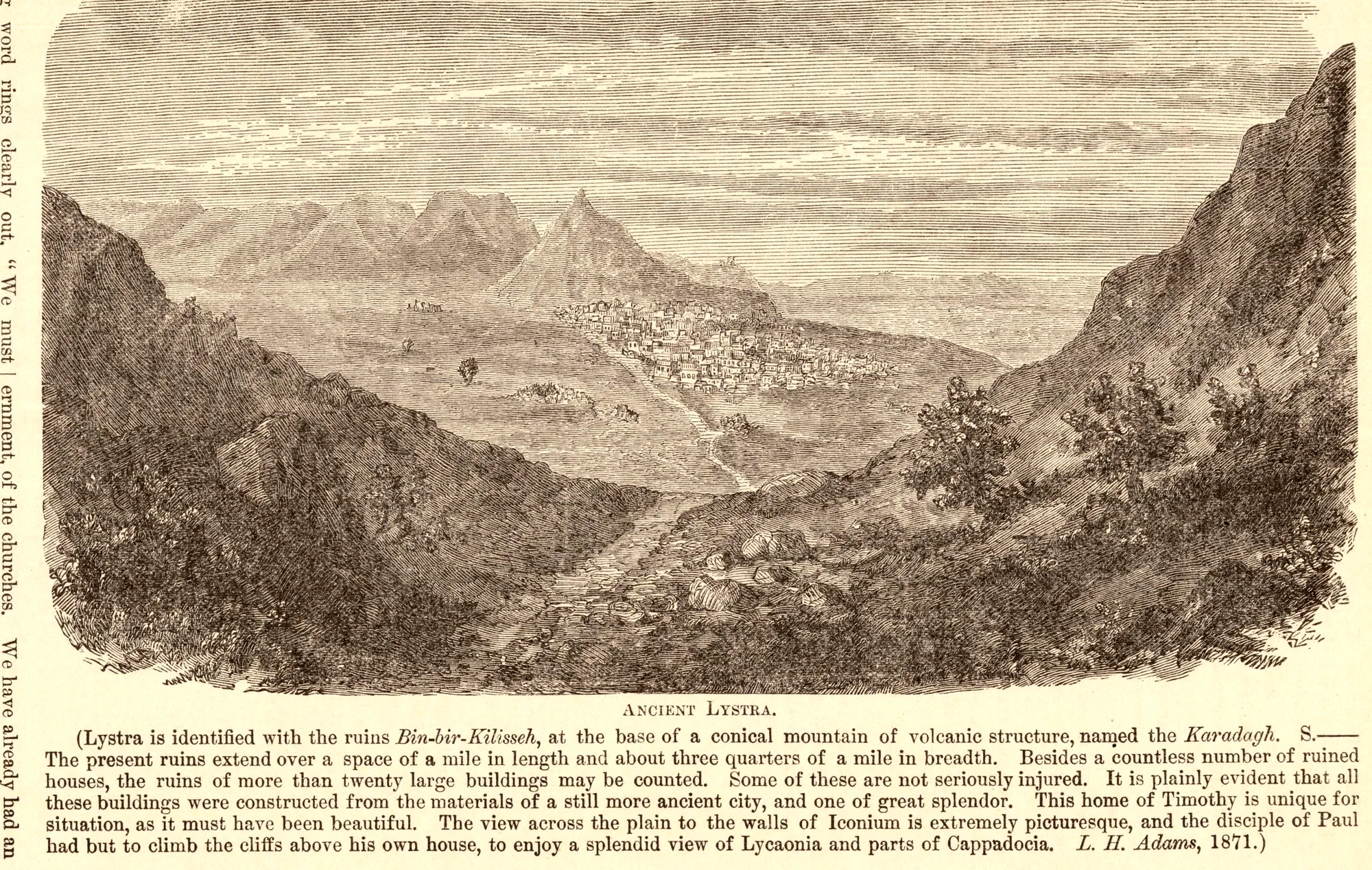
Ancient Lystra. (Lystra is identified with the ruins Bin-bir-Kilisseh, at the base of a conical mountain of volcanic structure, named the Karadagh. S.—The present ruins extend over a space of a mile in length and about three quarters of a mile in breadth. Besides a countless number of ruined houses, the ruins of more than twenty large buildings may be counted. Some of these are not seriously injured. It is plainly evident that all these buildings were constructed from the materials of a still more ancient city, and one of great splendor. This home of Timothy is unique for situation, as it must have been beautiful. The view across the plain to the walls of Iconium is extremely picturesque, and the disciple of Paul had but to climb the cliffs above his own house, to enjoy a splendid view of Lycaonia and parts of Cappadocia. L. H. Adams, 1871.)
Cite this item
“Ancient Lystra.” Illustration in The Bible-Work: The New Testament, Vol. II, Prepared by J. Glentworth Butler, D.D. · Funk & Wagnalls Company, New York and London, 1883. Antique Advertisements, no. P0359. https://antiqueadvertisements.com/from-the-pages/P0359-ancient-lystra-1883/
This item is in the public domain. You are free to use it for any purpose; a credit to Antique Advertisements is appreciated. Learn more about using these images.