Spanish Gipsies
- Date
- 1893
- Publication
- Adventures of Famous Travellers in Many Lands
- Imprint
- With Descriptions of Manners, Customs, and Places · William L. Allison Company, New York, c. 1893–1894
- Page
- [249]
- Black & White
Description
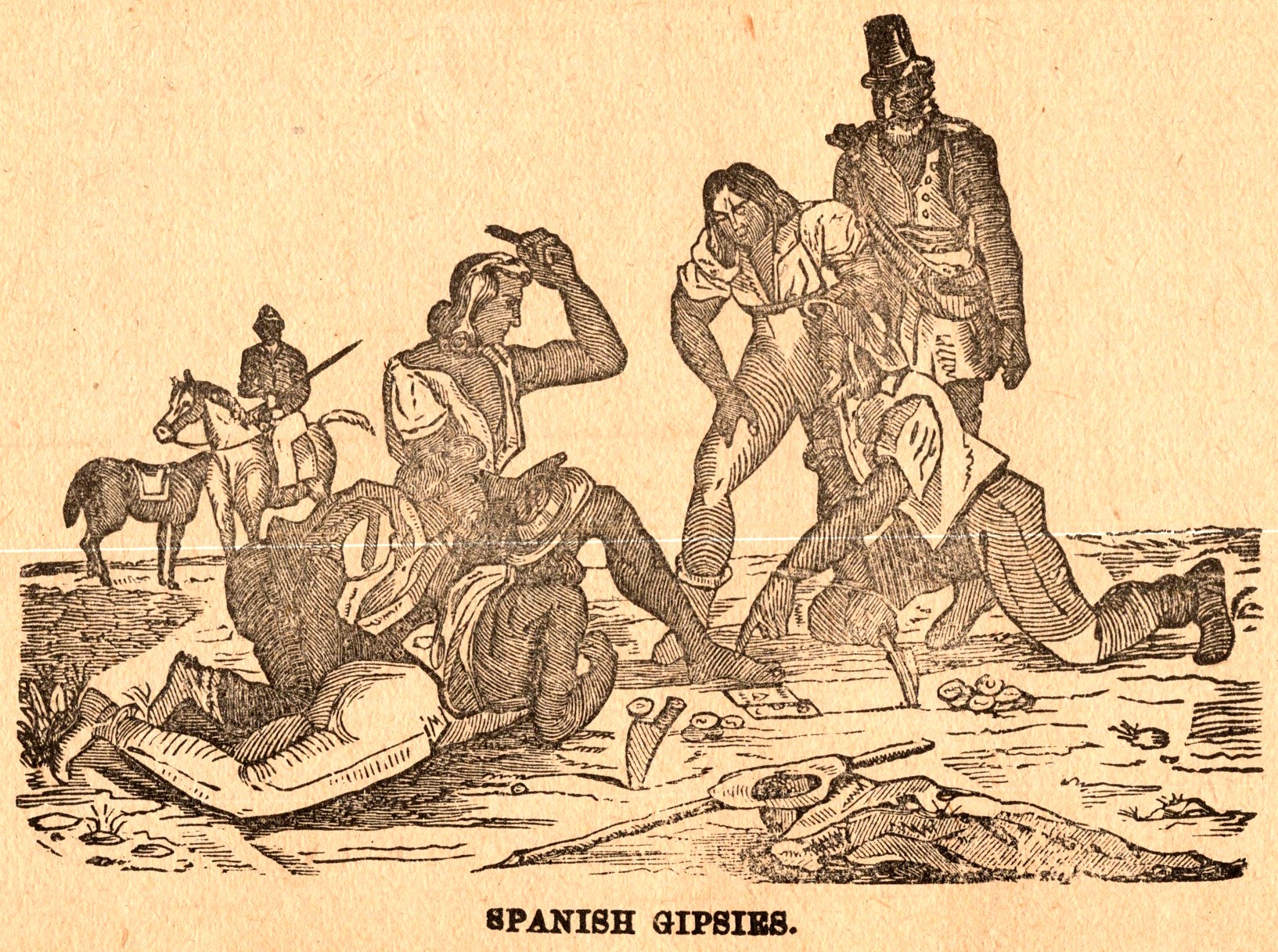
A group of Romani men and women sit and sprawl on the ground outdoors, one man in a tall hat standing over them, with a horse behind. It illustrates George Borrow’s accounts of the Romani of Spain. The plate was printed sideways and is shown here turned upright.
Historical note
George Borrow (1803–1881) travelled through Spain in 1835–40 as an agent of the British and Foreign Bible Society. He learned the Romani language and wrote The Zincali, an account of Spain’s Romani people, in 1841. The words “gipsy” and “gitano” come from an old mistaken belief that the Romani came from Egypt; their ancestors in fact migrated out of India more than a thousand years ago. Many Roma consider “Gypsy” a slur, and the first World Romani Congress in 1971 voted to reject it, though some groups, especially in Britain, still use it themselves.
Sources
- Borrow, George Henry, Encyclopedia.com
- Romani, World History Encyclopedia
- Romani people, Wikipedia
As printed
Spanish Gipsies.
Cite this item
“Spanish Gipsies.” Illustration in Adventures of Famous Travellers in Many Lands, With Descriptions of Manners, Customs, and Places · William L. Allison Company, New York, c. 1893–1894. Antique Advertisements, no. P0666. https://antiqueadvertisements.com/from-the-pages/P0666-spanish-gipsies-1893/
This item is in the public domain. You are free to use it for any purpose; a credit to Antique Advertisements is appreciated. Learn more about using these images.