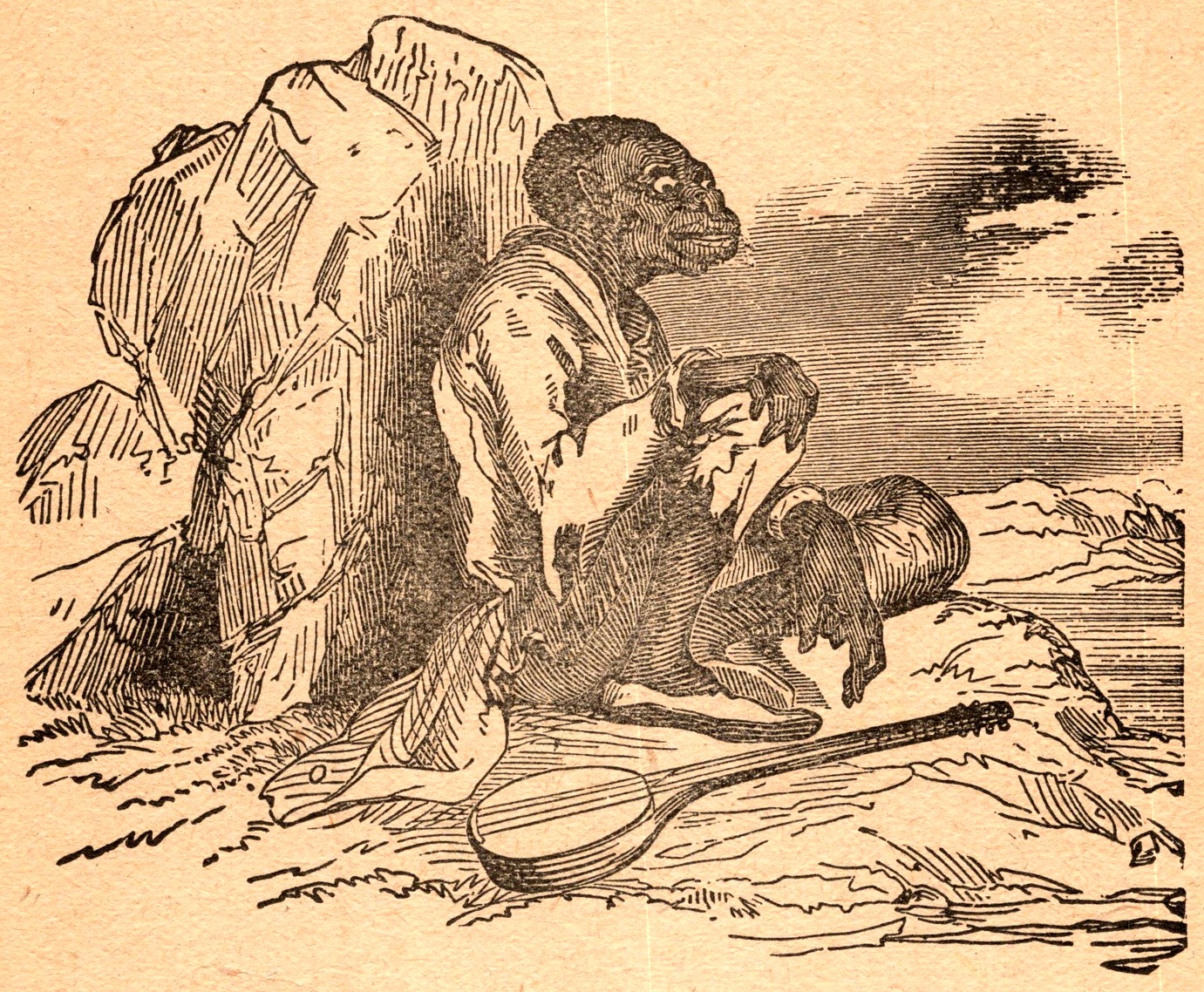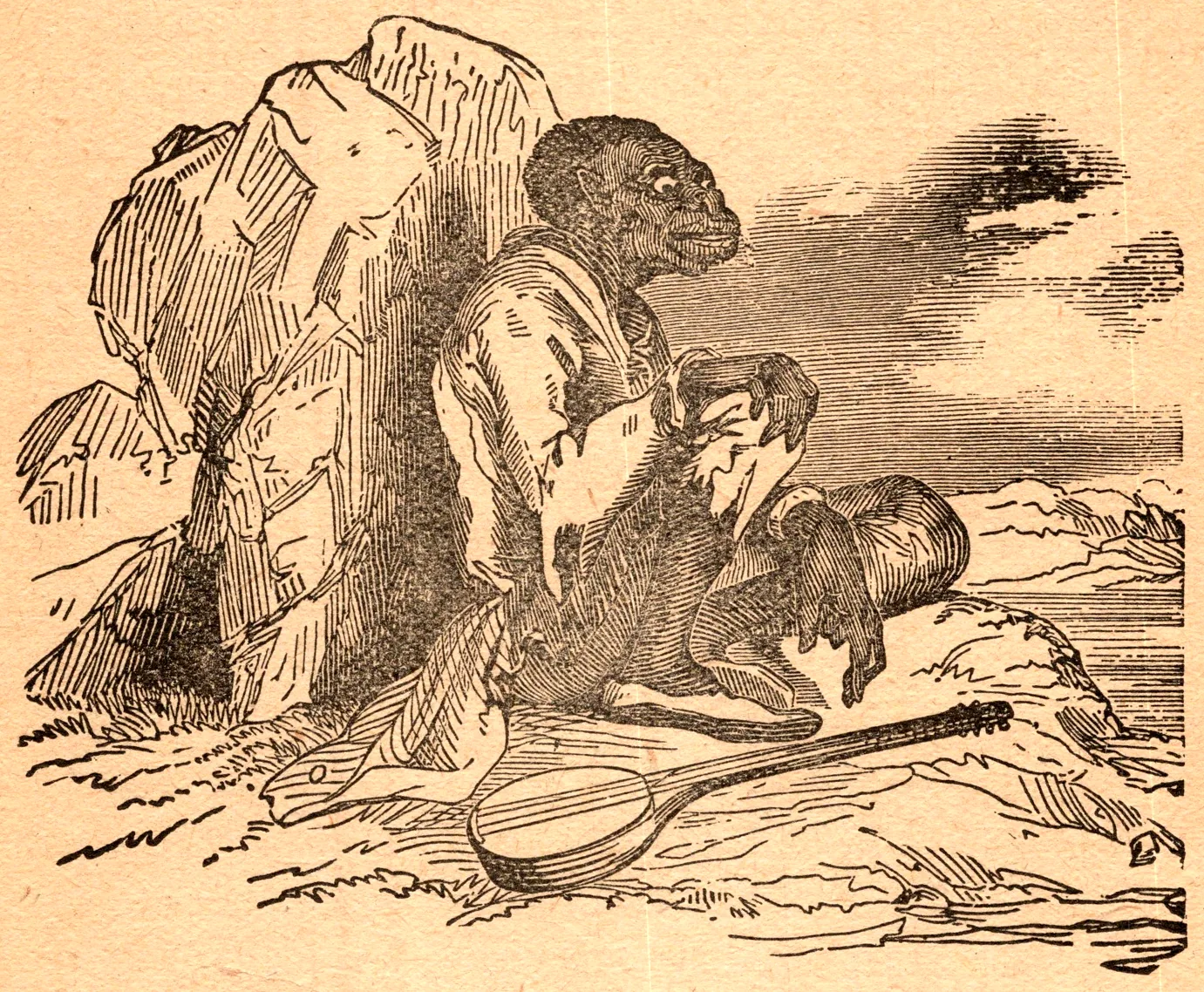
Caricature of a Black Man with a Banjo
- Date
- 1893
- Publication
- Adventures of Famous Travellers in Many Lands
- Imprint
- With Descriptions of Manners, Customs, and Places · William L. Allison Company, New York, c. 1893–1894
- Page
- 62
- Black & White
Description
A crude racist caricature of a Black man, drawn with ape-like features, sits against a rock with a banjo at his feet. It heads “Mr. Lewis in Jamaica,” extracts from the journal of the English writer Matthew Gregory Lewis, who owned two sugar plantations and the enslaved people who worked them.
Historical note
Matthew Gregory Lewis (1775–1818), called “Monk” Lewis after his Gothic novel The Monk, inherited two Jamaican sugar estates, Cornwall and Hordley, together with more than 400 enslaved people. He visited them in 1815–16 and again in 1817, and died at sea on the voyage home in 1818. His Journal of a West India Proprietor was published after his death, by John Murray in London in 1834, not by Lewis in 1833 as this book says. The ape-like caricature that heads the chapter belongs to a long tradition of images used to dehumanize Black people.
Sources
- Matthew Gregory Lewis, Legacies of British Slavery, University College London
- Journal of a West India Proprietor, Project Gutenberg
- Frequently Asked Questions, Jim Crow Museum, Ferris State University
Cite this item
“Caricature of a Black Man with a Banjo.” Illustration in Adventures of Famous Travellers in Many Lands, With Descriptions of Manners, Customs, and Places · William L. Allison Company, New York, c. 1893–1894. Antique Advertisements, no. P0584. https://antiqueadvertisements.com/from-the-pages/P0584-caricature-of-a-black-man-with-a-banjo-1893/
This item is in the public domain. You are free to use it for any purpose; a credit to Antique Advertisements is appreciated. Learn more about using these images.