Brown Tail Moth and Gypsy Moth
- Date
- 1918
- Publication
- The New Practical Reference Library, Vol. IV
- Imprint
- Charles H. Sylvester, editor in chief · Creecy-Smith Publishing Company, Kansas City and Dallas, 1918
- Full Color
Description
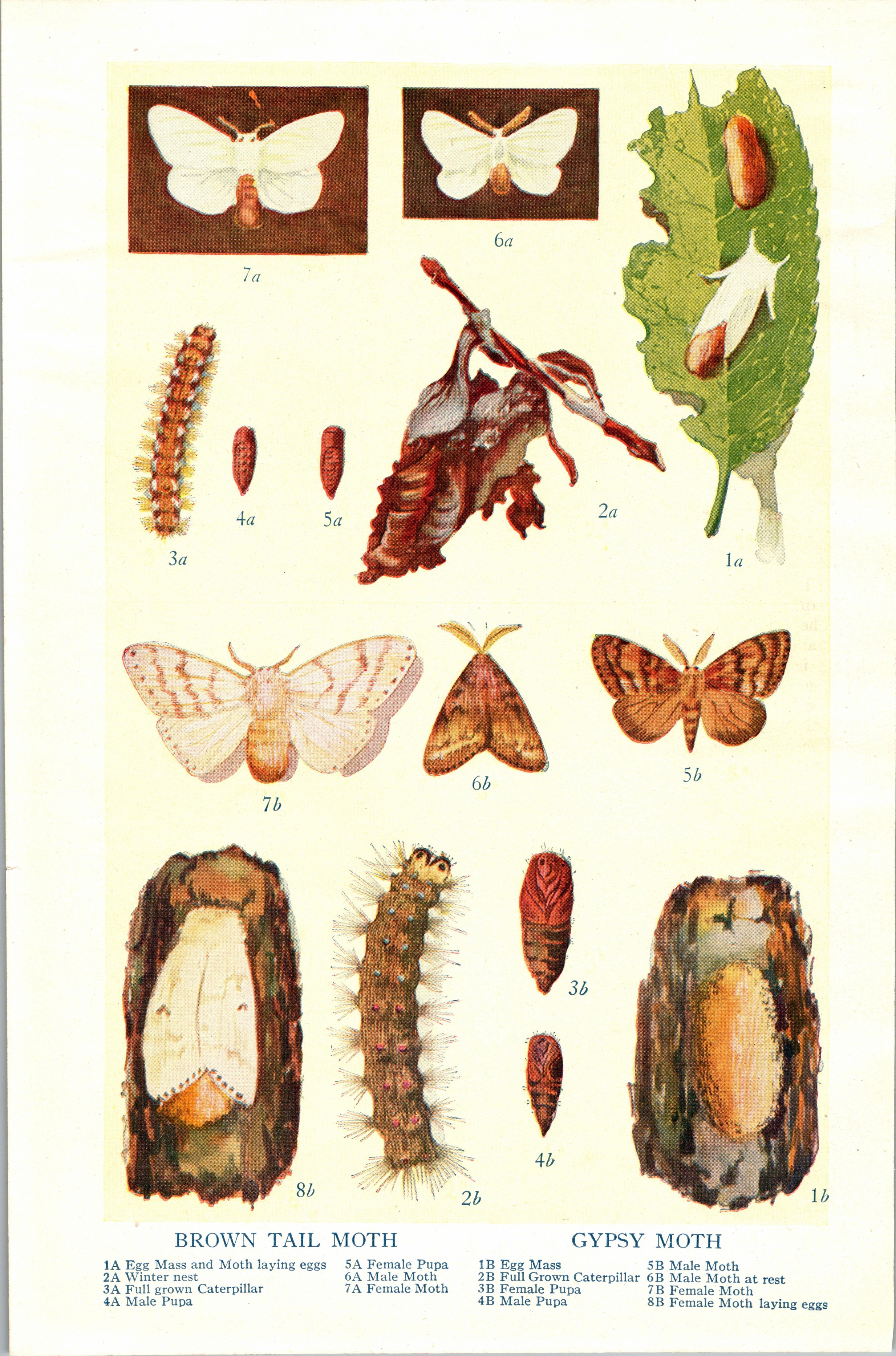
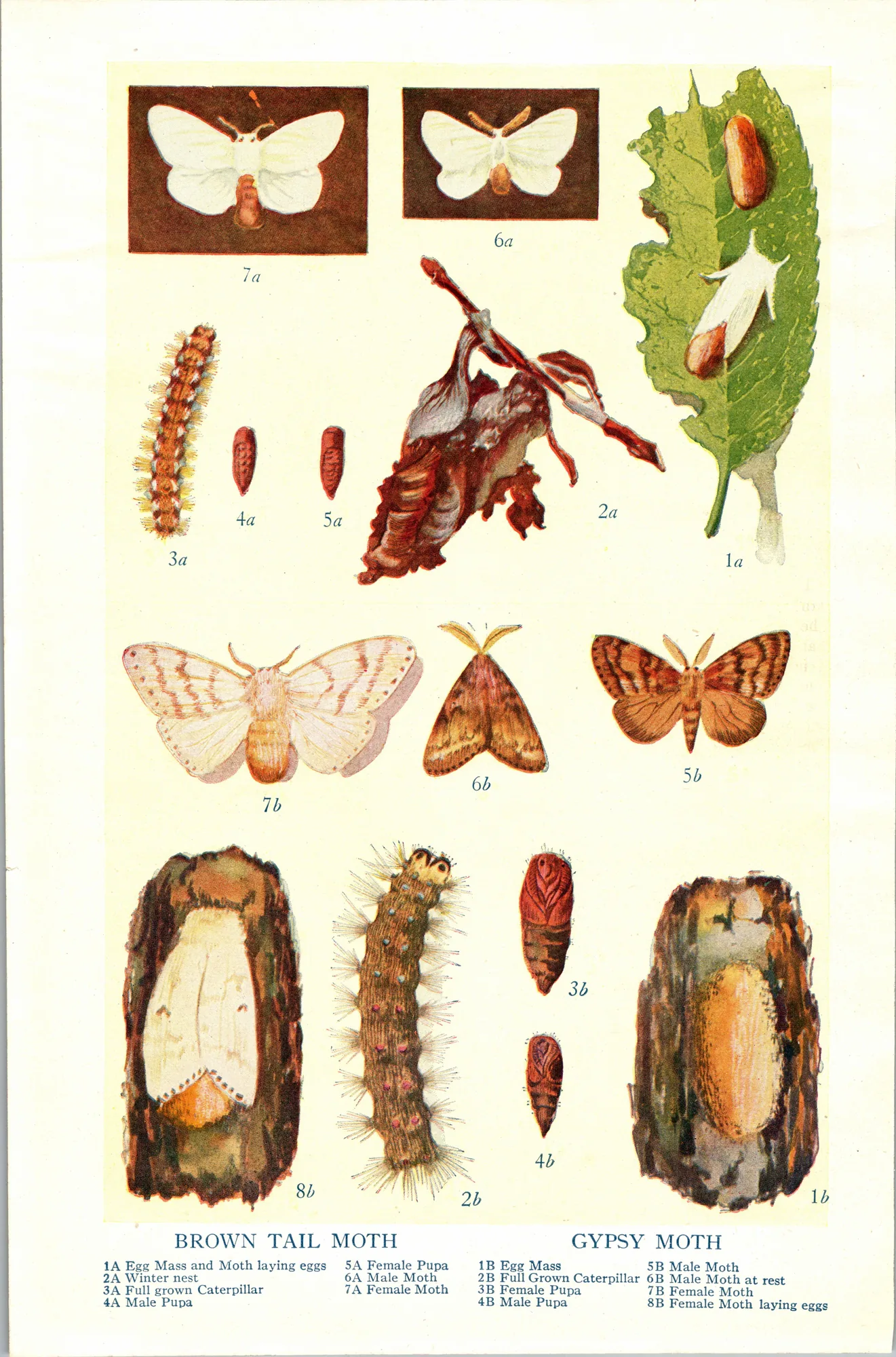
A color plate comparing two destructive moths accidentally introduced into New England: the brown-tail moth and the gypsy moth. Each is shown through its life cycle, from egg masses and caterpillars to pupae and male and female adults, with numbered keys below. Both were serious pests of shade and fruit trees at the time.
Historical note
The gypsy moth is still a serious forest pest in North America, but it now has a different common name. In 2022 the Entomological Society of America adopted “spongy moth,” after its sponge-like egg masses, replacing the old name because it used a slur for the Romani people.
Sources
- Spongy Moth, Entomological Society of America
- New name for a familiar pest: Gypsy moth is now spongy moth, State of Michigan
As printed
BROWN TAIL MOTH 1A Egg Mass and Moth laying eggs; 2A Winter nest; 3A Full grown Caterpillar; 4A Male Pupa; 5A Female Pupa; 6A Male Moth; 7A Female Moth. GYPSY MOTH 1B Egg Mass; 2B Full Grown Caterpillar; 3B Female Pupa; 4B Male Pupa; 5B Male Moth; 6B Male Moth at rest; 7B Female Moth; 8B Female Moth laying eggs.
Cite this item
“Brown Tail Moth and Gypsy Moth.” Illustration in The New Practical Reference Library, Vol. IV, Charles H. Sylvester, editor in chief · Creecy-Smith Publishing Company, Kansas City and Dallas, 1918. Antique Advertisements, no. P0438. https://antiqueadvertisements.com/from-the-pages/P0438-brown-tail-moth-and-gypsy-moth-1918/
This item is in the public domain. You are free to use it for any purpose; a credit to Antique Advertisements is appreciated. Learn more about using these images.